
The horrors that we witness in Minos Papas’s horror film, “Motherwitch,” are closely tied to the past of Cyprus around the time of British colonial rule. On the surface, the film is about a mother overcoming a grave personal tragedy while being all alone and shunned by the locals. Yet, it happens at a time in history when the world around her was experiencing a cultural shift carried out with the aid of colonizers, likely through indoctrination or forced submission. While addressing these subtextual layers from the past, the film presents a stunning gothic horror tale backed by endlessly mesmerising images that capture the beauty of those landscapes, from the intimate to the extreme.
Set in the late 19th century, the film centres around a spiritual bond between a grieving mother and a young boy, gifted with an eye for all things art. They met after Eleni (Margarita Zachariou) tragically lost all three children of hers in a mysterious accident. It happened out of nowhere and in a way that may even invite theories of divine intervention.
Until then, she lived a solitary but satisfying life as a painter, working for pleasure and self-fulfillment, when her work did not need to serve as an act of emotional exorcism or resistance of any kind. That’s why those early moments mark an idyllic chapter of her life in sharp contrast to her painful future.
After losing her children, Eleni gets ostracized, and villagers derisively call her a motherwitch. Their scorn adds another layer to her despair, as she recoils into her abode with barely any sign of light. While getting sucked into its overbearing bleakness, she finds some strength to get back on her feet from Michalakis (Sifis Katsoulakis), the artistically gifted boy who offers hope for her recovery. He shares her love for art, which, until then, was suppressed by his scornful father, Kaeemis (Athos Antoniou), who seemed to value the virtue of valor over artistic expression. That’s why Eleni represents to the child what the child does to her: a salvation from their sorrows.
The subsequent beats in the story may feel partially similar to the lonely mother’s arc in the Philippou brothers’ “Bring Her Back,” with Zachariou even being a spitting image of Sally Hawkins. However, the similarities end pretty much there, as the Australian duo focuses on visceral body horror elements to analyze the character’s descent into madness.
Papas focuses on the healing aspect of mutual connection through art. While not the most original thought, it works due to his masterful execution, backed by brilliant camerawork from Jack McDonald and an immersive soundscape that combines the natural sounds with Charles Humenry’s understated folk-tinged score.
Humenry’s work includes sounds from traditional string instruments paired with percussion that snugly fit with the film’s gloomy tone, which builds anticipation at a near-glacial pace. With that approach, the film runs at a risk of being staid and tedious, but the editing (by Smaro Papaevangelou) rarely lets that happen. Barring a few frames, everything feels intentional to the film’s tone, subtext, or structure.
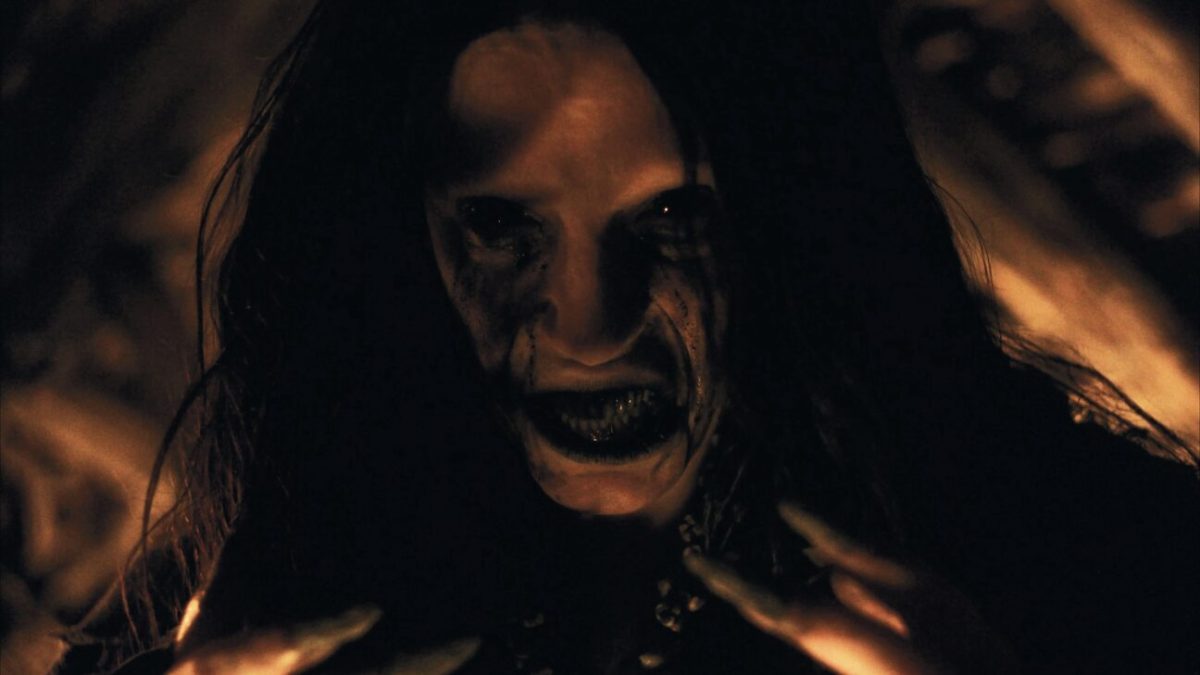
People often assume that good cinematography is simply about capturing the beauty of the setting, where every frame looks like a painting. Somehow, McDonald manages to do that while also ensuring his work moves the story forward as required. He captures the contours of the distant background as carefully as the minute details in the lush green landscapes, with all its beautiful tones and dimensions, while deftly contrasting those lilting frames with the horrid bleakness of interiors scarcely exposed to light. That intentionality is crucial in a film that relies on the tonal contrasts between different parts of this small world.
One shot, in particular, is exceptional, where the camera slowly moves across a dimly lit room, uninterrupted, gradually building a creepy, suspenseful tension, while sustaining the momentum toward a ghastly reveal. The edit carefully interlinks similar pieces of gothic horror with themes of motherhood, of life and death, of suppression and blind obedience, of survival, and the act of letting go.
Zachariou’s earnest performance, balancing her character’s grace with the pain and quiet rage, is also one of the film’s highlights. The script, co-written by Papas, also deals with themes related to Christianity, paganism, and the country’s history with the Ottomans and the British. Those who are familiar with the specifics of their connection may have a richer experience, but the film is rewarding regardless.
Moreover, the script briefly mentions kallikantzari, a goblin-like creature from the country’s folklore. If you take even a brief look at the folklore related to it, you can notice its ties to moments in the character’s life in relation to demons, whether internal, implicit, or imagined. After all, monsters are not simply ghastly ghouls lurking in the shadows.
They’re also lying in plain sight. Even a soldier who seems to have barely come of age, but kills someone innocent without a hint of emotion or a shred of remorse. Yet, while those subtextual layers add to the film’s depth, the film remains impressive regardless, thanks to its calculated pace and the sense of mystique Papas maintains throughout the duration.



![Pale Flower [1964] Review – A Noirish Parable with Striking Imagery](https://www.highonfilms.com/wp-content/uploads/2019/07/Pale-flower-cover-768x432.jpg)
![Kim Ji-Young, Born 1982 [2020] ‘NYAFF’ Review: A Delightful narrative in a sweet, somber film](https://www.highonfilms.com/wp-content/uploads/2020/09/KIM-JI-YOUNG-MOVIE-REVIEW-highonfilms-1-768x515.jpg)
![Raazi [2018]- A tribute to unknown heroes](https://www.highonfilms.com/wp-content/uploads/2018/05/Hindi-Movie-Raazi-Alia-Bhatt-Meghna-Gulzar-10-768x432.jpg)
![A Spike Lee Joint: Da Sweet Blood of Jesus [2014]](https://www.highonfilms.com/wp-content/uploads/2019/03/dasweet1.jpg)