If the landscapes in Wuthering Heights felt unforgettable, that’s because most of them are real places you can actually visit. Emerald Fennell’s film leans heavily on the raw beauty of the Yorkshire Dales, turning its windswept hills, stone villages, and lonely ridgelines into part of the story itself.
Now that the movie is out, fans are already heading to these locations to see the moors up close, walk the same paths as Cathy and Heathcliff, and experience the atmosphere that defines the film.
From remote valleys and ruined mills to historic estates and filming studios, here’s a complete guide to the real places behind the 2026 Wuthering Heights.
Swaledale and the Bouldershaw Lane Wedding Scene
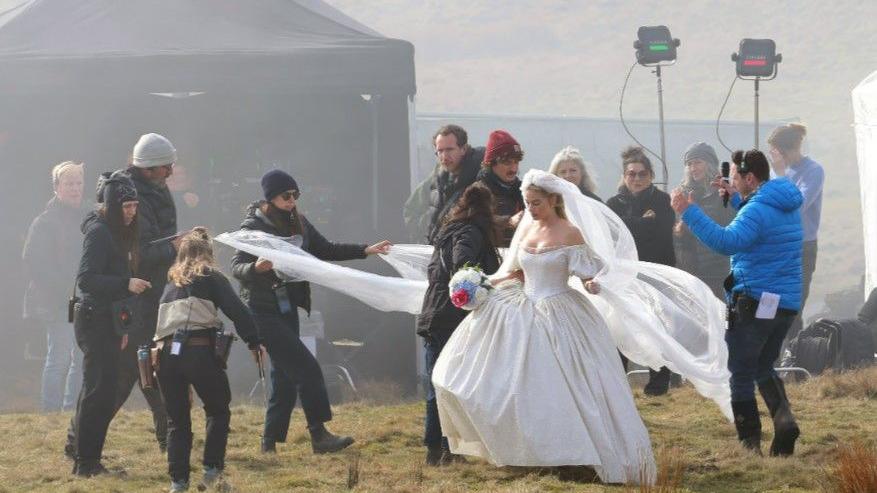
One of the most striking images from the trailers, Robbie standing in a flowing white wedding dress against open hills, was filmed in Swaledale. The crew worked along Bouldershaw Lane near the village of Muker.
This stretch is known for its dry stone walls, scattered barns, and open farmland that feels untouched by modern life. The setting captures the raw atmosphere Fennell was clearly chasing. Anyone visiting should expect wind and uneven ground. It’s beautiful but very exposed.
Old Gang Smelting Mill in Arkengarthdale
The exterior of the Wuthering Heights estate itself comes from the ruins of the Old Gang lead smelting mill near Langthwaite. These eighteenth century remains stand alone on the hillside, and their rough stone walls give the house a bleak, gothic identity.
The surrounding valley is quiet and remote, which mirrors the emotional isolation at the center of the story. The ruins are accessible by foot today and are already drawing photographers looking to capture the same mood seen in the film.
The Village of Low Row
Low Row appears as the main village setting. The production chose it because it looks almost unchanged for centuries. Narrow lanes, stone cottages, and the surrounding hills help it pass easily as a period location. Visitors can still stop at the Punch Bowl Inn, a seventeenth-century pub that feels right at home in the film’s world. It’s a good place to rest if you plan to explore the area on foot.
Booze Moor and Langthwaite
Arkengarthdale provided some of the film’s most dramatic outdoor footage. Booze Moor, which is very real despite the name, offers wide, elevated views that show up during the later sections of the film. The nearby village of Langthwaite served as a base for parts of the production. Some viewers may recognize the area from earlier television dramas, though here it’s photographed in a darker, more severe way.
Bridestones Moor and Healaugh Crag
The production also filmed near Bridestones Moor outside Todmorden. The strange, weather shaped rock formations there give the landscape a sculptural, almost unreal quality that fits the film’s tone. Healaugh Crag near Reeth appears in the quieter emotional moments, including scenes where Cathy waits across the hills. The steep ridges and exposed rock make this one of the more visually striking parts of the Dales.
Simonstone Hall in Hawes
Simonstone Hall near Hawes served as accommodation for the cast during filming. Robbie and Elordi reportedly stayed there for over two weeks. The historic country house has leaned into its connection to the film, and fans can now visit or stay there. Its setting above the valley makes it a fitting base for a story so tied to the landscape.
Warner Bros. Studios Leavesden and Sky Studios Elstree
While most exterior scenes were shot on location, many interiors were built in studios. The rooms of Thrushcross Grange and the interiors of Wuthering Heights itself were filmed at Warner Bros. Studios Leavesden and Sky Studios Elstree in Hertfordshire. Working in controlled spaces allowed the crew to shape the lighting, textures, and atmosphere more precisely than would be possible on the moors.
Knole House in Kent
Knole House in Kent was also used in the film. The National Trust property appears in the opening hanging sequence and also stands in for Gretna Green during Heathcliff and Isabella’s elopement. Its scale and formal architecture provide a strong contrast to the rough Yorkshire settings. The estate’s huge grounds and long history help give those scenes a sense of grandeur.
Here is the comprehensive guide and the “Wuthering Heights 2026” hiking map you need.
Because the Yorkshire Dales are notoriously difficult to navigate with GPS alone (and cellular signal is almost non-existent in the valleys), I have broken this down into a “Road Map” for your car and a “Hiking Map” for your feet.
The Wuthering Heights 2026: Official Hiking Map

To reach these spots, you should base yourself in the village of Reeth. It served as the production’s central hub, and most locations are within a 15-minute drive or a few hours’ hike from the village green.
Map Location 1: Bouldershaw Lane (The Wedding Procession)
The Insight: This is the exact spot where Margot Robbie was filmed in her white gown. It’s a narrow, stone-walled lane that feels incredibly isolated.
How to get there: From Muker, take the path heading North-East toward Thwaite. Bouldershaw Lane sits on the elevated shelf above the valley floor.
GPS: 54.3768° N, 2.1285° W
Map Location 2: Old Gang Smelt Mill (The “Heights” Exterior)
The Insight: These 18th-century ruins were used for the exterior of the Earnshaw family home. The jagged stone and industrial decay perfectly match Emerald Fennell’s “bruised” aesthetic.
How to get there: Park at Surrender Bridge. Follow the wide gravel track (The Old Gang Mill Track) heading West. It is a flat, easy 2-mile walk.
GPS: 54.4072° N, 2.0394° W
Map Location 3: Booze Moor (The Third-Act Galloping)
The Insight: This is where Jacob Elordi’s Heathcliff is seen riding during the film’s climax. “Booze” is a tiny hamlet with some of the steepest roads in England.
How to get there: Drive to Langthwaite. Follow the signs for the “Booze” hamlet. Once you reach the top of the hill, the moor opens up. Warning: This is a working farm area; stay on the marked bridleways.
GPS: 54.4175° N, 2.0012° W
Map Location 4: Healaugh Crag (The Yearning Rock)
The Insight: This is the “jutting rock” where Cathy sits while waiting for Heathcliff’s return. It offers a 360-degree view of Swaledale.
How to get there: Located on the Reeth Estate. You can hike up from the village of Healaugh (just West of Reeth). It is a steep 45-minute climb.
GPS: 54.3912° N, 2.0155° W
Essential Travel Logistics: How to Get to the Dales
1. By Car (Recommended)
The Yorkshire Dales are “Driving Country.”
From London: Take the M1 North to the A1(M). Exit at Skeeby/Richmond and follow the A6108 into Richmond, then the B6270 into Swaledale. (Approx. 4.5 hours).
Parking: In Swaledale, parking is very tight. Use the designated “National Park” car parks in Reeth, Muker, and Hawes. Do not park on the grass verges—you will get stuck or fined.
2. By Train & Bus
The Train: Take the LNER from London King’s Cross to Darlington. (2 hours 20 mins).
The Bus: From Darlington, take the X27 bus to Richmond. From Richmond, transfer to the 54 or 30 bus (The Swaledale Shuttle) to Reeth/Muker.
Note: Check DalesBus.org before you leave. In February, services are reduced, and some “Sunday Only” buses are the only way to reach the deep moors.
The “Cast-Spotting” Pub Guide
If you want to eat where the stars ate, these are the verified spots:
The Punch Bowl Inn (Low Row): Margot Robbie was spotted here several times. It’s a 17th-century inn with incredible views.
The King’s Arms (Reeth): This was the “unofficial” after-hours spot for the crew.
Simonstone Hall (Hawes): This is the hotel where the main cast stayed. They have “Wuthering Heights” themed dinners throughout February 2026.