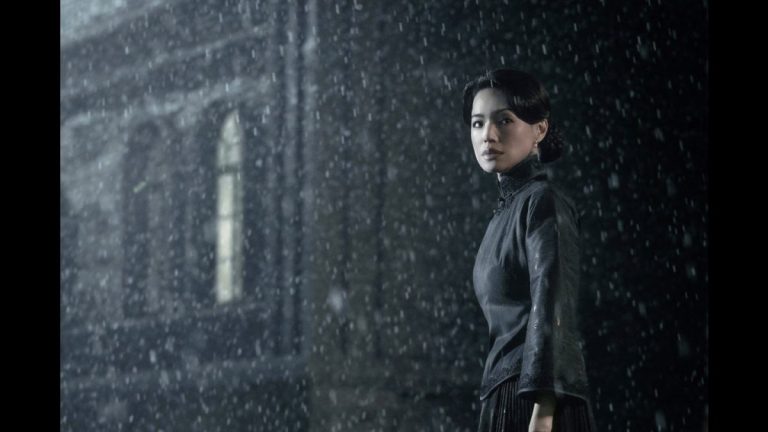
In the West, grotesque realism often emerges from an identifiable rupture—something within life turns unbecoming, unnatural, or philosophically estranged. The form thrives on specificity, on isolating one distorted idea and codifying it within a fabricated narrative frame. In the subcontinent, however, grotesque realism rarely announces itself as an aberration. It grows out of the ordinary.
The everyday rhythm of living makes space for a grim, hollowed-out desperation to briefly catch the light before fading again. This is not a commentary on the relative liveability of nation-states, but on traditions of storytelling—how certain emotions travel, translate, and mutate across geographies.
This tension between storytelling as aesthetic luxury and storytelling as existential necessity sits at the heart of “Dyspepsia” (original title: “Jonmo Theke Jolchhi”), a Bangladeshi short film by Fantasia alumnus Ahsabul Yamin. The film follows Johnson, a sensitive, slightly fragile young man sharing a cramped life with his friend Shaheen. His problem begins absurdly and horrifyingly at once: a plate that “could have had chicken, mutton, or beef” instead delivers an insect—one that refuses to die inside his body. What follows is not nihilism but persistence. Survival, even in the face of absurdity, remains the governing instinct.
Johnson’s attempts at diagnosis move from the bizarre to the invasive, from a veterinary pathologist’s clinic to the sterile anxiety of an operating theatre. The only consistent outcome is paranoia. The medical language offers no certainty; reassurance dissolves into doubt. In Shaheen, Johnson looks for comfort, for grounding. Yet even this intimacy is repeatedly undercut by the film’s most unsettling sonic motif: the strange, unpredictable farts that puncture conversation. Each one lands differently—awkward, absurd, intrusive—reducing comfort to interruption.
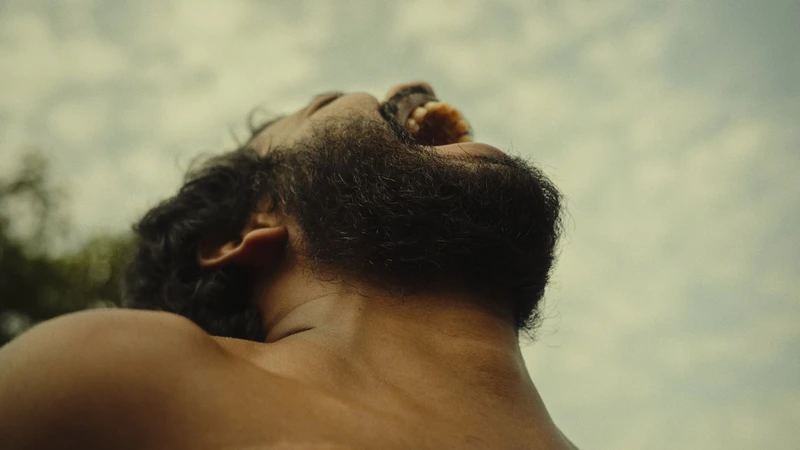
For a film this concise, the clarity of its origin is striking. Yamin has spoken about being moved by the image of a rotting chicken swarmed by ants. That image mutates here into a psychological landscape. The insect inside Johnson functions less as a literal threat and more as an embodiment of intangible anxiety, a colonising presence lodged within the body.
The question is not whether the rotting chicken represents a broken system. It is Johnson himself who becomes the decaying site. The ants, after all, could never truly “kill” the chicken. They simply feed off what is already compromised. The human mind operates similarly. It struggles to process political instability or economic erosion at scale, so it invents a smaller enemy—something precise, removable. Here, that enemy is the bug.
While the world around him drifts into numb indulgence, Johnson alone feels the insects crawling beneath the skin of society. His distress is deeply personal, but it carries the residue of a collective unease. Interestingly, the film’s most irritating formal choice also becomes its most effective thesis. The recurring use of farts as a soundscape transforms bodily absurdity into political commentary. Their varying pitch and frequency mark the collapse of meaningful communication. In a reality defined by institutional decay and political exhaustion, language begins to lose value.
Words become hot air—waste, noise, discharge. Reassurance, even when offered by someone close, fails to hold. It evaporates before it can settle. Johnson chewing jilapi while releasing gas forms a grotesquely precise metaphor: a society that consumes blindly and speaks without consequence.
Yet the film’s most politically potent gag arrives quietly. It almost slips past unnoticed before demanding a second look. The failure of the medical system reduces citizens to cattle in a processing line. Johnson’s first diagnostic visit is not to a doctor, but to a veterinary pathologist. The implication lands heavily. He is not treated as a patient but as livestock—something to be examined, processed, and moved along.
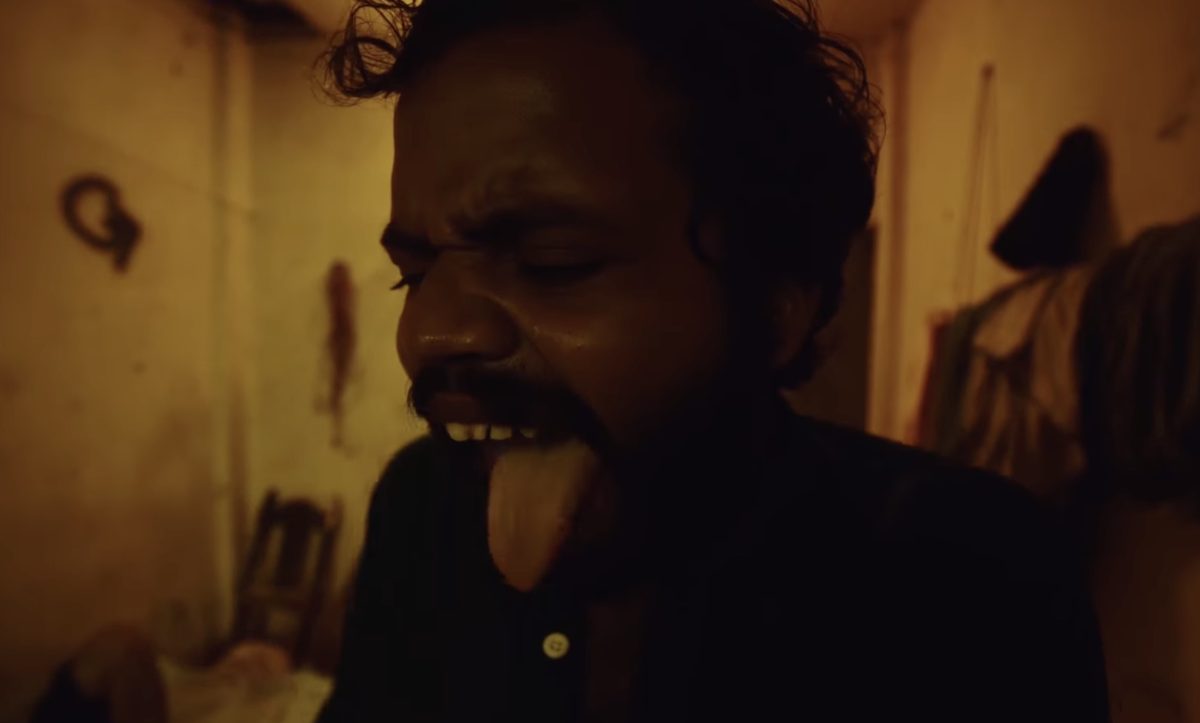
The system does not see a human body in pain; it sees a unit. The strange facial contortions Johnson makes throughout the film are not exaggerated acting choices but primal responses, the non-verbal language of a creature in distress that has lost the ability to articulate suffering within institutional frameworks.
The performances anchor this tonal tightrope with precision. Saroar Mim inhabits Johnson with a disquieting conviction, balancing mania and vulnerability in a way that unsettles rather than pleads for sympathy. His attempt to survive—physically and psychologically—feels raw enough to crawl under the skin. Opposite him, Aung Shingh Thowai Marma’s Shaheen embodies a disarming indifference. His sweetness, indulgence, and casual dismissal of Johnson’s suffering make him both comforting and complicit, an embodiment of the everyday apathy that enables collapse.
Ultimately, “Dyspepsia” sharpens the distinction between Western grotesque and its Eastern counterpart. Here, the body is not a fortress breached by an external force. It is porous, exposed, and public—a site where personal, social, and political conflicts bleed into one another. The horror does not lie in life breaking apart or transforming into something monstrous. The horror lies in continuity. Life goes on. routines persist. Meals are eaten. Jokes are made. And beneath all of it, the absurdity keeps humming, unresolvable and quietly devastating.



![Ferroequinology [2022] ‘Slamdance’ Review: A Meditative Documentary that Embraces the Mundane](https://www.highonfilms.com/wp-content/uploads/2022/02/Ferroequinology-2021-768x405.jpg)


![Nervous Translation [2017] Review: The Cinematic Beauty of A Child’s Gaze](https://www.highonfilms.com/wp-content/uploads/2019/06/Nervous-Translation-860-thumb-860xauto-69102-768x430.jpg)