When Michael Moore walked onto the Oscars stage in 2003, most viewers expected a routine acceptance speech. Instead, the Bowling for Columbine filmmaker delivered one of the most controversial moments in Academy Awards history.
His criticism of President George W. Bush and the Iraq War immediately divided the audience inside the Kodak Theatre. Some applauded. Others loudly booed. The speech lasted barely half a minute, but it triggered a backlash that followed Moore for years and turned the moment into one of the most talked-about speeches ever delivered at the Oscars.
More than two decades later, the Michael Moore Oscar speech continues to trend online as audiences revisit the moment that stunned Hollywood.
The Speech That Shocked the Oscars
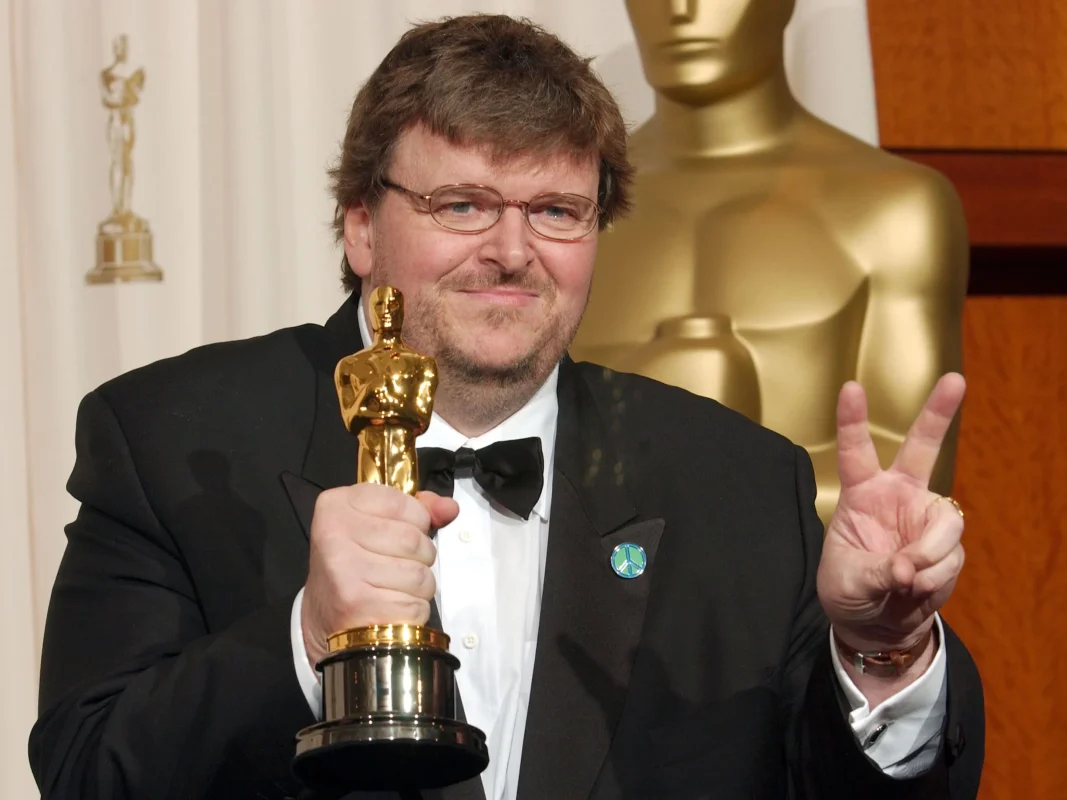
Michael Moore won the Best Documentary Feature Oscar at the 75th Academy Awards for Bowling for Columbine, his documentary examining gun violence in the United States.
Instead of focusing on a typical thank-you speech, Moore used the moment to criticize the U.S. government and the newly launched Iraq War.
During the speech, he told the audience:
“We live in fictitious times. We have fictitious election results that elect a fictitious president.”
He then directly addressed President George W. Bush.
“We are against this war, Mr. Bush. Shame on you.”
The response inside the theater was immediate. Cheers were quickly drowned out by loud boos from sections of the audience. The orchestra began playing to cut off the speech as Moore finished his remarks.
Why Michael Moore Decided to Speak Out
According to Moore, the decision to make a political statement was not planned far in advance.
The Iraq War had begun just days earlier. U.S. forces started bombing Baghdad four days before the ceremony, creating an intense political atmosphere across the country.
Moore later said that while walking to the stage, he felt two competing impulses. One voice told him to deliver a polite Oscars speech and thank the people who helped make the film. The other voice reminded him that millions of viewers were watching and that the moment might never come again.
He chose to speak.
What Happened Immediately After the Speech
The moment Moore finished speaking, tensions escalated behind the scenes.
He later recalled that security quickly surrounded him as he was escorted away from the stage. One stagehand reportedly shouted an insult directly into his ear as he walked backstage.
Moore described the moment as surreal. The first words he heard after winning an Oscar were not congratulations. Instead, two interns offered him “champagne” and a “breath mint,” while the stagehand yelled an insult.
Because of the rising tension backstage, security escorted Moore away from the immediate area.
The Backlash That Followed
The controversy did not end when the ceremony finished.
Television commentators immediately began debating the speech, and several pundits predicted that Moore had damaged his career. Some critics argued that political statements did not belong at the Oscars.
The reaction intensified when Moore returned home to Michigan. Protesters placed signs near his property accusing him of being unpatriotic. According to Moore, someone even dumped a pile of horse manure across his driveway.
He also reported receiving threats and said he had to hire security after the incident.
The Surprising Apology Years Later
Years after the Oscars controversy, Moore encountered one of the people involved in the chaotic moment backstage.
While appearing on The Tonight Show with Jay Leno, a crew member approached him after the taping and revealed that he had been the stagehand who shouted an insult at Moore on Oscar night.
The man told Moore that he later realized the intelligence used to justify the Iraq War was flawed and said he regretted his reaction that night.
Moore accepted the apology and told him he had nothing to apologize for.
How the Speech Changed Michael Moore’s Career
Despite the backlash, Moore continued making films.
In fact, the controversy did not slow his career at all. Within a year he released Fahrenheit 9/11, a documentary examining the Bush administration and the Iraq War.
The film became a massive success, winning the Palme d’Or at the Cannes Film Festival and becoming one of the highest-grossing documentaries ever released.
The success showed that Moore’s Oscar speech had not ended his career, even though many critics predicted it would.
Timeline of the Michael Moore Oscars Controversy
March 19, 2003
The United States launches the Iraq War with bombing raids on Baghdad.
March 23, 2003
Michael Moore wins the Oscar for Bowling for Columbine.
During his speech
Moore criticizes President George W. Bush and calls the war “fictitious.”
Immediate reaction
The audience responds with loud boos and applause.
2004
Moore releases Fahrenheit 9/11, which becomes one of the most successful political documentaries ever.
Other Controversial Oscar Speeches in History
Michael Moore’s speech is often mentioned alongside other politically charged moments at the Academy Awards.
In 1973, Marlon Brando refused his Best Actor Oscar for The Godfather and sent activist Sacheen Littlefeather to speak about Hollywood’s treatment of Native Americans.
Vanessa Redgrave delivered a controversial political speech during the 1978 Oscars.
More recently, filmmakers and actors have also used the Oscars stage to address political and social issues, showing how the ceremony often reflects the tensions of the moment.
Why the Michael Moore Oscar Speech Still Matters
The moment remains significant because it showed how powerful the Oscars stage can be as a platform.
At the time, social media did not exist in its modern form. Yet Moore’s 30-second speech still became one of the most widely discussed moments in Oscars history.
For supporters, it represented a filmmaker speaking truth to power during a moment of national tension. For critics, it was an example of politics intruding into entertainment.
Either way, the Michael Moore Oscar speech remains one of the most unforgettable moments the Academy Awards has ever seen.
FAQs
What did Michael Moore say in his Oscar speech
Michael Moore criticized the Iraq War and said the United States was living in “fictitious times” with a “fictitious president.” He ended by saying, “We are against this war, Mr. Bush. Shame on you.”
Why was Michael Moore booed at the Oscars
Many audience members disagreed with his criticism of President George W. Bush and the Iraq War, which led to loud boos inside the theater.
What movie won Michael Moore the Oscar
Moore won the Best Documentary Feature Oscar in 2003 for Bowling for Columbine.
Did the speech damage Michael Moore’s career
Despite the controversy, Moore later released Fahrenheit 9/11, which became one of the most successful documentaries ever made.
Courtesy: LATimes