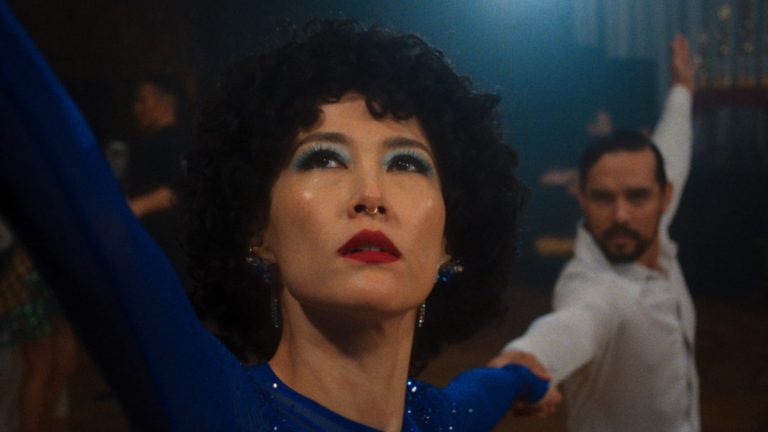
Written and directed by Amy Wang, “Slanted” explores a Chinese-American teenager’s harrowing experience while trying to survive through high school. It paints her struggles in a surrealist-horror fashion, tonally similar to Coralie Fargeat’s 2024 film “The Substance.” Wang employs body horror elements to analyze her protagonist’s feelings of inadequacy based on her racial identity. Instead of embracing herself for who she is, she often compares herself to her white peers, whose whiteness allows them certain privileges that she can’t attain through realistic means. That unfair comparison makes her school experience nightmarish.
Wang’s script uses an absurdist premise to analyze her protagonist’s identity struggles, but makes generalizations about certain details of her journey. Still, it makes sense within the context of her film because she presents it as a highly subjective experience. What we see is a worldview of a young girl put into a jarringly different environment, forced to deal with things beyond her control.
The script introduces an experimental procedure to help her gain that control. It leads her to reflect on her qualms, stemming from her urge for external validation, especially from her self-centered and ungrateful white peers. That’s why, despite the exaggerated narrative tone of her satire, the film is filled with pockets of universal resonance.
Spoilers Ahead
Slanted (2025) Plot Summary & Movie Synopsis:
What happens in ‘Slanted’?
Joan (Kristen Cui), a young girl about five or six years old, arrives in the US with her parents: Sofia (Vivian Wu) and Roger (Fang Du). While on her way to school, she listens to a radio broadcast featuring two American men rambling on and on about their experiences with food and the Super Bowl. Outside, she sees signs of everything that will be a part of her daily life.
Whether it’s a boots store, a coffee shop, or an ad for a hamburger, it has Americanness written all over it. Some of them do it bluntly, displaying the flag in some shape or form. Others do it through minimalist displays of national symbols like the Statue of Liberty. For a girl her age moving there from a different part of the world, that’s a lot to take in.
The cultural whiplash she experiences during this time turns into something far worse once she arrives at her class. A white classmate sitting next to her teases her for her appearance. That racial abuse becomes an unfortunate part of her formative memories. Some may call his naive behavior a result of his young age, but that doesn’t make him any less complicit in making the world far less hospitable than it is for him. Later, during the lunch break, she walks over to her classmates, hoping to join them for a meal. Yet, the moment she opens her lunch box, they recoil and leave her alone at the table.
That experience leaves her with a sting of their cultural stigma at an age she may not know how to put her feelings into words. Also, this happens in a school that claims inclusivity through quotes like ‘United we learn.’ The same night, she sees her father being forced to work extra hours at work instead of spending it with his family, celebrating the Dragon Boat Festival.
How does the prom night shape Joan’s aspirations?
During her time at the high school where her father works as a janitor, Joan sees something that shapes the next few years of her life. She steps into a prom night celebration just before the host was going to announce the prom king and the prom queen. Moments later, a white girl walks on stage to receive her crown.
Joan’s impressionable mind sees it through an aspirational lens, presuming it to be the only way she can be accepted by her peers and by the country that will be her new home. Flash forward a few years, and teenage Joan (Shirley Chen) nearly worships whiteness. She fills her entire wall with faces of white celebrities and becomes obsessed with her white-influencer classmate, Olivia (Amelie Zilber).
She also uses Ethnos, a photo filter that reframes her as a blonde girl with blue eyes. That filter preys on her insecurities about her racial identity by presenting her close to her ultimate beauty standard. Her parents see and appreciate her regardless of how she looks, and so does her close friend, Brindha (Maitreyi Ramakrishnan), but that doesn’t suffice for her.
Brindha also loves Joan’s homemade lunchbox, unlike the kids who once abandoned Joan because of it. Unlike Joan, she also doesn’t judge herself through unrealistic parameters of status imposed by their classmates. She seems content being a brown girl and doesn’t seek external validation to know and acknowledge her worth as a person.
Joan struggles with accepting herself for who she is. She remains so obsessed with Olivia that she reduces herself to how she is perceived by her peers. It also makes her overlook the racist undertones in Olivia’s brand positioning as a climate-crisis warrior. Brindha makes her realize that. That’s why she challenges Brindha to help her be the prom queen against Olivia’s friends to prove her point.
What does Joan do to be the prom queen?
Joan’s aspiration to be the prom queen leads her to take some extreme measures. The first of them is dying her hair blonde. She assumes her proximity to the perceived beauty standard would help her with her goal. That seems to have worked almost every other year at her school, given the grinning faces of prom kings and queens glued on the walls.
Whether it helps her secure the win or not, it helps her gain Olivia’s attention. Until then, she didn’t even seem to exist for Olivia. Yet, the hair color seemingly does the trick, offering her a chance to join them at a beauty salon. She assumes that’s because Olivia considers her a friend now that she resembles them a little. However, Olivia invited her only to get her to speak with the manager and get them a special discount.
Later, Olivia comments on the black roots of her hair, making her reassess her self-worth. That’s when she receives a text message from Ethnos, claiming they can help her with that issue. She walks into their clinic to meet Willie (R. Keith Harris), a white HOD who agrees to help her turn herself into a white person.
He claims it to be the ultimate solution for all her worries and a ticket to the kind of success she might be deprived of otherwise. To prove that, he uses his own example, claiming to have been a black scientist undervalued compared to his mediocre white colleagues. Joan can’t trust his unrealistic claim of racial transformation. So, she doesn’t undergo the procedure right away.
However, in the coming days, she reconsiders that option after an embarrassing experience where she gets humiliated by Olivia and her friends. It happens after she steps out of her work at Harmony’s (Elaine Hendrix) lavish house. Harmony is a wealthy, white woman who positions herself as a virtuous and charitable person, but her compassion goes for a toss the moment she sees her staff commit even a minor mistake.
Roger works at her house, but Joan fills in for him when he takes a leave to recover from an injury. Unlike Harmony’s children and their friends, who can be reckless, she is expected to be on her best behavior, cleaning up the mess they make. It all makes her reassess her stance on the Ethnos-backed procedure.
Slanted (2025) Movie Ending Explained:
Does Joan become the prom queen?

After feeling shunned by her white peers, Joan decides to undergo the Ethnos procedure. It transforms her into a white person (McKenna Grace), who gets the kind of effortless validation she often craved. She remains the same person from the inside, but her appearance changes, leading her to be accepted by Olivia’s clique.
That’s when she changes her name to Jo Hunt, getting rid of the last sign that would connect her to her real identity. The plan works in her favor, helping her gain Olivia’s attention. Still, Olivia doesn’t endorse her to be the prom queen, claiming a lack of trust. That forces Joan to do anything she can to gain that trust.
Around this time, Brindha realizes that Jo is actually Joan, which complicates the matter even more. Joan is forced to choose between Brindha and Olivia, and she chooses the latter just so she can come close to being the prom queen. It helps her be popular like them, but doesn’t get rid of her insecurities. She finds her skin peeling from her face.
The Ethnos clinic offers her a cream and a tape to take care of those issues, but they don’t offer a permanent solution to her worries. On the prom night, she finds her skin looking even worse than before. Olivia walks into the washroom when she tries to patch up the damage. So, feeling embarrassed, she hides her face. That’s when Olivia surprises her by revealing that she, too, is a client of Ethnos, which helped her be white.
After getting help from Olivia to patch her disfigured face, Joan/Jo is announced as the prom queen. Jo walks up on the stage to receive her crown, but the moment of pride quickly turns into one of horror and embarrassment. Her skin looks far worse than before, turning this dream moment into a tragedy. Realizing that, she faints. Later, she wakes up to find herself at Olivia’s home.
What does ‘the plant and the seed’ comment mean for Joan?
Olivia and her father welcome Jo/Joan with open arms. They reveal that they are actually Cuban immigrants who moved to Florida and decided to start their new lives as a white family. As white people, they claim they believe in equality but refuse to speak about race. So, they seem even more deranged than before.
They also claim that they never want to go back to their old lives and are happy with their present identity, even if it’s at odds with their authentic selves. It offers Joan an outside perspective on her own identity struggles, making her realize that she shouldn’t consider whiteness as a prerequisite for her American identity or for her worth as a human being.
Her father tells her the same thing: she shouldn’t try to hold herself to a cliched ‘high’ standard. There isn’t only one way to be a citizen. So, she shouldn’t be ashamed of her racial identity or cultural roots. After that heartfelt conversation, Joan returns to the clinic to meet Willie, wanting him to help her be her actual self.
He tells her that the procedure is irreversible and refuses to help himself. However, he tells her how she can get rid of her doctored appearance. “For a new plant to grow and nourish, the seed had to die,” he says. By that, he means that unless she gets rid of her excessive desire to be white to be accepted or respected, she can’t find her new identity.
The ending shows her taking her first step toward this by peeling her skin instead of trying to patch it up. That’s how she sees signs of her actual self in her face. Although covered in a horrifying amount of blood, it takes her closer to a form of self-acceptance she should have cared for instead of trying to be like her white classmates. It’s a shocking note to end the film with because Joan’s very first step towards genuine self-acceptance involves intense pain. Yet, that seems to be the point. Assimilation shouldn’t come at the cost of losing your own self.
Slanted (2025) Movie Review:
“Slanted” has a “Carrie” influence written all over it. Amy Wang’s film is also about a teenager struggling with her identity in high school. She also tries to fight her way against her domineering peers. However, unlike Sissy Spacek’s character, Joan is not held back by the expectations of religion. Her anxieties stem from her deep-seated fear of alienation due to her racial identity. Wang doesn’t hold back while critiquing the systemic racism ingrained in American society. The resulting bluntness sharpens the edge of her satire but dampens the drama because most of it feels too on-the-nose.
The script also seems vague when analyzing Joan’s ethnic roots as opposed to her racial identity. It explores her struggles in being accepted for her physical attributes quite well, but leaves the exploration of her cultural roots limited to some odd parameters. The thing is, one can choose to have a wider sense of identity than the culture they were born in, while not being ashamed or embarrassed about their racial or ethnic identity.
Wang explores the racial aspects of Joan’s anxieties quite well, but fails to capture the nuances in connection to her cultural roots. The latter is reduced to some vague standards of cultural authenticity, which feels quite dated in 2026. Even a single piece of dialogue in “Past Lives” about the protagonist feeling less or more Korean while speaking with her past lover conveyed far more than the film does in this context. Besides that, the script doesn’t explore the overlap of issues between her racial identity and class position well enough. Although well-intentioned, the script doesn’t quite know how to distinguish one from the other or to analyze their intrinsic connections.
Still, the film is an admirable and fairly effective indictment of racial prejudices in Western countries. More importantly, it analyzes a topic rarely discussed in similar projects: how some people of color view their proximity to whiteness as beneficial. You can notice it in the real world, where POCs become parts of right-wing coalitions to gain power, forgetting their own past or the present of anyone who resembles them. Moreover, the film is also quite evocative when focused on Joan’s emotional upheaval while facing all the challenges in her horrifying journey. Much of its credit goes to the performances by Shirley Chen and McKenna Grace, the duo who analyze Joan’s fears while leaving us with a visceral sense.