Krzysztof Kieślowski’s “Three Colours” Trilogy— “Three Colours: Blue,” “Three Colours: White,” and “Three Colours: Red”—takes its cue from the ideals of liberty, equality, and fraternity, but it never treats them as fixed or stable ideas. Instead, each film approaches them from a different emotional register, allowing their meaning to shift through lived experience rather than remain theoretical.
“Three Colours: Blue,” the first film, is linked to the idea of liberty, but it doesn’t frame freedom in any abstract or political sense. It begins with loss, and from that point onward, liberty becomes something uncertain, even burdensome—something Julie has to work through rather than simply possess. Co-written with Krzysztof Piesiewicz and anchored by Juliette Binoche’s restrained performance, the film unfolds in Paris with a quiet, deliberate rhythm, letting emotion emerge in fragments instead of presenting it all at once.
What distinguishes “Blue” is the way it begins with an absence that reshapes everything that follows. Julie’s life is reconfigured, and her response is to move toward a form of existence that appears self-contained, where memory, relationships, and even feeling itself are held at a distance. Yet the film observes how traces remain, through music, fleeting recollections, and the presence of others, suggesting that what one attempts to leave behind continues to exist in altered forms.
In this sense, “Blue” becomes less about escaping the past and more about understanding how it persists, and how the idea of freedom gradually shifts from separation to a more complex engagement with what cannot be entirely set aside.
Three Colours: Blue (1993) Plot Summary & Movie Synopsis:
What Remains for Julie After the Accident?
The opening movement of “Three Colours: Blue” unfolds with a quiet, almost observational rhythm that gradually gives way to a defining rupture. The film begins with a car journey with brief, fragmented images of motion, the road passing by, and mechanical details that feel detached from any immediate emotional context.
Inside the car are Julie, her husband Patrice, a celebrated composer, and their young daughter Anna. The film does not pause. It suggests a life that is already in motion, already complete in its own way. This sense of continuity is abruptly interrupted when the car crashes. The accident itself is presented with restraint, and the narrative quickly shifts its focus away from the event to its aftermath.
Julie survives. Her husband and daughter do not. The film situates us immediately within this condition of survival, where the emphasis is on what remains and how it is to be lived. In the hospital, when Julie is informed of their deaths, her response is internalised, almost suspended. There is no overt expression of grief in the conventional sense. The film registers a kind of withdrawal, as though the emotional impact has not yet taken a form that can be expressed outwardly.
What Happens When Julie Tries to Destroy the Past?
In a crucial moment, Julie attempts to end her life but stops midway. This gesture functions as an indication that she will continue to live, even if the terms of that life have fundamentally shifted. From here, the film begins to trace her actions with clarity. Once discharged, Julie makes deliberate decisions to detach herself from everything that connects her to her past. She sells the family home, refuses to engage with her husband’s professional circle, and chooses not to attend the funeral in a conventional, participatory way.
Most significantly, she rejects and attempts to destroy the unfinished musical composition her husband had been working on, a piece commissioned for a larger cultural purpose. Rather than preserving it as memory or legacy, she treats it as something that must be removed from her life entirely. She relocates to a small apartment in Paris, where she adopts a routine that is minimal and self-contained. Her interactions with others are brief, functional, and deliberately limited. The film carefully observes these actions, presenting them as part of a structured attempt to create distance from people, places, and from memory itself.
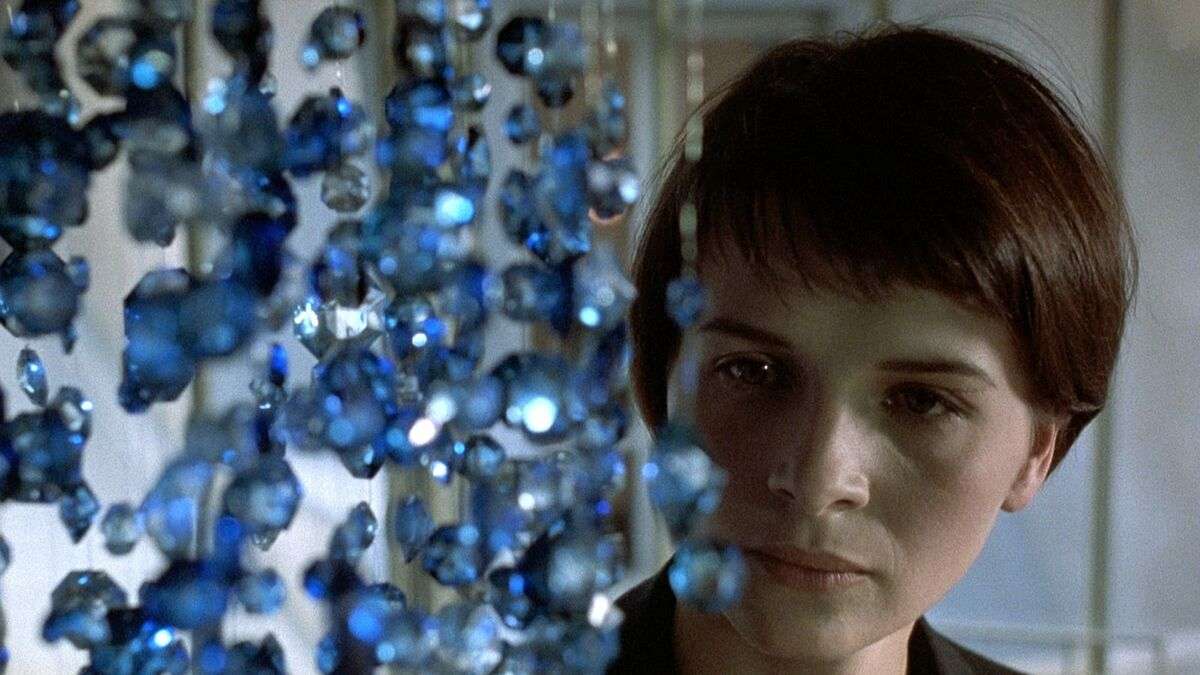
At the same time, certain elements begin to persist despite this effort. Fragments of music reappear, often without warning. A piece of blue glass from a chandelier becomes an object she cannot entirely discard. These moments introduce a quiet tension between her intention to detach and the persistence of what she is trying to leave behind. What the opening ultimately establishes is a condition in which continuation itself becomes the central question. Julie’s actions are clear and deliberate, yet they unfold within a space where complete detachment remains uncertain. The film, therefore, begins by foregrounding us in what happens and then gradually opens into how those events continue to shape what follows.
How Do Julie’s Choices Coexist with What She Cannot Remove?
After the accident and her discharge from the hospital, the movement of the cinema settles into something far more deliberate, almost quietly controlled, as Julie begins to reorganise her life with a clarity that feels both practical and deeply internal. She returns to spaces that once held meaning and gradually removes herself from them, through decisions that accumulate over time. The family home is sold as a way of stepping out of a space that no longer aligns with her present condition.
People who were once part of her everyday life – her husband’s colleagues, acquaintances, and social circle- remain accessible, yet she chooses a distance that keeps these connections from continuing in their earlier form. One of the most significant choices she makes concerns her husband’s unfinished musical composition, a piece intended for a larger cultural purpose. Rather than preserving it as an extension of his legacy, she moves to dismantle its presence in her life, treating it as something that belongs to a chapter that has already closed.
Her relocation to a modest apartment in Paris continues this movement toward a quieter, more contained existence. The routines she adopts are simple and unadorned, allowing her to move through daily life without the weight of constant interaction. Conversations remain brief, encounters remain functional, and her presence within this new environment carries a sense of anonymity that she seems to accept with ease.
At the same time, the film allows certain elements to remain gently persistent. A fragment of blue glass, the echo of a musical phrase, brief sensory impressions – these details reappear within her otherwise controlled surroundings. They do not disrupt her decisions but exist alongside them, suggesting that memory and experience continue to inhabit the spaces she now occupies. What emerges here is a coexistence: Julie’s life begins to take shape through both her conscious choices and the quiet continuity of what remains present, allowing the film to observe how a new form of living gradually assembles itself from both intention and trace.
Who begins to enter Julie’s new life?
As Julie settles into her new apartment in Paris, the film gradually introduces figures who begin to occupy the edges of her otherwise contained existence. These encounters emerge quietly, almost incidentally, as part of the everyday rhythm she now inhabits. One of the earliest presences is Lucille, a neighbour whose life operates within a space that is socially marginal yet emotionally direct. Their interactions begin without expectation, shaped more by proximity than intention, yet they slowly develop into a form of companionship that does not demand articulation. Lucille’s openness contrasts with Julie’s measured restraint, but the film allows their coexistence to suggest that connection can take forms that do not rely on similarity.
At the same time, Olivier, her late husband’s colleague, reappears within her orbit. His presence carries a different weight, tied as it is to Julie’s past, yet he approaches her with a sensitivity that does not impose itself. He offers the possibility of collaboration, particularly in relation to the unfinished composition, but Julie does not immediately respond to this. Their interactions remain suspended between familiarity and distance, allowing the film to explore how relationships can persist in altered forms.
These figures do not transform Julie’s life in overt ways, but their presence introduces a subtle shift. The space she has created for herself, while still defined by control and simplicity, begins to accommodate others, even if only at its margins. What unfolds here is the gradual recognition that isolation itself is never entirely singular. The film observes this with precision, allowing these connections to exist without forcing them into resolution, thereby maintaining the integrity of Julie’s chosen way of living while also opening it to quiet forms of continuity.
What does Julie discover about her husband’s past?
As Julie continues to move through this newly structured life, another layer of her past begins to take shape through discovery rather than memory. She learns that her husband had been involved in a relationship outside their marriage, and that this relationship has led to a pregnancy. The information does not arrive as a dramatic revelation. It unfolds through small, concrete interactions that gradually make the situation visible.
Julie encounters the woman, observes her circumstances, and begins to understand the reality of what had existed alongside her own life without her knowledge. What follows is handled with a striking sense of restraint. Julie does not respond through confrontation or emotional escalation. She chooses to engage with the situation in a way that reflects her evolving relationship to the past. She ensures that the woman is provided with a home, offering support that is practical rather than expressive. This action presents a shift in Julie’s orientation toward what has happened.
The presence of this child, yet to be born, extends the past into the future, making it impossible to contain it within a closed chapter. By acknowledging this continuity, Julie’s actions begin to move away from the earlier impulse to separate herself completely from what has been. The film presents this not as a transformation that overturns her earlier decisions, but as a continuation that now includes what could not be anticipated. In doing so, it expands the narrative beyond personal loss into a broader consideration of how lives remain interconnected, even when those connections are revealed only gradually.
When does Julie begin to re-engage with the music?
Within the film, the recurrence of music unfolds with a quiet inevitability, shaping Julie’s journey in ways that feel both subtle and deeply integrated into her lived experience. After the accident, her actions suggest a careful effort to move into a space that is entirely her own, and part of that involves distancing herself from the musical composition associated with her husband.
Yet the film allows music to return, as something that already belongs within her world. It emerges in fragments of brief passages, suspended notes, moments where sound seems to gather and then dissolve, often accompanied by a visual stillness that draws attention inward rather than outward. These moments do not interrupt her life so much as reveal an undercurrent that continues to exist alongside it.
As the narrative progresses, it becomes increasingly evident that Julie’s connection to the composition is not limited to memory or association. There is a sense that her presence has always been embedded within it, that the music carries traces of her involvement, her sensibility, her way of shaping what is heard.
This recognition arrives through repetition, through the way these musical fragments continue to surface with a familiarity that cannot be entirely set aside. The composition, therefore, shifts in meaning from something that appears to belong to the past into something that remains active within her present.
The film uses these recurrences with remarkable precision. Music does not simply accompany scenes. It creates spaces within them, moments where time seems to pause, and Julie’s internal experience becomes momentarily visible. Each reappearance carries a slight variation, allowing her relationship with it to evolve gradually.
What begins as distance begins to accommodate a form of engagement, not through a single decisive moment but through a series of recognitions that unfold over time. In this way, music becomes a medium through which continuity is felt rather than stated, offering a way for Julie’s present to hold what came before without needing to separate itself from it.
Three Colours: Blue (1993) Movie Ending Explained:
What exactly happens in the final moments?
The final stretch of “Three Colours: Blue” unfolds through a series of actions that are very clear on the surface, even as they carry emotional weight underneath. By this point in the film, Julie has made a decisive shift in how she engages with the unfinished musical composition that once belonged to her late husband.
Instead of keeping her distance from it, she actively returns to it. The film shows her working on the score, writing, revising, and shaping it alongside Olivier. Their collaboration is framed through the act of doing: sheets of music, rehearsals, and the gradual assembling of the piece into its completed form. What was once fragmented and intrusive earlier in the film now begins to take a coherent structure.
As the composition reaches completion, the film moves into its final sequence, where the music is performed in full. This moment is crucial because, earlier, the music appeared only in fragments, interrupting Julie’s attempts to distance herself from the past. Now, it flows continuously, without interruption, marking a clear shift in how it exists within the narrative.
Over this sustained musical passage, the film begins to cut across a series of images that show the different people connected to Julie’s life. We see Olivier, positioned within the space of the completed work, now part of Julie’s present rather than only a reminder of her past. We see Lucille continuing her own life, her presence still connected to Julie through the quiet companionship they developed.
The film also shows the woman who was involved with Julie’s husband, now carrying his child, living in the home Julie helped provide. We see Julie has acknowledged this part of her husband’s life and allowed it to continue forward rather than attempting to erase it.
Alongside these, the film returns to Julie herself. She is shown in stillness, her face composed, her presence grounded within the moment. The camera does not present her through overt emotional display. Instead, it observes her as part of this network of images. Each cut connects her life to others, not through direct interaction in this moment, but through the continuity that has been established over the course of the film.
The sequence also includes brief glimpses of additional figures and spaces, reinforcing that Julie’s life now exists within a wider field of connections. These are not random insertions; they are tied to the narrative progression we have already seen. The music continues uninterrupted across these images, creating a single, unified flow that brings together what had previously appeared as separate fragments, both in terms of sound and narrative.
What is happening here, in direct terms, is the completion of the composition and the presentation of Julie’s life as it now stands: connected, ongoing, and inclusive of multiple relationships and realities. The film stays within the present, showing where Julie is now, who exists around her, and how the elements of her life have come together. The ending, therefore, operates through clarity of sequence:
Julie completes the music, the music is performed, and the film moves across the people and spaces connected to her, before returning to her as part of this arrangement. It closes on this state of coexistence, where her life continues with both what has been carried forward and what has newly formed.
Three Colours: Blue (1993) Movie Themes Analyzed:
Freedom is letting go or learning what not to let go of
At the heart of “Three Colours: Blue” is the idea of freedom, but not in the way it is usually imagined. Julie initially tries to create freedom by removing everything that connects her to her past – her home, her relationships, her husband’s work, even her emotional attachments. The film shows this through very concrete actions: she sells the house, distances herself from people, and refuses to engage with the musical composition. For a while, her life becomes structured around absence.
But as the film progresses, it becomes clear that this version of freedom is incomplete. The past does not disappear simply because it is pushed away. Instead, it continues to exist in fragments through music, memory, and recurring encounters. By the end, Julie’s idea of freedom shifts. It no longer depends on erasing connections, but on choosing how to live alongside them. The film presents freedom as something that evolves, moving from detachment toward a more inclusive way of existing.
Grief that traverses through Silence
In “Three Colours: Blue,” grief is internalised as a governing force that shapes Julie’s behaviour, space, and sense of self. The film treats grief less as something that needs to be outwardly expressed and more as a condition that reorganises how life is lived after loss. Julie’s decisions to sell her home, cutting ties with familiar people, and refusal to engage with her husband’s unfinished work reflect an attempt to redefine existence by limiting exposure to anything that carries emotional residue, almost as if she is constructing a life that can function without emotional return.
In this sense, grief becomes spatial and structural, influencing how she occupies rooms, how long she stays in conversations, and how she allows or refuses continuity. This is particularly visible in the swimming pool sequences, where Julie repeatedly submerges herself underwater. The act is not framed as leisure. It feels controlled, almost ritualistic. Underwater, sound dulls and movement slows, creating a temporary suspension from the external world. It becomes a space where she can exist without interruption, holding grief in a contained, sensory environment rather than confronting it directly.
What deepens this portrayal is the way the film allows grief to surface indirectly. It embeds it within interruptions, most notably through the recurring fragments of music. One striking moment occurs when Julie is seated alone, and the composition suddenly rises in intensity, filling the space without warning, before cutting abruptly to silence.
These moments are immersive but brief, suspending her carefully maintained control before dissolving again. They suggest that grief is not fully containable. It persists beneath her decisions, emerging unpredictably rather than following a clear trajectory. What the film constructs, then, is a rhythm where control and disruption coexist, neither cancelling the other, but constantly reshaping how Julie continues to live within that tension.
Memory that refuses to stay in the past
Memory in the film appears within Julie’s present, often through sensory details of the colour blue, reflections of light, or the sudden return of music. These elements exist within her current environment, making the past feel present rather than separate. Julie’s attempt to distance herself from memory is shown clearly, but the film also shows how memory continues to inhabit the spaces she moves through.
By the end, memory is no longer something she tries to remove. Instead, it becomes something that coexists with her present life. The film suggests that memory does not need to be resolved or fully understood. It simply continues, shaping experience in ways that remain visible even when unspoken.
Isolation That Exists Even in a World Full of People
Julie’s life unfolds within environments that are active and populated across streets, cafés, and public spaces, yet her experience remains distinctly solitary. The film repeatedly places her among others while maintaining a sense of distance. Her interactions are brief, often functional, and rarely extend into deeper engagement. Even her relationships exist within this structure, where proximity does not necessarily lead to connection.
However, the film does not treat isolation as something absolute. Over time, small connections begin to form through Lucille, Olivier, and the people who remain part of her life in quieter ways. These connections exist alongside her solitude. “Three Colours: Blue” shows isolation as something that shifts, letting brief connections surface without ever fully replacing it.