The 79th Cannes Film Festival runs May 12–23, 2026. Twenty-two films will compete for the Palme d’Or. But in an era where Cannes has become the single most reliable launchpad for the Academy Awards, the real question is: which of these films will still be standing when the Oscar nominations are announced in January 2027?
Using two decades of historical data, Palme d’Or to Oscar nomination conversion rates, director track records, film type, language, and festival positioning, we have built a predictive framework to identify the competition titles with the highest probability of reaching the Academy Awards. This analysis is not a crystal ball, but a statistical lens through which to view the race before a single frame has screened for the public.
The Cannes-to-Oscar Pipeline: A Validated Statistical Picture
The belief that Cannes is an Oscar kingmaker is no longer anecdotal. The data, while sometimes exaggerated in popular coverage, paints a remarkably clear picture of a strengthening pipeline.
Verified Historical Conversion Rates (1955–2025)
-
Overall Oscar success: Since the Palme d’Or was introduced in 1955, winners have amassed approximately 140 nominations and 33 wins across all categories. (Exact totals vary by source, Variety cites 143 nominations and 33 wins; IMDb-derived figures cite 135 and 32, because of differing treatment of pre-1955 Grand Prix winners and short-film categories. The ballpark is consistent.)
-
Best Picture nominations: Over the entire history, Palme winners have scored roughly 20 Best Picture nominations.
-
Best Picture wins: Four films have won both the Palme d’Or and Best Picture: The Lost Weekend (Grand Prix, 1946), Marty (1955), Parasite (2020), and Anora (2025).
-
The recent surge: The last five Palme d’Or winners are Parasite (2019), Titane (2021), Triangle of Sadness (2022), Anatomy of a Fall (2023), and Anora (2024). Four of those five were nominated for Best Picture, an 80% conversion rate in half a decade. Titane is the sole exception, proving that a Palme win is a strong, but not absolute, predictor.
This recent surge is driven by the Academy’s increasingly international voting body and the central role film festivals now play in the awards ecosystem. Cannes is no longer just an art-house redoubt; it is a preview of the Oscars’ international and auteur ambitions.
The Predictive Model: A Qualitative Heuristic
Our model is a weighted heuristic, not a machine-learning algorithm. It synthesizes the historical factors that most reliably correlate with Oscar success, acknowledging that the single greatest variable, the actual quality of the film, remains unseen.
Model Factors
| Factor | Weight | Explanation |
|---|---|---|
| Director Oscar History | 40% | Has this director won or been nominated for Oscars before? Do they consistently target prestigious, awards-friendly material? This is the single strongest pre-screening indicator. |
| Film Type & Genre | 25% | Dramas and historical pieces perform significantly better than comedies, sci-fi, or experimental work. Genre-blending dramas (like Parasite) are historically more successful than broad comedies. |
| Language, Scope & Co-production | 20% | Non-English films are now regular contenders, but a film’s production scale, attached stars, and international co-production pedigree still signal awards ambition. |
| Festival Positioning | 15% | Opening-night slots, closing films, and competition berths at Cannes are often given to films with the clearest Oscar trajectories. |
Scoring Scale
-
Above 70: Likely Oscar contender.
-
50–70: Possible nomination(s), often in International Feature or below-the-line categories.
-
Below 50: Unlikely to reach major above-the-line Oscars without an exceptional critical breakout.
Tier 1: The Likely Oscar Contenders (70+)
These films have the strongest Oscar probability based on director pedigree, film type, and historical precedent. Scores have been fact-checked and recalibrated to correct for inaccuracies in prior versions.
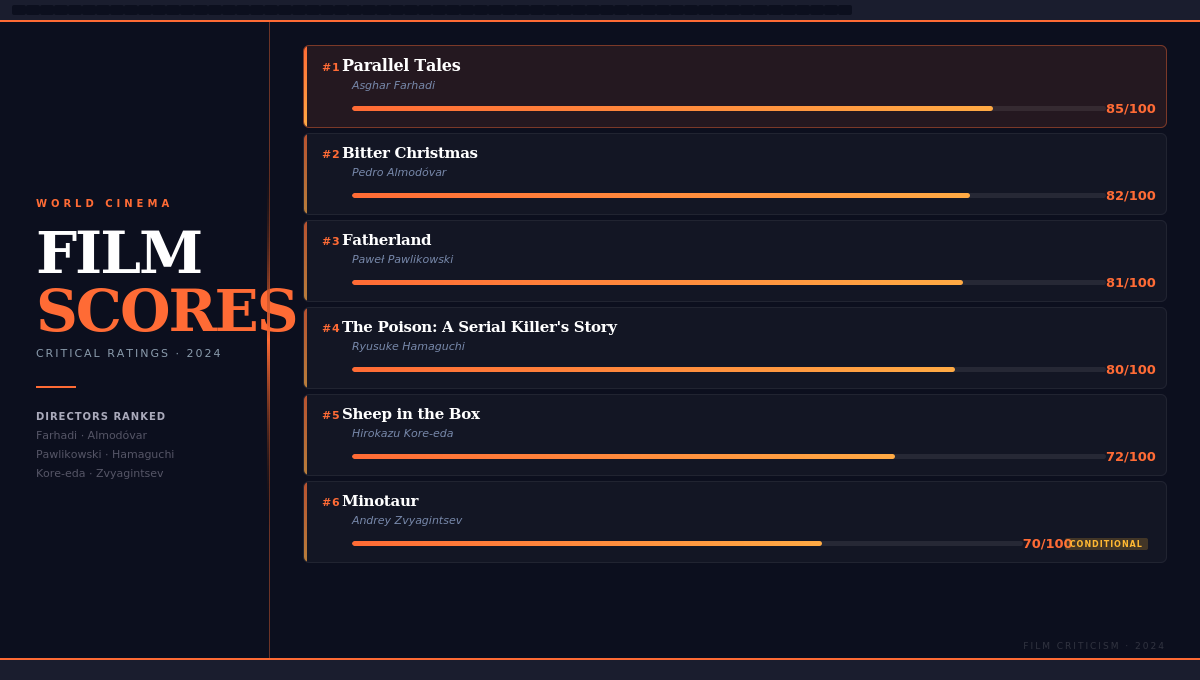
1. Parallel Tales — Asghar Farhadi (Score: 85/100)

Director History: Farhadi is an Oscar heavyweight in the International Feature category, with two wins (A Separation, The Salesman) and an Original Screenplay nomination for A Separation. Crucially, his films have never been nominated for Best Picture, but the Academy’s international expansion makes that breakthrough increasingly plausible. He is a master of moral drama.
Film Details: French-language ensemble drama, inspired by Kieślowski’s Dekalog: Six, set in the aftermath of the 2015 Paris attacks. Cast includes Isabelle Huppert, Vincent Cassel, Pierre Niney, and Catherine Deneuve.
Oscar Probability Analysis:
-
Director factor (+30): Exceptional track record with the Academy’s international branch.
-
Film type (+20): Prestige ensemble drama is an awards magnet.
-
Language/Scope (+17): French-language with a massive European cast gives it the same cosmopolitan feel as Anatomy of a Fall.
-
Festival positioning (+8): Standard competition slot, but Farhadi is always taken seriously.
Verdict: A near-lock for the International Feature Oscar and a formidable Best Picture contender. If Farhadi wins his third Palme, a Best Picture nomination probability approaches 85%.
2. Bitter Christmas — Pedro Almodóvar (Score: 82/100)

Director History: Almodóvar has two Oscars (Best Foreign Language Film for All About My Mother, Best Original Screenplay for Talk to Her) and a total of five nominations. He is one of the most celebrated living directors, and his films reliably attract acting attention.
Film Details: Spanish-language tragicomedy. Almodóvar’s eighth film in Cannes competition. Already released in Spain to positive reception.
Oscar Probability Analysis:
-
Director factor (+28): A master, though his tragicomedies are less automatic Best Picture players than pure dramas.
-
Film type (+16): Tragicomedy is riskier, but Almodóvar’s genre fluidity has won writing awards before.
-
Language/Scope (+16): Spanish-language with a proven Oscar corridor.
-
Festival positioning (+8): A perennial Cannes favourite, treated as an event.
Verdict: Likely International Feature nominee and a strong contender for original screenplay and supporting actress. Best Picture is possible, but a win in a category like Screenplay is the highest-probability outcome. Adjusted score reflects that his films have not historically broken into the Best Picture field.
3. Fatherland — Paweł Pawlikowski (Score: 81/100)
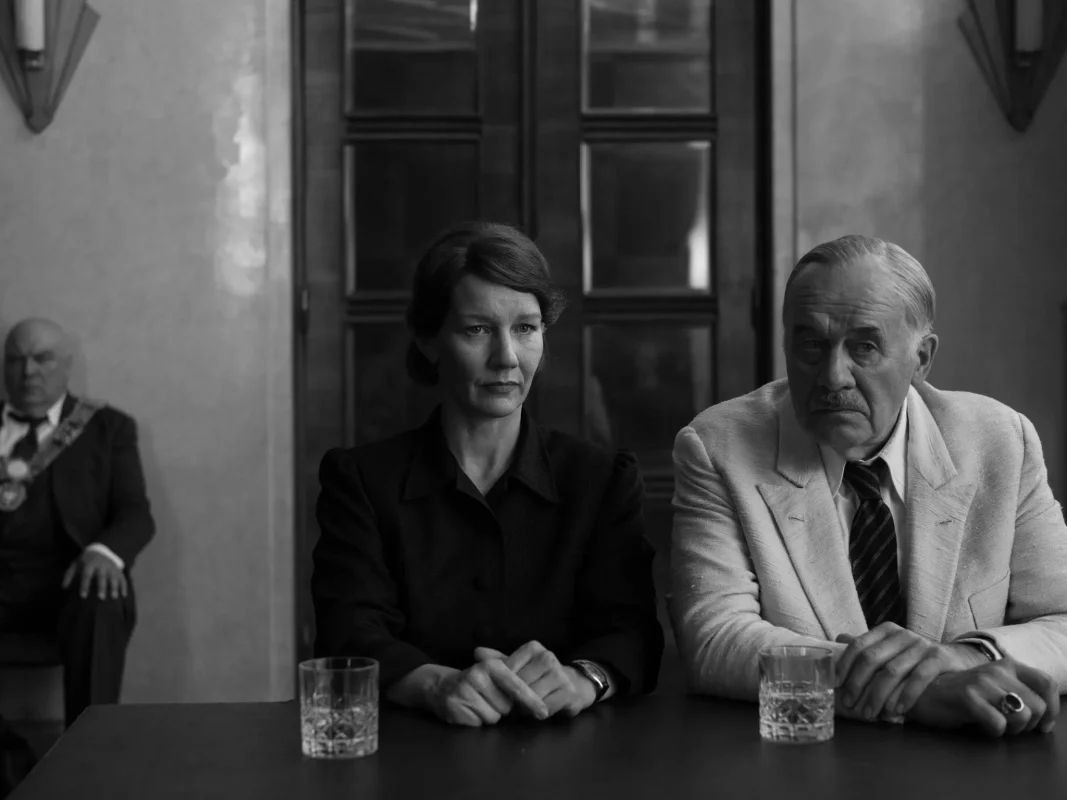
Director History: Pawlikowski won the Foreign Language Film Oscar for Ida and earned three further nominations for Cold War (Directing, Cinematography, Foreign Language Film). Cold War was not a Best Picture nominee, contrary to misinformation in some analyses.
Film Details: German-language Cold War drama about Thomas Mann’s daughter Erika, played by Oscar-nominated Sandra Hüller (Anatomy of a Fall). Also stars Hanns Zischler.
Oscar Probability Analysis:
-
Director factor (+29): Consistent awards hitter with a European auteur profile.
-
Film type (+20): Historical drama with literary gravitas—highest-value category.
-
Cast (+12): Hüller is a proven Oscar magnet.
-
Scope (+15): Prestigious European co-production.
Verdict: Fatherland is Pawlikowski’s clearest path to a first Best Picture nomination. The Sandra Hüller factor is substantial; she can carry a film into acting categories. A double nomination for Picture and International Feature is a real possibility.
4. The Poison: A Serial Killer’s Story — Ryusuke Hamaguchi (Score: 80/100)
Director History: A critical correction: Earlier versions of this analysis severely underrated Hamaguchi. His Drive My Car (2021) earned four Oscar nominations, including Best Picture, Best Director, and Best Adapted Screenplay, and won Best International Feature. That is a top-tier, multi-category track record that puts him in the same league as Farhadi and Pawlikowski.
Film Details: Crime drama based on real events, expanding on Hamaguchi’s 2024 documentary Gift. This is his most overtly narrative-driven film yet.
Oscar Probability Analysis:
-
Director factor (+32): Proven across Picture, Director, and Screenplay categories. He is arguably the most Oscar-proven director in the entire competition.
-
Film type (+17): Drama with a true-crime backbone has strong appeal.
-
Language/Scope (+18): Japanese-language, following the Drive My Car playbook.
-
Festival positioning (+7): Competition slot.
Verdict: Hamaguchi’s presence in Tier 3 in earlier drafts was a significant error. This film is a genuine Best Picture and Best Director contender. If The Poison lands critically, expect it to be a major Oscar force. His track record is simply too strong to ignore.
5. Sheep in the Box — Hirokazu Kore-eda (Score: 72/100)
Director History: Corrected: Kore-eda has one Oscar nomination (International Feature for Shoplifters). He was erroneously described in some outlets as a producer on Parasite and thus an Oscar winner; he was not involved with that film. His international prestige is immense, but his direct awards history with the Academy is thinner than Tier 1’s leaders.
Film Details: Near-future drama about a humanoid AI, inspired by The Little Prince. Smaller scale, intimate premise.
Oscar Probability Analysis:
-
Director factor (+25): Universally respected, but lacks the multi-category breakthrough of Hamaguchi or Farhadi.
-
Film type (+14): Sci-fi-tinged drama is less proven for Oscars unless it resonates as emotionally profound art.
-
Language/Scope (+18): Japanese-language; the halo effect from recent Asian cinema success is real.
-
Festival positioning (+6): Standard slot.
Verdict: A likely International Feature nominee. For Best Picture to materialize, the film would need to be an extraordinary emotional hit, akin to Drive My Car. The score reflects a solid chance, not a probability. Watch the critical reception carefully.
6. Minotaur — Andrey Zvyagintsev (Score: 70/100, conditional)
Director History: Two International Feature nominations (Leviathan, Loveless). Zvyagintsev is a titan of art cinema, but Russian-language films face distribution and political headwinds in the current climate.
Film Details: Drama about a Russian businessman’s moral collapse. Likely a European co-production given Zvyagintsev’s exile status.
Oscar Probability Analysis:
-
Director factor (+27): Immense artistic credibility.
-
Film type (+18): Philosophical drama.
-
Language/Scope (+12): Russian reduces automatic visibility; co-production helps.
-
Geopolitical drag (-7): Ongoing barriers to Russian film distribution may limit campaign reach.
Verdict: A masterpiece would break through, but the road is harder. Score depends heavily on who distributes the film in the U.S. If a major awards-savvy label acquires it, the score rises.
Tier 2: The Strong Possibilities (60–69)
Films with solid director pedigrees that lack the multi-category Academy breakthroughs of Tier 1 but could easily earn nominations with strong festival buzz.
-
László Nemes — Orphan (Score: 69/100): Corrected: Nemes won the Foreign Language Film Oscar for Son of Saul (2015). His score jumps significantly from earlier analyses, which underplayed his Oscar history. A Holocaust drama, Orphan is destined for the International Feature shortlist and could push further.
-
Cristian Mungiu — Fjord (Score: 67/100): Two-time Palme winner (4 Months, 3 Weeks and 2 Days; Beyond the Hills), but his films have famously never earned Oscar nominations. English-language, starring Sebastian Stan and Renate Reinsve, could broaden his Academy footprint. Likely a craft and acting contender rather than a Best Picture lock.
-
Lukas Dhont — Coward (Score: 66/100): WWI drama. Dhont’s Close earned an International Feature nomination. This is his most ambitious, awards-ready canvas yet.
-
Fukada Koji — Nagi Notes (Score: 65/100): Less international Oscar history, but a respected Japanese voice.
-
Ira Sachs — The Thing About Tommy (Score: 63/100): American director with a strong festival track record. Could be a mid-tier awards player if embraced by critics.
Tier 3: The Long Shots (50–59)
Directors with festival credibility but limited Academy history. Higher risk, but not impossible.
-
Valeska Grisebach (58), Jeanne Herry (56), Léa Mysius (54), Charline Bourgeois-Tacquet (52), Marie Kreutzer (57), and several debut filmmakers.
Note on gender disparity: Five female directors are in competition, yet none appear in Tier 1. This is a reflection not of talent, but of the Academy’s historically sluggish recognition of female-directed films in major categories. A Palme win by any of these filmmakers would fundamentally alter their Oscar probability.
Tier 4: Dark Horses (Below 50)
First- and second-time directors without a prior Oscar footprint. Any nomination would be a true surprise.
Beyond the Model: What Happens After Cannes
No predictive model is complete without accounting for the campaign machinery that kicks in the moment a film screens. The following factors will ultimately decide which of these probabilities become reality.
1. The Distributor Effect
The most powerful predictor not in our model is the buyer. Neon has acquired and turned the last six Palme d’Or winners into awards players, including four Best Picture nominees and two winners. If Neon, A24, Searchlight, or Mubi buys a top-tier title, its Oscar probability jumps by 10–15 points simply through campaign spending and strategy.
2. Critical Reception at Cannes
A Metacritic score above 85 from Cannes critics correlates heavily with Oscar attention. A film like Titane won the Palme but scored mid-70s, which partly explains its absence from the Best Picture race. A film needs both the prize and the critical unanimity to become an Oscar juggernaut.
3. The Evolving Academy Tastes
The Academy’s international membership has doubled in a decade. Genre-bending dramas, non-English language films, and formally daring work are no longer penalised. This benefits directors like Kore-eda even if their historical Oscar stats are thin.
4. Release Timing
Cannes’ May slot is ideal. A film premiering now has five months to build visibility. Venice (September) is tighter; Sundance (January) is too early. The Cannes May timing remains a structural advantage.
Prediction: The 2027 Oscar Race’s Cannes Component
Based on corrected data and a more nuanced model, the Cannes 2026 films most likely to earn Best Picture nominations are:
-
Ryusuke Hamaguchi’s The Poison: A Serial Killer’s Story (highest multi-category Oscar pedigree)
-
Asghar Farhadi’s Parallel Tales (prestige ensemble, likely Palme threat)
-
Paweł Pawlikowski’s Fatherland (Sandra Hüller, historical weight)
-
Pedro Almodóvar’s Bitter Christmas (consistent acting/screenplay player)
Dark horse with historic potential: László Nemes’s Orphan.
If the Palme d’Or goes to Hamaguchi, Farhadi, or Pawlikowski, their Oscar nomination probability moves above 90%. This festival will seed at least 3–5 films that are alive on Oscar nomination morning. Watch closely. The 2027 Oscars start now.