
Alexander Carson’s “Alberta Number One” is a deceptively simple film about a documentary crew travelling across a Canadian province to record details from its roadside attractions. It plays out like a classic road drama about a group of sightseers travelling from town to town, trying to learn more about their cultural history and heritage through the places they visit.
They travel with all their shooting equipment, which sets them apart from the rest. However, there’s an air of nonchalance to their behavior that seems quite odd for a crew that is supposed to record the truth. While they remain curious during these visits, you can’t help but find them unenthused about it all.
The rest of their time is spent on dealing with everyday matters. We hear them talk about their relationships, the boundaries they have set, and the ones they are willing to cross. We see them making stops at roadside motels and having their meals. In between, we see them preparing for the site stops, noting down questions that they will ask the owners. During these visits, they look for all the information they can gather about things on display, which range from topics of human evolution to aviation. Besides answers, they note down owners’ views on relevant themes.
In between, they interact with the casual visitors at these places. Some crew members playfully guess their motivations behind the visit, while others end up in unpredictable altercations with them. Throughout all those interactions, the crew seems oddly detached from their work. They seem more invested in finishing the film rather than its content.
So, they look for subjects when there are none, at times building stories out of thin air to make some sort of point. It makes sense to Vanessa (Liz Peterson), who has been working in the field for many years and is past her adolescent idealism. However, her research assistant, Naomi (Ingrid Vargas), struggles to come to terms with it.
Somewhere down the line, it becomes increasingly clear that the crew does not have a clear idea of how the final output should be. They are simply winging it as they go along without a strong bout of motivation. They unwittingly represent the gradual decay of millennial optimism, which once made soul-searching through escapades seem like an essential part of life.
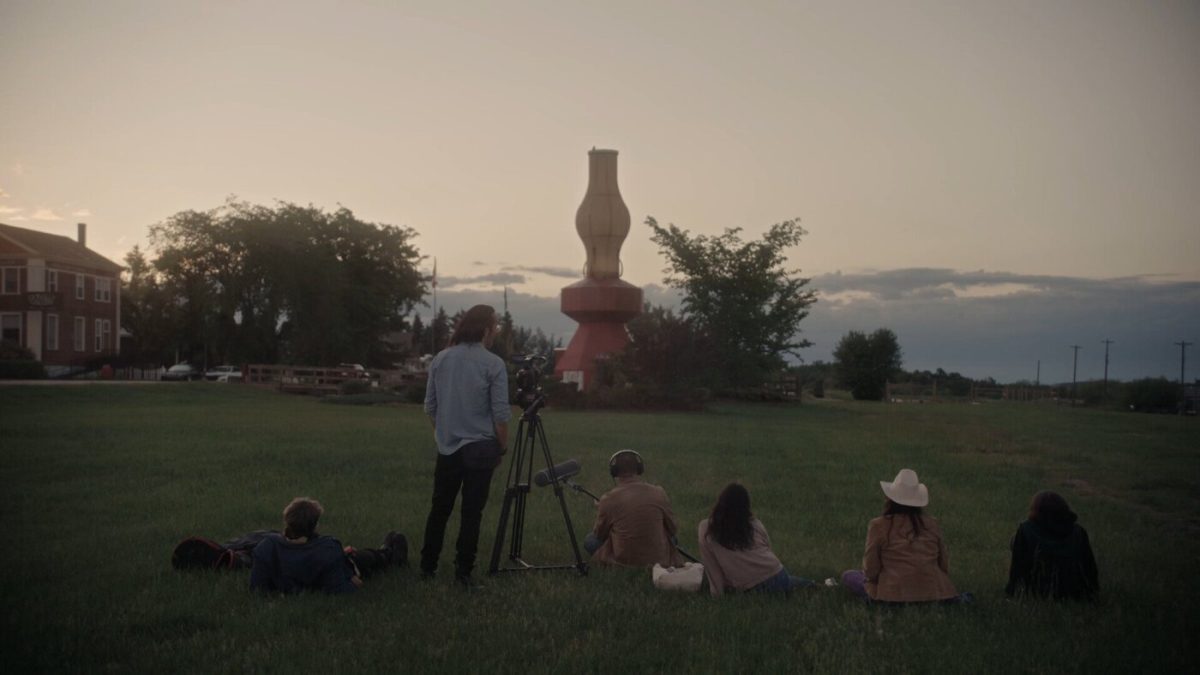
Everyone except Naomi seems weary and worn out by years’ worth of drivel. They appear either comfortable or relieved by accepting their personal defeat. At one point, a fan of Vanessa’s recognizes her and praises her work. Vanessa reacts placidly, knowing how to react in similar situations. There’s no pride in her reaction, but almost a rehearsed matter-of-factness.
Carson uses that sort of behavioral dryness and plainness for its wry, deadpan humor, which elevates the film from the dreadful monotony of their work. Wes Anderson has famously popularized the use of deadpan in his colorful world, but Carson doesn’t lean on quirkiness or the quirks. He uses frequent deadpan as a charming part of his low-key road film that passes by like a breeze.
That’s also due to their conversations, which do not revolve around lofty materialistic goals. They seem effortless despite being moderately chaotic. Over time, they reveal the interpersonal dynamics between these professionals struggling to find meaning in their work.
Consumed by their relentless boredom, the film soothes you in its comforting, unhurried rhythm while occasionally offering a window into the tension simmering underneath. Some of them are hoping to escape the complications of their personal lives, while others are escaping the ennui. Carson doesn’t make any of those tensions obvious, which works in the film’s favor, since it builds on a sense of ambiguity about their lack of passion.
Carson’s script can roughly be divided into three segments: locations, observers, and central characters. The locations (the roadside attractions) add anthropological insights to the overarching narrative, while observers (casual visitors) build on that school of thought further. They inform what kind of people show up at these spaces, even at a time when they have lost their relevance.
The characters represent the film’s thematic conflict between the past and the present. As they contend with the weight of their emotions, Carson effectively conveys the hollowness of grief, whether you are mourning the loss of your loved one or your old self.
Caron excels in sustaining that mood, which becomes the film’s quiet strength. Peterson, who remains the central focus of Carson’s script, is one of the film’s highlights. She embodies Vanessa’s duality under her pretense of nonchalance, while longing to return to her idealistic past self. In the end, the thematic exploration of one’s relationship with the past feels rather thin and familiar.
Still, the film shines through a series of quiet revelations that Peterson beautifully captures with her understated performance. The supporting characters, although not explored in depth, feel like real people, thanks to the direction and the performances.




![Lucy in the Sky [2019]: ‘TIFF’ Review – Never Takes Off](https://www.highonfilms.com/wp-content/uploads/2019/12/Lucy-in-the-Sky-768x512.jpg)
![Rewriting History with the Ink of Film: Once Upon a Time in Hollywood [2019]](https://www.highonfilms.com/wp-content/uploads/2019/08/once-upon-a-time-in-hollywood-768x427.jpeg)