There is something curiously intimate about revisiting a haunted object, and “Annabelle Comes Home” understands this intimacy perhaps more than it understands terror. It is positioned within the ever-expanding architecture of “The Conjuring” Universe, the film outperforms by widening the mythos in the operatic way of “The Conjuring” or even the ecclesiastical solemnity of “The Nun.” It shrinks its geography to the Warren household, to a single night, to a room of cursed relics that feels less like an archive of unresolved grief. In doing so, it becomes, interestingly, a story about proximity.
Directed by Gary Dauberman, who has long been associated with the franchise’s writing DNA, the film feels like an internal conversation with its own legacy, as though it is aware that audiences already carry expectations of jump scares, shadowed corridors, and Catholic iconography, and instead of subverting them radically it arranges them with a certain methodical patience, building a haunted-house chamber piece that relies on the adolescent vulnerability of Judy Warren and her friends. This shift in emotion is a distant family, but from the careless curiosity of children left alone with a locked cabinet, which makes the narrative central to the fragility of boundaries.
The film’s premise is disarmingly simple: Annabelle is placed in a blessed glass case, secured by Ed Warren and Lorraine Warren, only for that containment to be undone during a babysitting mishap. Yet within this simplicity lies an almost classical dramatic unity of time and space, reminiscent of a stage play where one setting becomes elastic enough to house multiple anxieties, and the artefact room itself transforms into a metaphorical subconscious, each object a repressed story waiting for accidental liberation.
What the film appears to be interested in is that Annabelle is a singular demonic conduit and contains the idea of contagion, how one malicious presence can activate dormant horrors, turning a curated collection of evil into an orchestra of disturbances. The doll becomes a catalyst, an axis around which minor spirits orbit, each vying for narrative space, resulting in sequences that feel episodic yet interconnected, like short ghost stories stitched into a single restless night.
When “Annabelle Comes Home” begins with Ed Warren and Lorraine Warren transporting the doll to their home and sealing her inside a blessed glass case, the film establishes a carefully constructed idea of order. The act of locking Annabelle away is presented as a ritual of containment shaped by faith, discipline, and accumulated experience. The Warren artefact room, lined with objects gathered from earlier investigations, functions as a physical archive of the supernatural, a room where past confrontations remain preserved rather than erased.
Each object carries a narrative, and the doll is placed among them as if catalogued within a museum of unresolved histories. This sense of curated danger creates an immediate thematic framework: evil can be managed, organised, and restrained, but it continues to exist. The blessed glass case reassures through visibility and ritual, and also quietly suggests that such reassurance depends on constant vigilance.
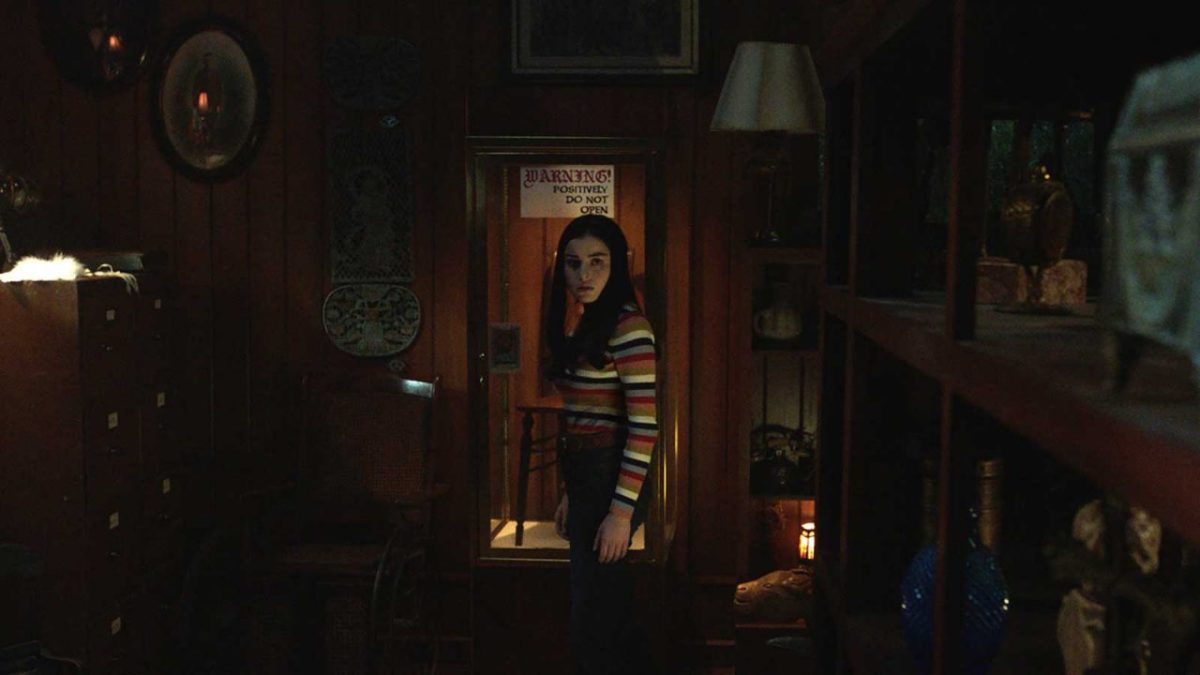
The narrative moves into its central conflict when the protective boundary around Annabelle is disturbed during a seemingly ordinary babysitting evening. The decision to unlock the case emerges from emotional vulnerability rather than cruelty. That distinction shapes the tone of the film in important ways.
The events of the night unfold within the confined space of the Warren household, and this spatial limitation intensifies the drama. By restricting the action to one location and one continuous stretch of time, the film creates a concentrated atmosphere in which tension accumulates steadily. The house gradually transforms into a dynamic landscape of shifting shadows and remembered presences. Rooms that once appeared familiar begin to reveal layers of unease, and the artefact room becomes the symbolic centre from which disturbances radiate outward.
What makes this structure compelling is the way it connects supernatural events with adolescent emotional states. Judy Warren’s awareness of her parents’ work positions her in a unique psychological space. She understands that her home contains forces beyond ordinary explanation, and she lives with the knowledge that attention from the supernatural world might gravitate toward her.
This awareness lends the film an undercurrent of inherited burden. Judy’s experience suggests that children often carry the emotional weight of their parents’ vocations, even when they do not fully participate in them. The night’s chaos amplifies that tension, as personal insecurities and social anxieties intersect with literal manifestations of fear. The supernatural disturbances mirror feelings of isolation, jealousy, and longing for acceptance, allowing the horror to resonate on an emotional level.
“Annabelle Comes Home” directs its attention toward an idea that extends beyond Annabelle as an individual demonic presence. It explores the notion of spiritual contagion, presenting the doll as a force that activates other dormant entities within the Warren artefact room. Annabelle functions as a catalyst that awakens the energies attached to the objects surrounding her. Once the protective barrier is lifted, the entire room responds, as though each relic has been waiting for permission to reassert its presence.
This approach expands the narrative from a single haunting into a network of disturbances that unfold throughout the house. Each spirit introduced during the night carries a distinct identity and visual language, yet all of them remain connected through Annabelle’s influence. The film, therefore, constructs a layered structure in which separate supernatural encounters contribute to a unified dramatic progression. The effect resembles a series of interwoven ghost stories occurring within one continuous timeline, each episode intensifying the emotional and psychological stakes.
The cinematography supports this progression through deliberate shifts in lighting and color. Early scenes are bathed in warm tones that convey domestic stability and emotional security. As the disturbances multiply, the lighting gradually transitions into cooler hues and deeper shadows. This visual transformation mirrors the characters’ changing emotional landscape. The home remains the same physical space, yet its atmosphere evolves in response to the awakened forces within it. The camera frequently adopts a patient, observant stance. It lingers in corridors and doorways, allowing tension to accumulate through anticipation rather than immediate action.
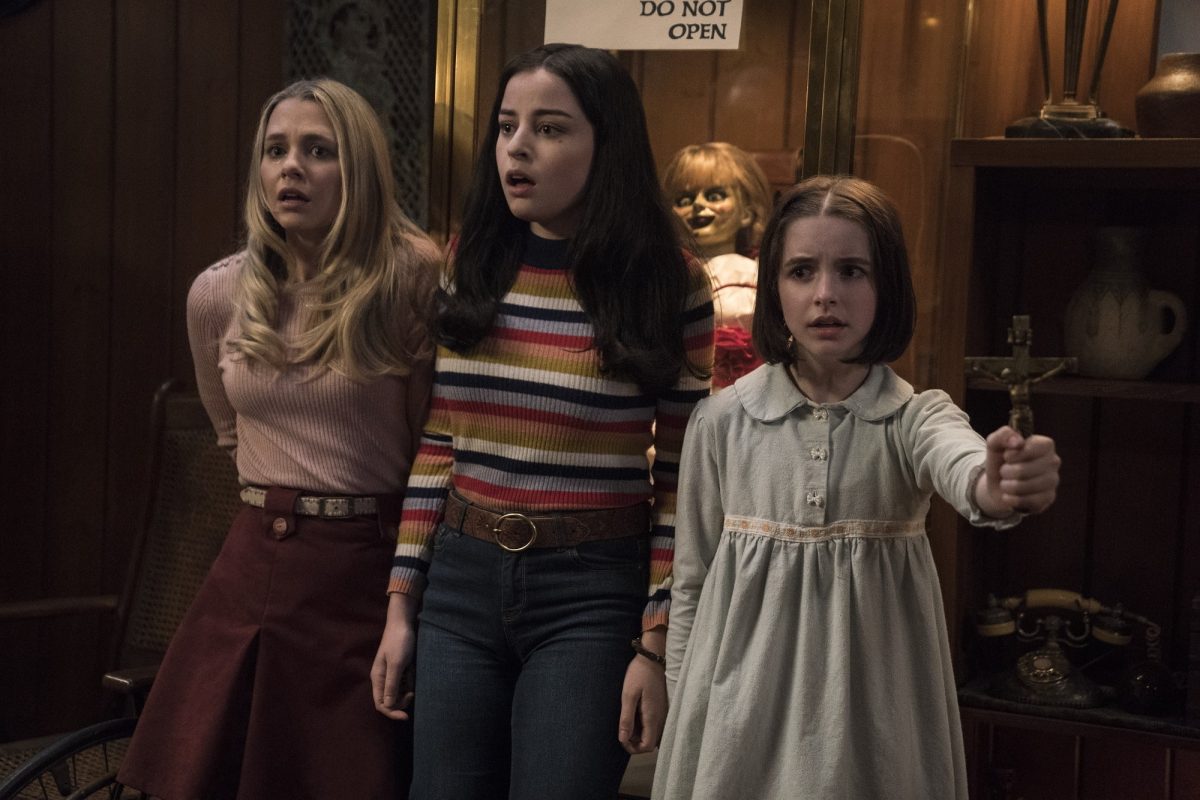
What carries particular emotional weight is the portrayal of Judy Warren and the specific form of isolation that shapes her everyday life. Judy grows up fully aware that her parents, Ed Warren and Lorraine Warren, engage directly with forces most people prefer to imagine at a safe distance. This awareness shapes her sense of self. She understands that her home contains objects associated with violence and spiritual unrest, and she recognises that her family name carries a certain reputation within the world of the supernatural.
As a result, her experience of childhood includes an unusual layer of vigilance. She moves through her own house with knowledge that other children never need to consider. The film presents this as a quiet psychological condition. Judy’s anxiety arises from association. She senses that attention from malignant forces might gravitate toward her simply because of who her parents are and what they represent. Judy negotiates a legacy she did not actively choose, and the story allows this dynamic to unfold gradually across the course of the night.
The cinema develops a sustained reflection on the idea of containment and the structures human beings create in order to feel secure. The Warren artefact room stands as a carefully organised attempt to give shape and boundary to experiences that resist ordinary explanation. Each object rests behind glass or within a designated space, labelled and blessed, arranged in a manner that suggests supervision and order. Through this design, the film presents containment as a system built on ritual, faith, and discipline.
However, the release of Annabelle activates a network of stored histories. The house becomes animated by forces that had been catalogued yet remained active in potential. In this way, the film explores how classification and preservation provide reassurance while the underlying energies continue to exist with their own agency.
The recurring image of the blessed glass case communicates this idea visually. Glass allows visibility while asserting separation, and once that separation breaks, the illusion of stability gives way to movement and consequence. The shattering of boundaries, therefore, symbolises the fragility of human systems designed to manage the unknown.
This film might be seen as one of the most domestically focused, a narrative that trades epic exorcisms for bedroom doors creaking open at midnight, and this modest scale allows it to explore fear as something intimate rather than apocalyptic, something that occupies the same space as childhood memories and family photographs.
There is a quiet tenderness in the way the film stages the Warrens’ return at dawn, and this tenderness carries emotional significance within the larger arc of the night’s events. After hours of escalating disturbances, shifting shadows, and emotional strain, the arrival of Ed Warren and Lorraine Warren restores a sense of balance to the household.
Their presence re-establishes the emotional foundation of the family. The film presents their return as an affirmation of continuity. The parents step back into a space that had momentarily slipped beyond control, and through ritual, prayer, and composed authority, they reassert stability. This sequence communicates the idea that belief and affection operate together as stabilising forces. The morning light that accompanies their arrival reinforces this sense of renewal.




![Sharmaji Namkeen [2022] Review: A Deliciously crafted tribute to Rishi Kapoor](https://www.highonfilms.com/wp-content/uploads/2022/03/Sharmaji-Namkeen-3-768x576.jpg)
![The Sky Is Pink [2019]: ‘TIFF Review – Be Ready To Be Moved](https://www.highonfilms.com/wp-content/uploads/2019/10/The-Sky-Is-Pink2-TIFF-highonfilms-768x326.jpg)