
There is something strangely persistent about the way horror returns to the house, and in “Annabelle: Creation” (2017) directed by David F. Sandberg and nested carefully within “The Conjuring” universe, that return feels less like a jump scare strategy and more like a meditation on grief that never found language; set twelve years after the accidental death of a little girl.
The film opens with an absence, with a farmhouse suspended in the kind of stillness that feels too deliberate to be peaceful, as if the walls themselves are holding their breath. It is this stillness that gives the narrative its moral temperature, because what follows, that is, the arrival of orphaned girls and a nun into the dollmaker Samuel Mullins’ home, introduces victims into a haunted space, and alongside, introduces fragile hope into a structure that has already made a bargain with something inhuman. That bargain, the invitation extended to a demonic presence under the guise of reunion with a lost child, becomes the emotional hinge on which the entire film turns.
What renders this installment more absorbing than its predecessor, Annabelle, is its remarkable tonal control, a discipline that feels deliberate rather than decorative. In “Annabelle: Creation,” horror is propelled by an excess of revelation and restraint, by an almost classical patience that understands fear as something cultivated in the margins of visibility. The film allows uncertainty to linger, and in that lingering space, anxiety grows organically. In choosing to withhold information rather than parade it, the film transforms the act of watching into an active, almost collaborative experience.
The viewer’s attention strikes remarkably with abrupt musical cues or immediate visual confirmations, it allows silence and stillness to settle over the frame, creating a subtle tension that encourages the eye to wander. One begins to search the corners of the screen instinctively, lingering on the dark space behind a door, the faint outline at the end of a hallway, the negative space beside a bed where nothing is visible yet everything feels possible.
This deliberate ambiguity has sharpened the perception. The absence of immediate revelation compels the viewer to project possibilities onto the screen, and in doing so, the imagination becomes an accomplice to the film’s horror. What might be standing there? What might move? The mind fills in what the camera withholds, often constructing something more unsettling than any explicit image could provide.
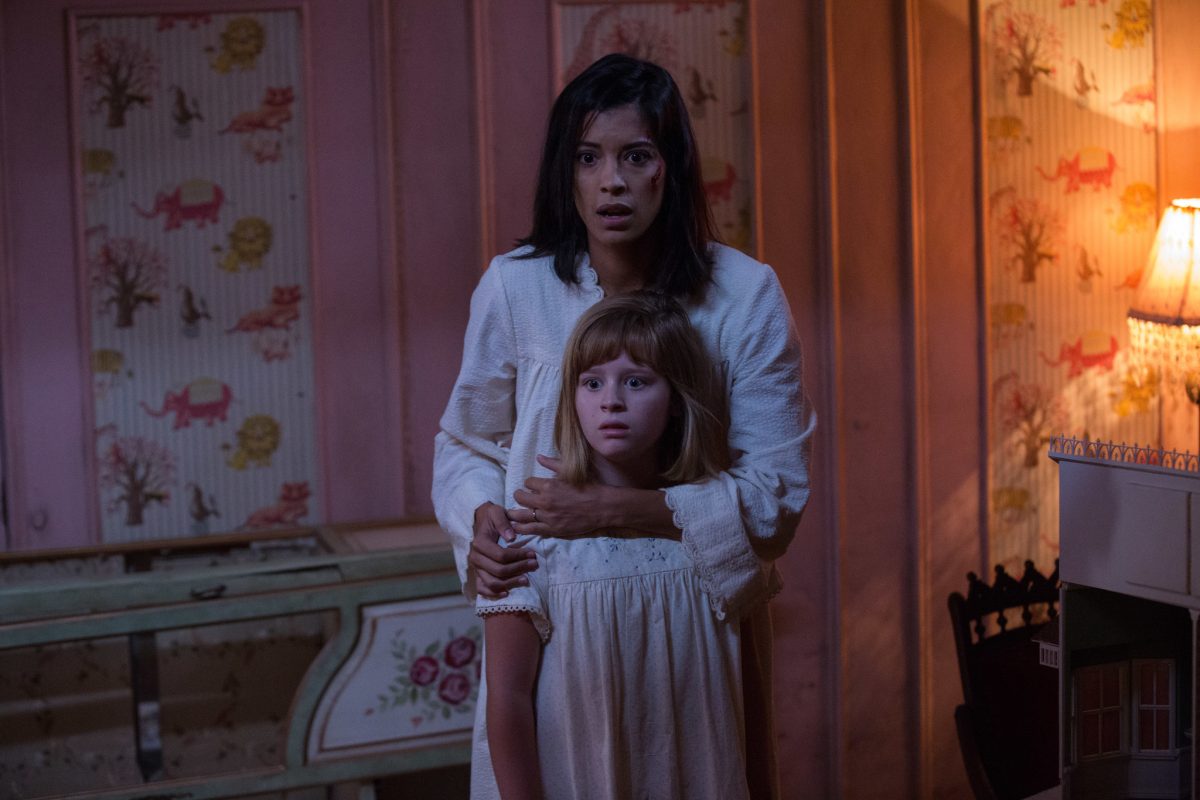
This strategy aligns with David F. Sandberg’s demonstrated sensitivity to spatial tension in “Lights Out,” where darkness itself functioned as both setting and antagonist. In “Annabelle: Creation,” however, space becomes morally charged. The farmhouse is constructed as a labyrinthine architecture of consequence. Its corridors elongate perception; they seem to stretch just enough to delay certainty, and that delay transforms movement into suspense. Bedrooms, conventionally associated with safety and intimacy, are framed as precarious sanctuaries that can be overturned by the simple extinguishing of light.
The house operates almost allegorically, each room a chamber of concealed grief, each staircase a descent into unresolved memory. In this way, the film’s tonal discipline is inseparable from its spatial design, where dread is embedded within the structure itself, gradually intensifying until anticipation becomes indistinguishable from fear.
Yet what lingers after the film ends is not the doll itself, with its fixed porcelain smile and lacquered stare, but the ethical question of consent in grief, because the Mullins couple’s decision to allow a spirit into a doll in order to see their daughter again is framed as heartbreakingly human. The horror grows precisely because the audience recognises that impulse, as to how easily love can be manipulated when it refuses to accept finality, and this recognition shifts the film from mere supernatural thriller into something closer to tragic fable, where the demon’s violence is spectacular but the real terror lies in the slow corrosion of discernment.
The orphan Janice, whose physical vulnerability makes her both sympathetic and narratively exposed, becomes the film’s tragic conduit, not because she happens to long to belong, and in her loneliness, the demon finds an aperture, so that possession is staged less as invasion and more as seduction, a sequence of whispered assurances and small permissions that feel disturbingly intimate.
In watching this, one may sense that the film is not interested in shock more than in the psychology of temptation, in how isolation alters judgment. The doll itself defies a sense of characterisation, and operates as an icon, a static object that gathers meaning from the gaze projected onto it. This is where the film’s craftsmanship deserves attention, because it understands that the uncanny requires proximity, that terror accumulates when the camera lingers and refuses to blink.
The sound design, with its restrained creaks and distant knocks, functions almost like a second narrator, suggesting presence before confirming it, so that when violence does erupt, it feels earned rather than gratuitous. The religious imagery, embodied in Sister Charlotte, is quietly persistent, framing the farmhouse as contested territory between faith and despair.
Yet the film resists simplifying that conflict into a sermon, allowing instead the unsettling possibility that evil requires only invitation, and that good intentions are insufficient armor against metaphysical cunning. What complicates the experience further is the film’s structural decision to fold back into the broader mythology of “The Conjuring” universe, creating a circularity that transforms what initially appears as a self-contained tragedy into a prelude, and while such intertextual stitching could have felt mechanical.
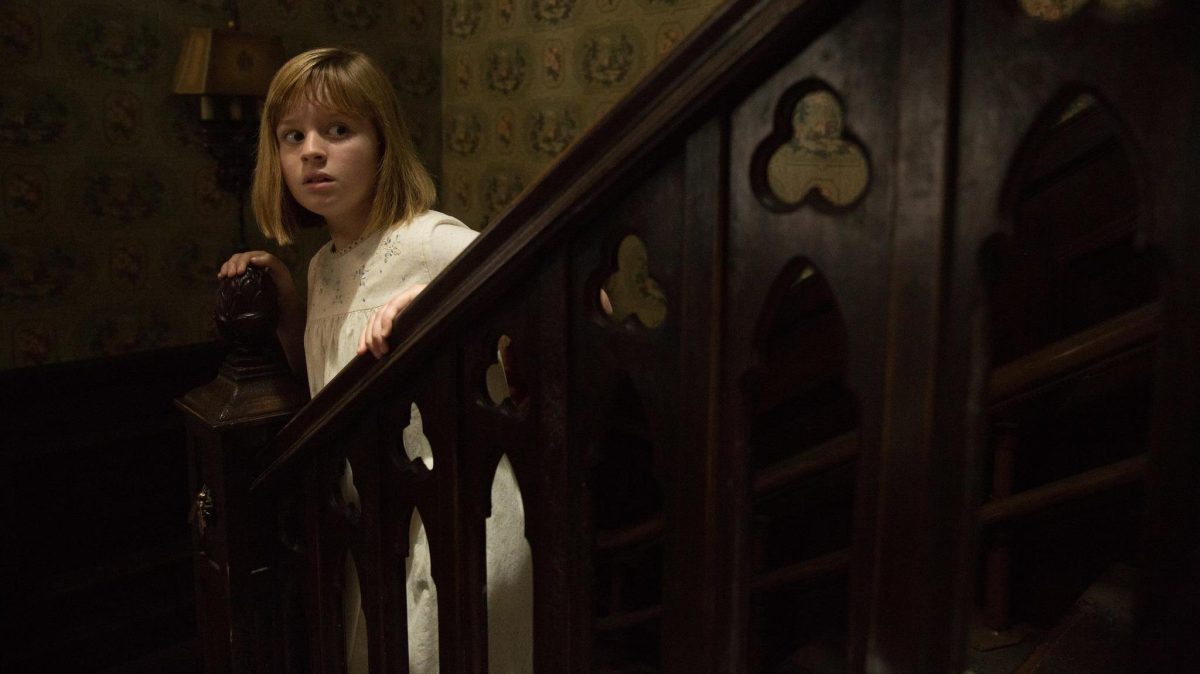
Here, it amplifies the sense of inevitability, as though the events in the farmhouse are a wider pattern of human error and supernatural opportunism. The pacing is patient, almost classical in its escalation, and this patience allows the audience to inhabit the house long enough to feel its geography, to anticipate which room will betray safety next. That spatial familiarity becomes the ground on which fear stands, because terror is sharper when it intrudes upon the known.
What ultimately distinguishes “Annabelle: Creation” within the larger architecture of “The Conjuring” universe is an understanding of fear as a psychological collaboration between image and spectator, an approach that feels markedly more refined than what was attempted in “Annabelle.” In defiance against relentless manifestations, the film calibrates absence with precision, allowing stillness to acquire density, so that each pause becomes charged with expectancy, and each shadowed threshold suggests an unseen negotiation between safety and threat.
This restraint transforms spectatorship into an act of vigilance, and the film relocates horror from spectacle to cognition. The dread emerges not at the moment of revelation but in the elongated seconds preceding it, where imagination proliferates unchecked. However, the film does not demand a singular emotional response. It would be reductive to insist that it is either a profound study of grief or merely an efficient horror prequel, since it occupies a liminal space between those registers, offering enough psychological texture for reflective viewers while still delivering the visceral rhythms expected of mainstream horror.
Perhaps its most intriguing quality lies in this balance, in its refusal to announce its thematic ambitions too loudly, allowing viewers to encounter them at their own pace. The farmhouse itself, rendered through carefully measured compositions and deliberate pacing, operates as a psychological mechanism. Its corridors extend suspense temporally as much as spatially, its rooms oscillating between refuge and entrapment.
While it would be excessive to claim that “Annabelle: Creation” revolutionises the genre, it undeniably refines a particular strain of contemporary horror that privileges atmosphere over spectacle, suggestion over exposition, and moral consequence over arbitrary cruelty.
By the time the narrative closes its loop and the doll’s journey intersects with the events that initiate the 2014 film, the experience feels less like a franchise obligation and more like a cautionary echo, reminding the viewer that horror often begins with a door opened out of love.
Once certain thresholds are crossed, innocence does not simply return to its prior shape, and if the film leaves one unsettled, it is solely because it quietly proposes that the most devastating hauntings originate in the unresolved chambers of the human heart, where longing, unchecked and unexamined, can become an invitation to something far less benign than memory.





![Verónica [2017]: Scariest Movie Ever, My Ass!](https://www.highonfilms.com/wp-content/uploads/2018/03/veronica-768x432.jpg)

