A satirical look at the military–industrial complex and America’s intrusion into Iraq, Hailey Gates’s “Atropia” (2025) aims high but often gets tangled in its own ideas. Hailey Gates’ directorial debut tries to stake out a clear position, but the film keeps drifting, as if it isn’t sure what its central argument should be. Still, there’s a lot that works.
The performances stand out: from Fayruz (Alia Shawkat), the wannabe Iraqi actor who has never set foot in Iraq, to Abu Dice (Callum Turner), the veteran playing an Iraqi insurgent. Even Channing Tatum shows up, playing a foolish version of himself, preparing for a role. It’s all fun, but the question remains: what does the film finally want to say?
Set after 9/11, around 2006, “Atropia” takes us into a government-approved military role-playing town meant to prepare soldiers for Iraq. The fictional village of Atropia becomes the stage. From the start, Hailey Gates leans on Fayruz and her longing to leave this artificial world and become a real actor. She records herself on a video camera, and when she hears a major Hollywood actor might join the next round of drills, she slips copies of her DVD into boxes being sold by another role-player.
The plan goes sideways, but it leads her to Abu Dice, the Iraq veteran newly assigned as the insurgent. Their accidental meetings draw them toward each other. There’s a funny moment where Fayruz complains that there’s never enough water in the mock village and says she feels like a dirty dish. Later, Dice drags her into the desert to give her an actual shower, only for the soldiers to catch them, and in the chaos, we learn she’s pregnant, with the father still in Iraq. The film keeps moving in this strange rhythm as Dice and Fayruz break loose and stage a mock insurgent attack on Thanksgiving, wiping out the platoon and resolving their will-they-won’t-they tension.
Later that day, Fayruz discovers that Dice already has a wife and child. With things falling apart, Dice is pushed toward marrying Maria, but Fayruz switches places with her. Before anything can happen, the remaining soldiers grab Dice. The observers decide he’s too valuable to stay here and send him back to Iraq — the place he wanted to escape. Fayruz spends one final night with him in Vegas, then pleads with the observers to keep him, saying the soldiers who “died” in the mock attack clearly aren’t ready. Nobody listens.
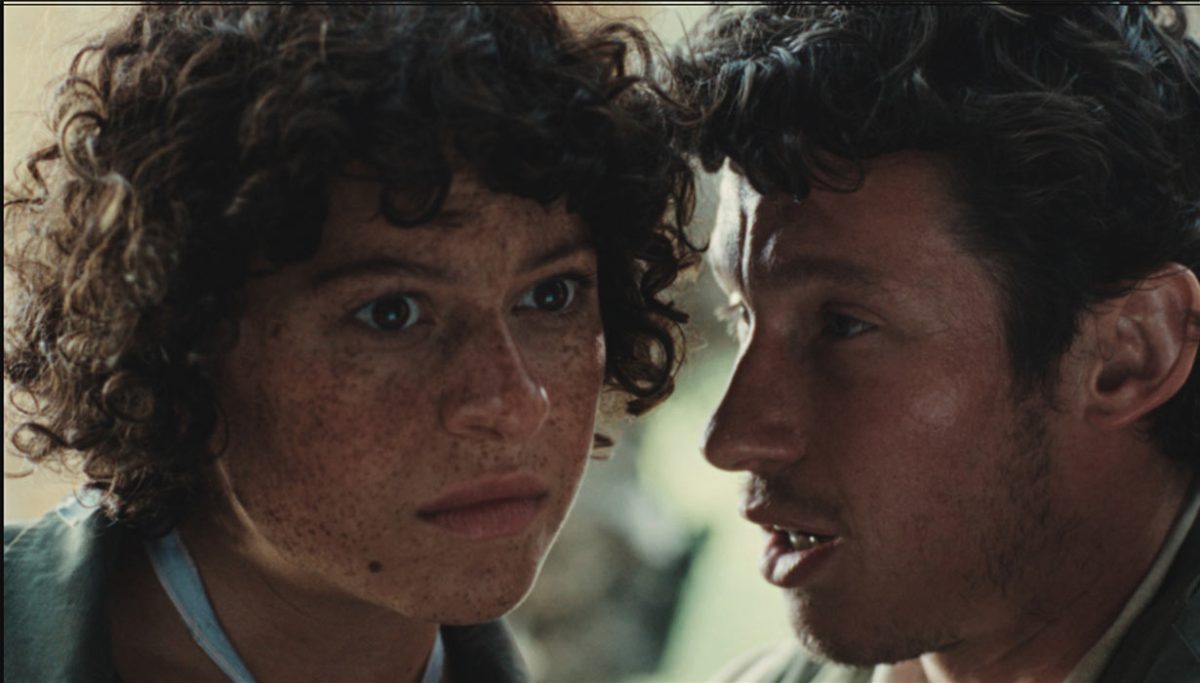
The film is full of ideas and recurring images. The military space becomes a kind of stage production, raising questions about what war becomes once it’s rehearsed and repeated. Real geopolitical conflicts are reduced to scripted drills, acted out by people who have their own wounds and histories. But this is where Gates’ insight plateaus. The motifs repeat, and by the end, Fayruz’s emotional arc feels pushed. Mock reporters and news crews appear throughout, like the scene where soldiers have to play dead and the journalist insists they don’t look “dead enough,” splashing blood on them to fix it.
Where the film truly shines is in its characters. Each soldier carries something — insecurity, longing, prejudice — and these small cracks reveal how war shapes ordinary people. It’s in these moments that the film feels most alive. But Gates has trouble holding together the human and the artificial at the same time. “Atropia” works best when it exposes how soldiers get dehumanized.
To Fayruz, Iraq is a place she imagines. To Dice, it’s a place he can’t stop reliving. Even though the film nods to how unnecessary the war was, it doesn’t soften the trauma Dice carries. Every time Iraq is mentioned, real battlefield footage appears, pulling the story back to reality and showing how the drills trivialize something that was never trivial. The desert tortoise, too, becomes a metaphor: the U.S. stretching its reach, disrupting ecosystems and communities because it can.
But the film never settles into a coherent narrative. It survives on the strength of its performances. Every time it builds toward something, it veers off. There are flashes of sharp satire, but they’re lost inside a plot that can’t quite decide its shape. Gates’ research is solid and her symbols are rich, but without a strong central thread, the film lands as both ambitious and uneven — a debut that hits and misses in equal measure.





![Teen Aur Aadha [2018]: ‘PIFF’ Review — Of Stories Untold And Secrets Unguarded](https://www.highonfilms.com/wp-content/uploads/2018/09/Teen-Aur-Aadha-1HOF-768x474.jpg)
![Thupparivaalan [2017] – An Entertaining albeit a Tad Underwhelming Thriller](https://www.highonfilms.com/wp-content/uploads/2017/09/Thupparivaalan-Movie-Stills-6-768x512.jpg)