It’s within the first third of “Blue Heron” that it could be comfortably assumed that writer/director Sophy Romvari’s feature film debut is a modest, albeit very perceptive autobiographical experience about her own experiences growing up within a challenging household on Vancouver Island. It’s a shape that many indie artists take within their early features, and generally allows them to offer as much personal detail as possible, whilst refining their craft for something more ambitious down the line.
Romvari certainly shows more resilience and patience than most of her peers, which is why the misdirection that “Blue Heron” takes comes as such a gutting, emotionally devastating twist. Romvari isn’t just broadcasting her family history, but doubling back to analyze it in a fascinating, thoughtful way. To say that Romvari’s work is a personal expression would perhaps undercut it, as “Blue Heron” touches on universal themes about family stability that hold overwhelming profundity.
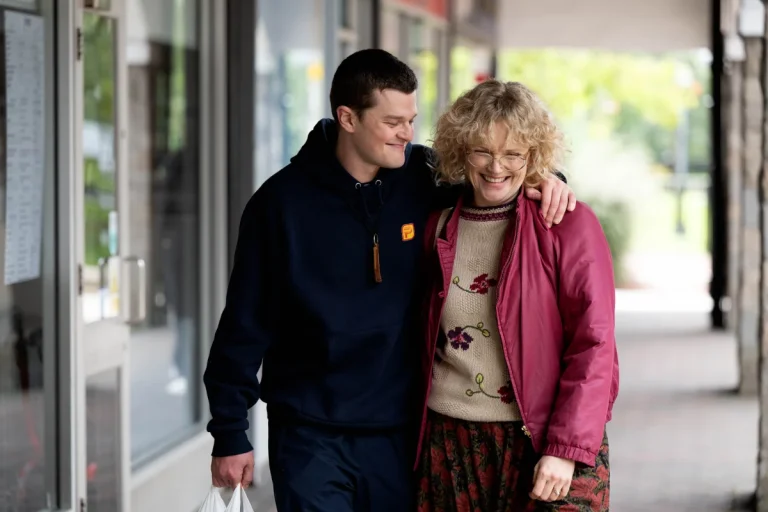
“Blue Heron” is the story of a Hungarian immigrant couple (Iringó Réti and Ádám Tompa) who move with their four children to Canada in the early 1990s, where they adapt to start a new life. The family patriarch has three young children named Sasha (Eylul Guven), Henry (Liam Serg), and Felix (Preston Drabble), but his wife has an older son, Jeremy (Edik Beddoes), who comes from a previous relationship.
Jeremy is troubled and deals with bouts of depression, yet is still an immigrant who doesn’t entirely feel at home in an environment that feels foreign to him. While some of his reluctance to come out of his shell is a result of the crossing of cultures, he’s also seen to be a potential harm to himself and others.
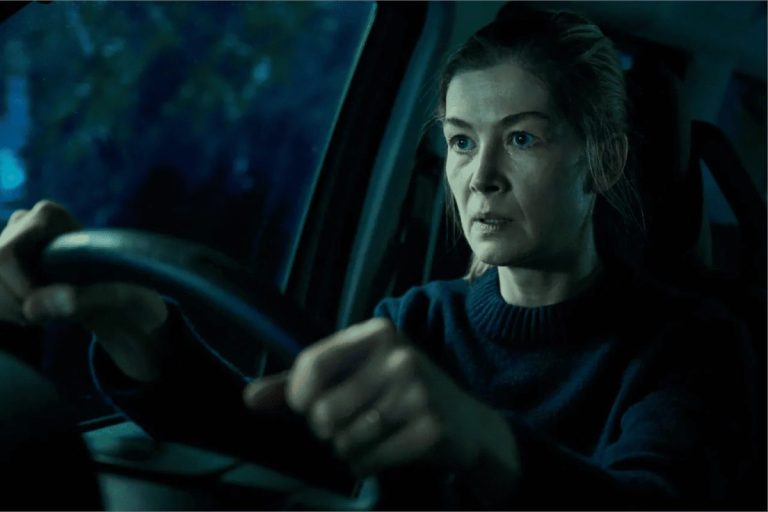
What “Blue Heron” does not automatically announce is that it is a memory piece, and that the young girl Sasha is a stand-in for Romvari. An older version of Sasha, played by Amy Zimmer, had returned to the place where she grew up to reflect on how her family evolved, and how Jeremy’s condition grew worse.
The sense of discovery that Sasha is going through as she addresses her memories mirrors that process Romvari had when constructing the form of her feature. Sasha is forced to interact with reminders of the past that feel lived-in, creating a blurring of reality that doesn’t have the formal diversion to immediately announce itself.
The perspectives of both versions of Sasha become interchangeable thanks to the lived-in ways that Romvari chooses to examine the research process. There are times in which Sasha imagines herself as the therapist or authorities that interviewed her parents, as if to give her the chance to grill them for their decisions. At the same time, Sasha is often a prisoner of the past, as her adult self is stuck in the same position of helplessness as she watches her brother’s health face a sharp decline.
“Blue Heron” required precision for each of its stars, and that Romvari assembled an ensemble that so authentically feels like a real family is by no means an easy achievement. She’s perceptive enough to understand that. As an immigrant family, she fostered a closer bond with her siblings because of their shared cultural heritage, and the result of the move gave her more insight into her parents’ financial and personal well-being than most kids her age.
The beauty of seeing an adult Sasha return to the past is getting to see her develop an appreciation for her parents as adults, and not just the guardians who protected her throughout her life. Few things are more affecting for a child than to see their parents confused and in pain, and “Blue Heron” finds these poignant moments without any of the conventions of typical flashbacks.
The most critical performance in the film is from Beddoes, who immediately announces himself as a major actor who is sure to have many more great roles ahead of him. Jeremy’s characterization is very specific. He faces obstacles that are to be expected, such as being sent to a new home when he was already adjusted to a different culture, and being the oldest, and therefore most burdened by responsibilities, of his siblings.
The diagnosis that Jeremy is given by Sasha’s interview subjects in retrospect doesn’t necessarily suggest that things could have gone a different way, but it does imply that the advances within mental health research would have changed the position that her parents are in. What Sasha is most devastated to learn in the flashbacks is that her parents knew Jeremy was troubled, but clung to him because they couldn’t bear the thought of “abandoning” him to a system, which likely wouldn’t have offered him any real help at the time.
Sasha may have become an adult who can see the parameters within her younger self’s perspective, but she is still limited by the exclusive memories that she had. The worst of Jeremy’s actions is only alluded to, as Sasha still views him as a curiosity who remains somewhat pure.
Although it’s expected that those she would be interviewing years later would emphasize that he was inherently a “good kid,” there’s enough evidence compiled to suggest that Jeremy was not brewing with hate, but was genuinely crying for help because of the actions he was helpless to commit.
The most radical moments in the film involve an adult Sasha’s reckoning with Jeremy, but even then, it’s a specifically coded means of mourning. Sasha never got to see the side of Jeremy that her parents were afraid of, but she can compile her own memories to think about her brother in a new light.
“Blue Heron” is a naturalistic film that doesn’t leap to conclusions, nor does it deny the moments of sweetness and beauty that were bound to pop up, even in a challenging time in its characters’ lives. It’s not only a gorgeous recreation of what Vancouver offered as a place of respite, but a window into how traditional customs can be retained by immigrants. “Blue Heron” isn’t a self-aggrandizing work of autobiographical fiction on Bovari’s part, but a helpful and thoughtful time piece with the power to connect with anyone because of how truthful its approach is.