“Greenland 2: Migration” (2026) has no reason to exist. Clueless, rudderless, entirely lacking in personality or redeeming humour, the sequel to 2020’s “Greenland” is as embarrassingly generic as an exercise in utter futility. It has nothing going for it, repeatedly cast ashore by contrivances and survival tricks continually favouring the protagonist and his family.
As if in contrition, the lead does take a hit, but it unfolds with such garish, glaring predictability that any emotional force is blown to smithereens. What’s visible instead, in direly amplified measure, is a slew of otherwise handsomely staged sequences, cranked up with generous CGI, all in pursuit of a vapid destination. There’s a redundancy that coats films, smugly fitting themselves into franchises, drawn by the allure of lucre, the hope of replicating past success without carving any new blazing path.
“Greenland 2: Migration” finds Ric Roman Waugh reprising the directorial helm. But here, he seems to be blindsided by the perils and shortcomings of franchise expansion. It’s what traps and stultifies the sequel, throwing it into a ring of pointless, drably unimaginative loops. You keep wishing for it to do more, stretch more intelligently, expansively, and ambitiously.
But it keeps forsaking all those in empty exhibitionism, a fatal excess of banalities. All of it is so direly boring that any chance of tension and momentum is mostly extirpated. A film like this should interweave other characters, give peeks into their conflicts and apprehensions to present a larger picture. Here, you pedal through the same tired beats, arriving at the obvious and the overdone.
Greenland 2: Migration (2026) Plot Summary & Movie Synopsis:
Gerard Butler also looks the most disinterested he’s ever been, sleepwalking through gruelling situations and mustering just a grimace. It’s all about enduring the worst and most difficult conditions to summon a spirit of resilience and resolve to get through and carve a place of safety. Yes, it’s a parable of ecological disarray and what happens to the wreck of humanity in its wake.
Do we band together or organise silos and attack each other, propelled by self-preservation instincts? This question could have mined moving depths, but here, it strikes as bland and rehashed to death. The actors are serviceable without transcending somewhere plaintive and arresting. However, you can’t really take issue with them when the script is so marooned in an utterly uninspired mess that pretends to surge forth yet feels static and one-dimensional.
You almost want to jolt the makers awake and bluntly point out what a catastrophe they have made. Dystopia can be death by dullness, and this sequel richly testifies to it. The sense of an apocalypse has rarely felt this workmanlike, stagey, and unendingly plodding. Characters seek to escape and outdo the most forbidding environment that closes in on them.
Some demonstrate extraordinary luck, like the leads. The horizon of a safer future peeps out, wielding the allure of reconstruction and renewed vitality, the happier turn after the horror that’s taken the planet ransom. Can they save each other when everything seems so dismal and godforsaken?
Gestures towards resilience and dogged re-emergence can accrue true meaning and poignance only when padded with a script that knows its worth, how it designs its march forth. It’s not to be found in this shoddy, sloppy film that runs in overexerted circles. John (Gerard Butler) is once again poised as the superhero of sorts who can ensure his family and others a site of safety and shelter.
The sequel opens five years after the comet Clarke hit the Earth, and humanity has had to hunker down. John is relatively safe, together with his wife Allison and son Nathan, in a government bunker. There’s merriness and camaraderie among the survivors bunched together. However, grimness does lace the air. Safety is an illusion, accentuated by the fear of absolute destruction, which might as well happen anytime. How secure are any of them? They live from day to day.
Where does the lifeboat land?
One day, the dreaded happens. The bunker is struck down by a seismic earthquake, which you’ll soon come to discover is quite a frequent actuality on the planet ever since the comet hit. The effects are tremendous, and the whole place is torn apart as people scurry out for their lives. Moreover, the island itself is endangered. So they have to get off it.
There are lifeboats on the shores, on which people hasten and struggle to leave as soon as possible. But the number of lifeboats is starkly disproportionate to those hoping to board. Inevitably, scores of people are left behind who’ll be swallowed by the escalating calamity.
Your Next Read: 7 Movies Like Geostorm That’ll Keep You Glued With Chaos, Tech & Action
Luckily, the family at the core, along with Dr. Amina do make it on the boat. There are squalls along the way, fears of the gas running out before the boat touches shore. Yet somehow, the boat does reach Liverpool. Thankfully, there’s no casualty yet, crisis swings in as quickly as the people disembark and make their way through the ruins of Liverpool.
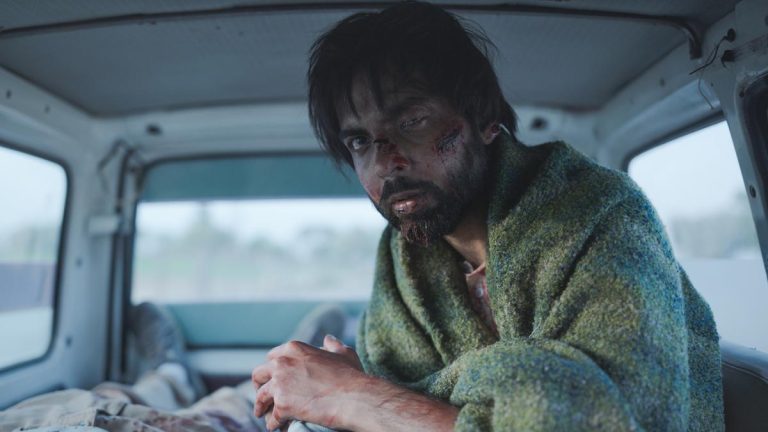
There are other survivors, and the city has been sectioned off. Security is tight and terrifying. Soon, John’s group loses several members. But he does have his wife, child, and Dr. Amina also remains. They are headed for the place of Allison’s family member, Mackenzie, whom she hasn’t seen in several years. They face the wrath of radiation storms and meet Obi, who takes them in his van. Sadly, he doesn’t survive, knocked out by the storm as he’s trying to clutch onto his car. John cautions him against it, but Obi doesn’t heed, insisting the car is everything to him and ends up being killed.
Who joins John’s family on the mission?
After the tragedy, the four manage to reach Mackenzie’s place, where she shelters and looks after a bunch of old Alzheimer’s patients. It’s at this place that John confides in Allison that he’s been developing symptoms of radiation sickness, and he worries he’ll die soon. So, he must do something for Nathan. John is buoyed by Amina’s confidence and reassurance that they must go to the crater.
A scientific theory posits that new life will spring at the site, the renewal of civilisation. It’s this belief that drives John to think up a scheme going forward, where his family can carve out a safer future. However, there are still ample hurdles, roadblocks, and quandaries to face and battle out.
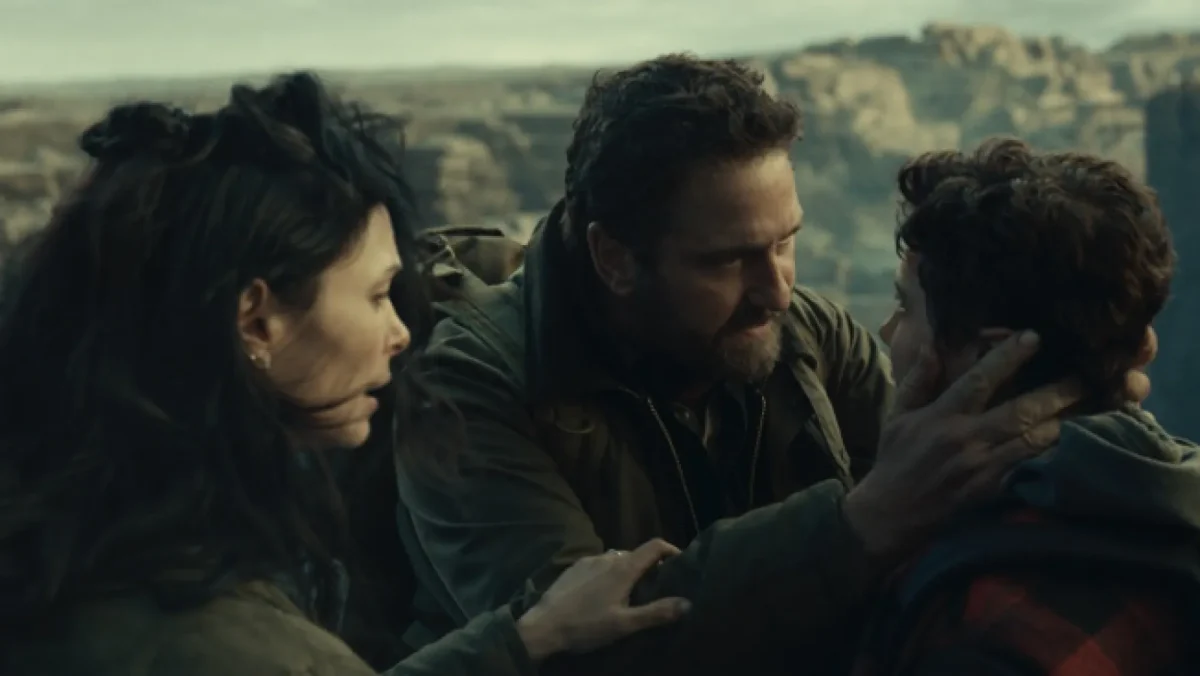
Shortly after leaving Mackenzie’s house, the four come under heavy fire. Ultimately, Amina gets hit and dies on the spot. The three miraculously survive and endure treacherous hikes, crossing a dangerous, threadbare bridge. Nathan keeps baulking, but John pushes and goads him. The latter is insistent on his son pushing through no matter the steep adversity.
The odds are stacked high, but the father is intent on taking his family to safer shores. Fortunately, they come under the protection of Denis, who takes them in. He has military connections, which will help John in his pursuit. But he also makes John take his daughter, Camille. Denis’ wife is paralytic and hence would need his care.
Greenland 2: Migration (2026) Movie Ending Explained:
Does John’s family reach the crater?
John departs with his family and Camille, who parts tearily but understands this is the pragmatic path. Denis has given them a contact in the army who can guide them to the crater, basically guaranteeing safe passage. However, when they do reach the army camp, it turns out the contact person is dead. The kindness of another soldier enables John to let his family through. The four proceed once again under heavy firing from the enemy side. It’s a contested zone they are passing through. Fate has favoured them time and again. But it turns out it does have a few shocks up its sleeve.
However, John gets hit, and his symptoms exacerbate. The ending is sentimental as John dies, but he encourages Nathan to build a safer future. There’s flourishing greenery, fecundity, and the bright, dazzling promise of a civilisation getting back on its feet. Nathan and Camille will be a part of that, as John hopes. The decisively optimistic ending of the sequel will have to take stock of the huge work that the forthcoming generations need to take on. Nevertheless, it reposes full faith in them to execute it and bring humanity to greater heights.