Few Netflix originals have captured the strange, suffocating tension of a real-world hostage crisis like iHostage, the 2025 Dutch thriller that quietly became one of the platform’s most-watched international releases of the year. Based on the true 2022 hostage situation at an Apple Store in central Amsterdam, the film is brutal, economical, and — depending on which critic you ask — either one of the year’s most underrated thrillers or a glossy retelling that softens the rough edges of the real event. For a full breakdown of the film, plus where to stream it if it isn’t showing on your region’s Netflix library, you can click here and we’ll cover everything below.
In Short
Short on time? Here’s the essential breakdown:
- iHostage is a 2025 Dutch-language Netflix thriller directed by Bobby Boermans.
- It’s based on a true story: the February 22, 2022 hostage crisis at the Apple Store on Amsterdam’s Leidseplein square.
- The film stars Admir Šehović as the hostage and Soufiane Moussouli as the gunman, with a strong supporting cast.
- Runtime: 100 minutes. Released globally on April 18, 2025.
- It’s a tight, real-time-feeling thriller — closer in DNA to Captain Phillips and 15 Minutes of War than to a typical Netflix Euro-thriller.
- The real incident ended with the hostage escaping unharmed after nearly five hours; the gunman was hit by a police car and later died in hospital.
- Reception: mixed but mostly positive — critics praise the tension and lead performances; some find the film’s “hero” framing too clean.
Now let’s dig into everything.
What is iHostage About? The Plot, Without Spoilers
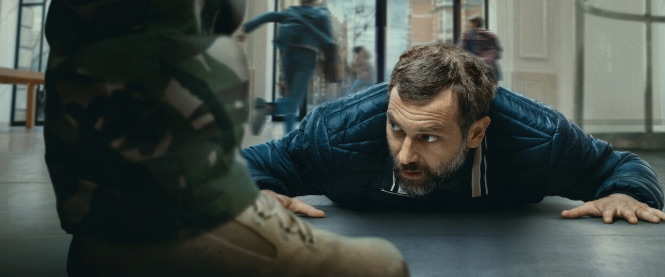
The premise is brutally simple. Ilian Petrov (Admir Šehović), a Bulgarian man working temporarily in Amsterdam, walks into the Leidseplein Apple Store to buy a new pair of AirPods. Wrong store, wrong time. Within minutes, a masked man in camouflage (Soufiane Moussouli) bursts in, fires a warning shot, and takes Ilian hostage. He demands €200 million in cryptocurrency and a vehicle for safe passage.
The film then unspools the next five hours from three intercut perspectives: the hostage trying to keep himself alive, the gunman spiraling under pressure, and the police outside attempting to negotiate while figuring out whether he has explosives strapped to his body. (He does — or appears to.) Dozens of other people are trapped inside the Apple Store and the floors above it, hiding in cupboards, behind counters, listening to every shot fired.
Bobby Boermans, who lives near the store and walked past it the morning after the real incident, shoots the film with a controlled, almost claustrophobic energy. There are no flashbacks, no romantic subplots, no exposition dumps. You’re in the store for the duration, and the film trusts you to feel that.
The True Story Behind iHostage
This is where iHostage gets genuinely unsettling — almost every key beat in the film actually happened.
What happened on February 22, 2022
At approximately 5:30 PM local time, a 27-year-old Amsterdam resident named Abdel Rahman Akkad (renamed Ammar Ajar in the film) walked into the Apple Store on Leidseplein wearing camouflage and carrying two firearms. He fired warning shots, sending dozens of customers and staff fleeing. Four employees hid in a cupboard. Others on the upper floors of the building — which housed offices and apartments — were trapped, unable to leave.
Akkad seized only one hostage: a 44-year-old Bulgarian man whose name was never publicly released by authorities. The two would remain together for nearly five hours.
The demands
Throughout the standoff, Akkad communicated with police and with Dutch broadcaster AT5, to whom he sent photographs that appeared to show explosives strapped to his torso. (Police later confirmed the explosives were real but not ready to detonate.) His demand was startlingly specific: €200 million in cryptocurrency and a vehicle to leave the country.
The number was, in retrospect, absurd. No European hostage negotiator in modern history has paid out a fraction of that. But the cryptocurrency framing — rather than cash — gave the demand a peculiar 2020s flavor that the film leans into hard.
How it ended
After roughly five hours, Akkad asked police to bring him water. They complied. When the door opened, the Bulgarian hostage saw his chance and ran. He sprinted out of the store into Leidseplein square. Akkad chased him, gun in hand. Within seconds, a police vehicle drove directly into Akkad, intentionally striking him. He was taken to hospital with severe injuries and died the following day.
The hostage was unharmed. Amsterdam police chief Frank Paauw later described him as having “played a heroic role by forcing a breakthrough” in the standoff. Approximately 70 people in total were freed from the building over the course of the night.
What’s true and what’s fictionalized
Director Bobby Boermans and screenwriter Simon de Waal (himself a former Amsterdam homicide detective) worked with officers who were on scene to keep the broad shape of events accurate. According to Boermans in interviews with TIME, certain elements were dramatized — particularly internal dialogues and the emotional arcs of side characters — but the macro events, timeline, demands, and resolution all match the real record.
The Bulgarian hostage himself has remained anonymous, which means the character of Ilian Petrov is built more from inference than testimony. Some critics have argued this gives the film license to glamorize a man whose actual experience may have been less narratively neat. Others argue it’s a respectful choice — protecting the privacy of a man who didn’t ask to become public property.
The Cast: Who Stars in iHostage
The film is performance-driven, with two leads carrying nearly the entire runtime.
Admir Šehović as Ilian Petrov (the hostage) — Šehović is Bosnian-born and gives what might be the year’s most physically restrained performance. Most of his work is in his eyes; he barely speaks for long stretches. The film lives or dies on whether you believe him as an ordinary man making impossible split-second decisions, and you do.
Soufiane Moussouli as the gunman (Ammar Ajar) — Moussouli has the harder job: making a character whose motivations are never fully explained feel three-dimensional rather than a movie-of-the-week villain. He largely succeeds, especially in the quieter moments where the gunman’s bravado cracks.
The supporting cast is deep with familiar Dutch faces:
- Loes Haverkort as a senior police negotiator
- Marcel Hensema as the operational commander
- Emmanuel Ohene Boafo in a critical role inside the store
- Matteo van der Grijn (recognizable to international viewers from Ted Lasso and Tribes of Europa)
- Fockeline Ouwerkerk, Robin Boissevain (Netflix’s Ares), Louis Talpe, Eric Corton, and Jasmine Sendar round out the ensemble
It’s a who’s-who of contemporary Dutch screen acting, and the film benefits enormously from a cast that brings real gravitas to even the smallest roles.
iHostage Review: Is It Actually Good?
Honest answer: mostly yes, with caveats.
What works
The pacing is the star. At a tight 100 minutes, the film never lingers. Boermans clearly studied how thrillers like Captain Phillips and A Most Wanted Man used confined geography to build pressure, and he applies those lessons effectively. The Apple Store itself — minimalist, brightly lit, surrounded by glass — becomes its own character. Every camera angle reminds you that there’s nowhere to hide.
The lead performances are excellent. Šehović and Moussouli share genuine chemistry as captive and captor, and the film smartly resists the temptation to make them friends or moral equals. They’re two men trapped in the same emergency, neither understanding the other.
The procedural detail is sharp. De Waal’s police background gives the negotiation scenes a credibility that most movie hostage standoffs lack — the rhythms feel real, the tactical decisions feel earned.
What doesn’t fully work
The film does veer into what one critic called “hero-story” territory, giving brief heroic beats to side characters who in real life played split-second roles. It’s a small criticism but a fair one — some moments feel like the film is reaching to ensure no one watching feels like a passive victim. The real-world chaos of a hostage situation is messier than that.
There’s also a thoughtful critique from publications like In Review Online that the film leans into post-9/11 thriller conventions in ways that flatten the gunman into a familiar archetype. The motivations in the real case were never fully clarified by authorities, and the film perhaps over-fills that vacuum with cinematic shorthand.
Critical reception summary
Across major outlets, iHostage landed in the 6.5–8 out of 10 range — solidly above average, well below masterpiece. IMDb scores hover around 5.7/10 from general audiences, suggesting the film plays better with critics primed to evaluate craft than with casual viewers expecting Netflix-style escapism. The Reel Bits called it “a minor outing… painted with a splash of true-life terror.” What’s on Netflix called it “worth a watch for true crime fans.” Time magazine ran a full long-form piece on it. It’s the kind of film critics respect and audiences either deeply engage with or quietly forget about.
iHostage Ending Explained
Spoiler territory below.
The film’s final act stays remarkably faithful to what really happened. After roughly five hours of negotiation, Ilian is given a chance to escape when the gunman requests water from the police. Water is delivered to the door. Ilian sees an opening — a half-second of distraction — and bolts for the exit, sprinting across the square.
The gunman gives chase, gun raised, fully prepared to shoot him in the back. He runs out of the building into Leidseplein. A police vehicle then deliberately drives into him, striking him at speed. The gunman collapses to the pavement; a police robot examines him for explosives. He survives the impact but is critically injured.
The film ends with the hostage being walked away by paramedics — alive, in shock, but free. A title card notes that the real gunman died in hospital the following day. The hostage was never publicly named at his own request.
Why the ending matters
The “ending” of iHostage isn’t a twist or a reveal — it’s the moral question of what we do with stories that don’t have clean villains or clean heroes. The Bulgarian hostage saved his own life with a split-second decision. The Amsterdam police prevented a catastrophe but also killed a man who, for all his explosives and demands, never actually shot anyone fatally inside the store. The gunman’s motives were never explained.
iHostage doesn’t pretend to have those answers. It just shows you what happened, in the order it happened, and lets you make of it what you will. That restraint is what elevates it above standard Netflix-thriller fare — even when the film stumbles in other places.
Where to Watch iHostage
iHostage is a Netflix original, which means it’s available globally — in theory — on the Netflix platform from April 18, 2025. In practice, regional Netflix libraries vary, and some viewers may find the film unlisted in their country. If iHostage isn’t appearing in your local Netflix library, you can click here for a guide to international streaming access and similar Dutch thrillers worth watching alongside it.
For viewers who enjoyed iHostage, the strongest companion watches are:
- The Golden Hour (2022, Netflix) — also by Boermans and de Waal, fictional but with the same procedural texture
- Ferry and Ferry: The Series (Netflix) — Dutch crime drama, character-driven
- The Forgotten Battle (2020, Netflix) — historical Dutch war film, broader scope
- Captain Phillips (2013) — the obvious American DNA influence, still the gold standard of “real-event hostage cinema”
- A Most Wanted Man (2014) — for those who want a cerebral cousin
Final Verdict
iHostage is the kind of film that proves Netflix’s international slate is doing something genuinely worthwhile when it gets out of its own way. It’s not a masterpiece — but it doesn’t try to be. It’s a well-crafted, performance-driven, 100-minute thriller about a real event that the Netherlands hasn’t quite finished processing yet, made by a director who lived a few blocks away and wanted to tell the story honestly.
For viewers interested in true-crime adaptations, Dutch cinema, or simply tight thrillers that respect their audience’s intelligence, iHostage is firmly in the “worth your evening” category. Just don’t expect it to give you the closure that the real event itself refused to provide.