“Night Stage” (“Ato Noturno”) is a Brazilian erotic thriller directed by Marcio Reolon and Filipe Matzembacher. The film traces a clandestine relationship between an actor and a politician. As their story unfolds, the two develop a shared inclination for sexual encounters in public spaces — the closer they move towards their ambitions of fame, the more seductive the pull of risk becomes.
As both creative and romantic partners, Reolon and Matzembacher have long engaged with queer subjectivities, frequently exploring sexuality through bold and sensorial visual strategies. Here, they weave elements of thriller and crime into the narrative, intensifying an atmosphere of tension and unease at the volatile threshold of transgression and taboo, while nodding to filmmakers such as Brian De Palma and Paul Verhoeven. The film also recalls the work of Alain Guiraudie, particularly “Stranger by the Lake” and “Staying Vertical.”
“Night Stage” had its world premiere at the 75th Berlin International Film Festival in February 2025, followed by its UK premiere at BFI Flare in March 2025. The film is scheduled for theatrical release in the UK on 3 April 2026, distributed by Peccadillo Pictures, with international sales handled by M-Appeal.
Rino: I was deeply drawn to this story when I first saw its synopsis. I felt it was both very wild and also very bold. So I wonder what inspired you to write this story in the first place. For me, something that feels especially exciting is this mixture of danger and desire.
Filipe Matzembacher: For us, that was indeed something very exciting to work with. This idea of combining danger and desire is central, and I think all of our films, in different ways, deal with this kind of duality — between danger and desire, between the public and the private.
This duality creates the possibility to build a strong and compelling atmosphere, something visually and emotionally interesting. At the same time, it gives the actors a lot of range, allowing them to explore their characters in depth. It opens space for them to play, especially through improvisation within the characters. So this dynamic was something we were very interested in developing and working with throughout the film.
Rino: How did you find the actors?
Marcio Reolon: We started with an open casting call, and we received almost 1,000 applications. We went through all of them, although of course we focused more closely on those we felt had real potential to be strong candidates. Then we conducted interviews and moved into a long selection process with auditions.
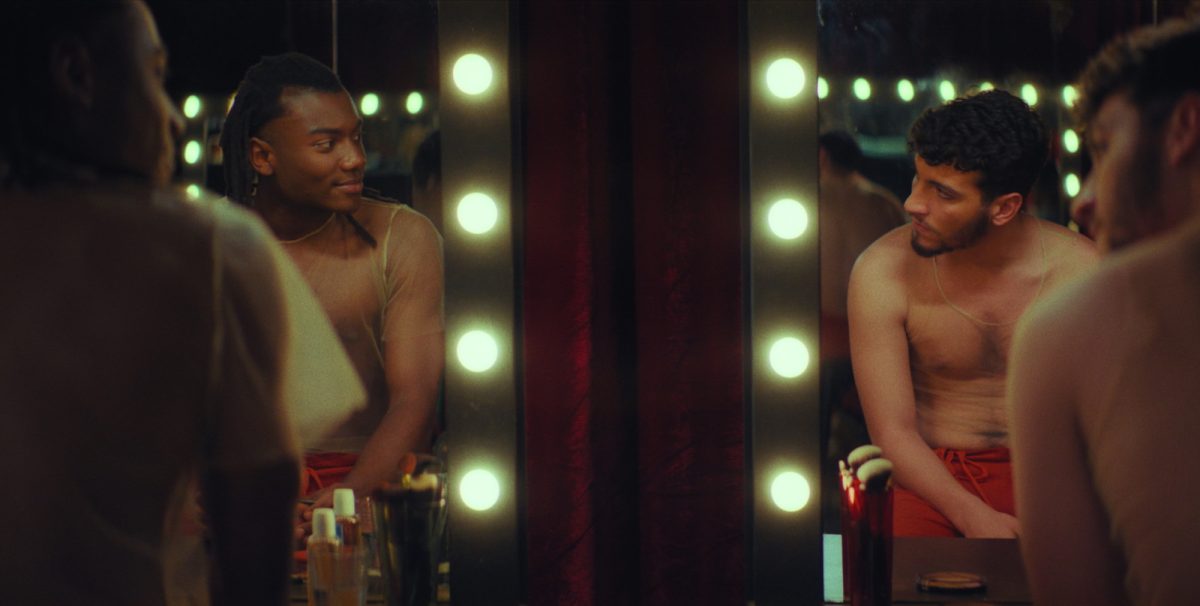
Eventually, we auditioned Gabriel, who plays Matias. We really liked his work, but more than that, we felt we connected with him — intellectually and artistically. There was a strong sense of alignment, and we felt he could really understand the character. That’s why we thought he would be the perfect match for Matias.
As for Cirillo, who plays Rafael, he was recommended to us by a friend who is a casting director. Gabriel, interestingly, had never worked on camera before — this was his first on-screen role. He comes from the theatre. Cirillo, on the other hand, has a background in television. He has done soap operas and even played leading roles in popular productions. However, this was also his first experience working in a cinema.
Filipe Matzembacher: And among the four main characters, only Gabriel is from our hometown.
Rino: That’s interesting to know, because I noticed that Gabriel’s character is also a stage actor within the film. So I wondered whether that had something to do with his own background.
Marcio Reolon: Not really. The character was already written that way. But it turned out to be a very good match, because he naturally understood how stage performance works. So even though it wasn’t intentional casting in that sense, it added something very nice to the role. He already had that embodied knowledge of theatrical performance, which translated well into the film.
More broadly, it was very important for us that all the actors were open to using their bodies in their performances. This is a very physical film. There are choreographed movements, sex scenes, and scenes of violence, so the body is always present. Because of that, we needed actors who were willing and comfortable engaging physically with the material.
Rino: There are many violent scenes, as well as very intimate ones, in the film. How did you negotiate and coordinate these moments with the actors, especially in terms of intimacy?
Marcio Reolon: From the very beginning, we try to be extremely honest and transparent. In our first meetings with the actors, we clearly explain what we expect the final result to be and how we intend to achieve it.
At the same time, we listen carefully to their responses — how they feel about it, what their limits are. We aim to create a long rehearsal and preparation process, where trust and confidence can be built gradually. Through that process, we construct these scenes together. It’s very much a collaborative approach.
Filipe Matzembacher: Yes, and during this process, we also give the actors tools that make these sequences easier to perform. By the time we actually shoot these scenes, they are already very familiar with their own bodies, with the bodies of their co-actors, and with the crew. The scenes are carefully choreographed, whether they are sex scenes, fight scenes, or even death scenes. So the actors know exactly what they need to do. This preparation allows them to focus on creating the moment, rather than worrying about the mechanics of it.
In fact, these scenes often end up being the least difficult to shoot. As Marcio mentioned, we are very direct from the beginning. We share references and say, “This is what we want to do, what do you think?” The actors are usually very engaged. They respond with enthusiasm, saying, “This is a great idea, I want to be part of this.” For us, that sense of shared creation is very important. The film comes from our ideas and sensibilities, but it must also be something the actors feel represented in.
Rino: Some of the scenes were particularly striking for me. For example, scenes of sex in public spaces, like in a pub or a parking lot, or the moment in the office where an erection is shown through a video call. How did you approach creating those moments?
Filipe Matzembacher: For us, it was actually very fun to work with those elements. I really enjoy watching the audience’s reaction to these scenes. You can see that people are both laughing and feeling tense at the same time. They become very engaged. The screenings we’ve had so far have been beautiful in that sense. You can really feel the audience responding to the film.
Marcio Reolon: During the writing process, we were constantly thinking about how far the characters could go. We kept asking ourselves: how can they take one step further, and then another step further? How can they become more daring, more bold, more dangerous, more risky? There is a progression, almost like a scale, that builds throughout the film. And this escalation culminates in the final climax, where the characters reach a point of maximum exposure. Everything they have been moving toward finally comes together at that moment.
Rino: While watching, I felt that the film is exploring the limits of sexuality and emotional boundaries, while politics and sexuality are deeply interconnected. Rafael, for instance, has a kind of dual identity. On the one hand, he is a politician who must exist in the public sphere, especially in relation to elections and visibility. On the other hand, he is a closeted gay man who is drawn to public sexual encounters.
Everything he does feels like it is on the edge of danger — there is always the risk of being exposed. This creates a strong emotional tension, where the audience experiences constant highs and lows, almost like being on a roller coaster. So my question is: how do you think about this dialectical relationship between the public and the private, or between openness and secrecy, in these characters?
Filipe Matzembacher: I think this connects to two main aspects.
First, on an aesthetic level, it was very exciting to create this constant sense of performance. During the day, he performs as a politician. At night, he is also performing, but in a different context, one that is not entirely private. We explored this idea through choreography, blocking, and staging. It was a way of constructing an image of continuous performance.
At the same time, we were interested in questioning how society imposes norms and expectations. People are often required to suppress parts of themselves in order to reach a certain level of success. But this suppression creates a sense of emptiness. For us, the idea of sex in public spaces becomes a response to that repression. It is a way of pushing back against it, of resisting that imposed control.
That’s why, in the end, we see the film as optimistic. Even though the final image is very strong, the characters are making a conscious decision. They decide not to suppress who they are anymore, and not to live according to societal expectations.
Rino: Would you say that their actions are a form of resistance against social norms? Since you mentioned the patriarchal structure of society, are these characters expressing that through their actions?
Filipe Matzembacher: Yes, I think so. For me, this idea of seeking these encounters outside of conventional spaces is an instinctive response. It’s a way of reconnecting with their original desires. And there is something very beautiful in that. At the same time, these are characters who love the spotlight. If you want to be a politician or an actor, you have to enjoy being seen — you have to love the stage. That aspect doesn’t disappear in their private lives. Even there, they continue to perform in some way. This overlap between public performance and private desire was something very interesting for us in shaping these characters.
Rino: Towards the end of the film, there is a moment where they imagine a future — perhaps in ten or twenty years — where they no longer have to hide. It feels quite romantic. Is there a sense of hope that you are trying to convey?
Filipe Matzembacher: I think whether a film feels tragic or optimistic depends very much on where you choose to end it. If the film ended with Rafael’s monologue, where he suggests that by making compromises now, they might achieve freedom in the future, then it would be a tragedy. Because that idea is not true. Once they are no longer useful or profitable, they would simply be discarded. So when they articulate that idea, they also realize that they must do the opposite. That realization leads to their decision, which becomes a way of freeing themselves from these imposed roles.
Rino: So in that sense, it still feels quite realistic?
Marcio Reolon: I wouldn’t describe it as realistic. But I would say that the ending is definitely optimistic. It is the first moment in the film where their desire is no longer suppressed by their expectations of professional success. They reach a point where they decide: we are not going to continue like this. We are not going to suffocate our desires anymore. In a way, they give up the careers they have been building throughout the film in order to finally achieve a sense of freedom.
Filipe Matzembacher: We are very drawn to films in which characters don’t necessarily get what they think they want, but instead get what they truly need. And what they need, in this case, is to understand that they should not minimize who they are. That realization is what defines the ending. And in that sense, we see it as an optimistic conclusion.