It’s been almost three decades now. Film and Television in India have gone through a turbulent metamorphosis. Stylistics have changed. For instance, you pick an image from a 90’s Doordarshan soap and compare it with an image from a contemporary show. There’ll be striking differences. In contrast with the polished contemporary imagery, the grainy older images might lose their charm.
Amidst this, one transition after another, a coterie of actors has remained the only constant, and Kumud Mishra certainly belongs to that cohort. A National School of Drama graduate, Kumud came to Mumbai inspired by pundit Satyadev Dubey and began his career through Doordarshan. As years passed, Mishra gained a fanbase who loved his commanding Hindi vocabulary fused with a soft yet steady oration.
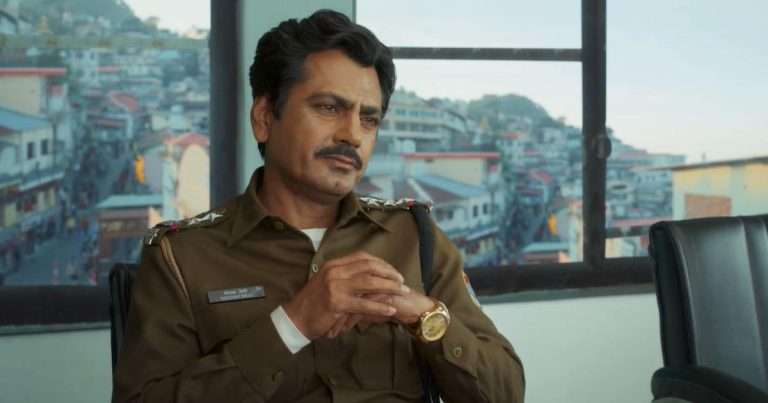
Now it’s been a few years since Kumud started his tryst with negative characters, and after playing “Ambika Prasad” in Anurag Kashyap’s “Nishanchi,” he must be receiving a great many offers to play anti-hero characters, as we have witnessed his brilliance in the Kashyap duology. His latest engagement is a show called “Satrangi: Badle Ka Khel,” where he played the character of “Sona Singh,” a U.P.-based upper-caste politician.
The show delves deep into the caste-hierarchy-ridden political ecosystem of U.P., where strongmen say the last words and the marginals often earn their bread through “Launda Nach” (a U.P.-based tradition of dance where men, in a woman’s attire, dance to beats created by small hand drums and cheap saxophones). A few days back, I sat with Kumud Mishra to discuss his character in this show, his journey as an actor, and his tastes in cinema. Below is my conversation with him – one of the humblest gentlemen I have ever met, and I hope you enjoy the conversation.
Soumalya: How’re you, Kumud?
Kumud Mishra: I’m great!
Soumalya: Cool. Let’s get started with our conversation.
Kumud Mishra: Yes.
Soumalya: First of all, I would say I really appreciated your performance in “Satrangi: Badle Ka Khel” as “Sona Singh.” Would you tell me how you approach a character? I mean, let me be a little precise… I’m not asking particularly about your approach for this character, but generally, how do you prepare for a character when somebody offers you to do one? I’m really curious to know.
Kumud Mishra: The crux of approaching a character is its script, then there are many factors such as the vision of the director, the cinematographer… so there’s no such general way of approaching a character. So, when you’re approaching a character, you’re operating in a particular space, and the space gets affected by the entire crew team, and thus, it also affects you… I mean, it should. So initially you prepare alone, but then the team comes, and you need to coordinate with the team. If you fail to coordinate with the team and try to impose your individual vision, then the entire process fails. But it is also true that there might be contradictions between your imagination and the director’s vision, so the only way to get it done is by understanding the factors at work and the situation… so the process is dialectical.
Soumalya: I understand. So, when you play a character like “Sona Singh,” which I find has been written in a very realistic way, you have a lot of references available in society… I mean, Sona Singh is the typical upper-caste U.P.-based politician, and we read about the likes of him every day in the newspapers. So, when playing such a character, do you study the examples available around you? Like… how do they talk? How do they react to something? their body language…
Kumud Mishra: I would say it’s a much bigger process than what you’re saying. While living our lives, we come across many different kinds of people. If you’re aware and conscious enough, then you will be observing them, and it remains in your subconscious. Then, when the time comes, it pops up in your mind, and you blend your skills and experience with it. Hence, the process doesn’t take place in your consciousness entirely and cannot be articulated properly. So, I can’t say that I studied a particular individual, but since I lived in this belt of India, I have some memories and knowledge (not very deep though) required to portray the character.
Soumalya: That’s really interesting.
Kumud Mishra: Yes, it is.
Soumalya: Kumud, I wanted to discuss another thing with you. I learnt somewhere that your first screen appearance was in a Doordarshan show called “Swabhiman,” where you played the character of a trade union activist. Correct me if I’m wrong, and would you let me know about your journey from NSD to Doordarshan? How were those days?
Kumud Mishra: I think it was “Zameen Asman,” which aired before “Swabhiman,” but they appeared almost at the same time. Those were the early days of my career, and I moved to Mumbai because of Pandit Satyadev Dubey and met Mahesh Bhatt there, who took me into the show. That was a great learning experience for me. I gained the first-hand technical experiences of an actor required on a film/television set, but now, when I look back on it, I find my performance embarrassing. But I would say again that it was a great learning experience because I was then shifting from theatre to cinema, and such experiences are very much needed for an actor who is going through such a transition. My identity as an actor in the new medium became clear to me through that show.
Soumalya: Kumud, could you name a few actors who inspired you in your formative years?
Kumud Mishra: How many names do you want? (chuckles) … if I have to take just one name, then I would say it’s Naseeruddin Shah, and apart from him, I’m very inspired by Alok Chatterjee and Dwaraka Prasad, whom I have seen on the stage. They were brilliant actors, and I have also been fortunate enough to work with Alok Chatterjee in Bhopal. Those Bhopal days were very important in shaping me as an actor, and that was a learning process through which I went and learned a lot from those stage actors who were really brilliant … I learned the nuances of the medium in those years … I also remember a few productions which were instrumental in shaping me such as Alakhnanda’s “Chanda Bedni,” Shyamanand Jalan’s “Kanyadan,” Fritz Bennewitz’s plays … the list is long.
Soumalya: Do you remember where you first met Naseer saab? Was it at NSD?
Kumud Mishra: Yes, yes. Absolutely … but I consider my first meeting with him actually happened when I was in the military school, when I first watched him in the cinema, and after that, my idea of an actor couldn’t go beyond him. Even though there have been, and even now there are, so many actors—my colleagues—who inspire me, but still, if I have to take one name, I could firmly take Naseer saab’s name.
Soumalya: So, Last Question! Before we end this, we always ask our guests about their five favorite films, but since we’re called “High on Films,” could you share some movies that you believe represent the cinematic high moments, where you feel cinema truly reached its peak? What films made you feel that way?
Kumud Mishra: That’s very difficult to answer, sahab! (chuckles) … I become uncomfortable with these questions because when someone asks me such questions, names stop popping up in my mind … but anyway, I would like to mention “Pather Panchali” (1955). I watched it for the first time when I was very young, and I thought what a terrific film I had seen, without understanding its true brilliance, because there was peer pressure.
If you don’t become a connoisseur of such films then your peers would consider you as a person lacking taste in art … and for years I kept talking about the film, and then after many years when I had done some work and started to understand the film medium I decided to watch it again … and when I watched it again I understood that all those years I was lying about the greatness of “Pather Panchali” because I didn’t understand the film in my first watch.
This happens with every classic … every time you watch them, they’ll come up with new meanings for you. Then I decided to rewatch Satyajit Ray, Ritwik Ghatak, and the other great Indian filmmakers … so the list is really long. Still, I would take the names of “Do Bigha Zameen” (1953), “Sparsh” (1980), “Masoom” (1983), then of course there is “Mughal-E-Azam” (1960). The list is endless. In contemporary times, Anurag Kashyap is a great filmmaker, I must say. “Black Friday” (2004) was a terrific film … sometimes I remember Om Puri’s performances … what a simple actor he was … a great actor needs to become only 10% of what Om Puri was, and he will be successful.
Soumalya: Do you remember where you watched “Pather Panchali” for the first time?
Kumud Mishra: I think it was in Bhopal when I had just passed out from school … it was in a festival and everyone around me was applauding, and I didn’t want to be left out, so I also praised the film (chuckles) … then I lived with that lie. Whenever in a discussion someone began talking about cinema, I would refer to “Pather Panchali,” and people would appreciate my wisdom for knowing about Satyajit Ray … you know, we live with such lies, and I also lived with it, but then when the true light of wisdom actually came, I felt really embarrassed (chuckles).
Soumalya: Ha Ha Ha … Thank you, sir. It was a pleasure talking to you, and I wish you all the very best for “Satrangi.”
Kumud Mishra: Thank you so much!