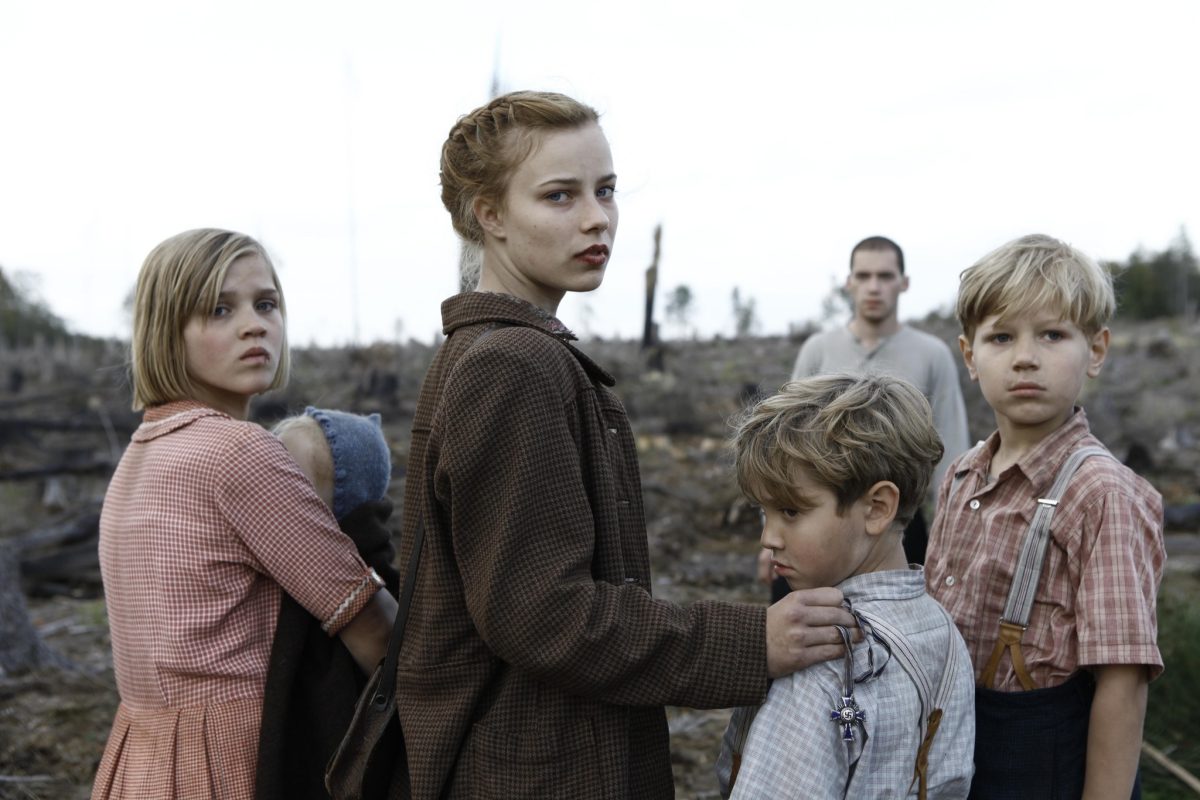
Directed by Cate Shortland, “Lore” (2012) asks what happens when a child raised inside a lie is suddenly forced to walk through the ruins of that lie. Lore is not introduced as cruel. She is young, intelligent, protective of her siblings, and deeply shaped by the world her parents built around her. But that world is tied to Nazism, hierarchy, obedience, and racial hatred. She has inherited beliefs before she has had the chance to examine them.
When Germany fell at the end of World War II, Lore and her siblings were abandoned by the very adults who taught them certainty. What follows is a journey across a broken country, but also through a broken identity. The real distance in this film is not 900 kilometers. It is the distance between ignorance and recognition.
Spoilers Ahead
Lore (2012) Plot Summary and Movie Synopsis:
What Happens When Lore’s Family World Suddenly Ends?
The film begins with the return of Lore’s father, a Nazi officer, as Germany is collapsing. His arrival does not feel warm or loving. It feels tense, hurried, and fearful. The family quickly packs, kills the dog, and retreats to a remote cabin in the woods. That detail matters. Even before the children fully understand it, the adults know the world they served is finished.
Their authority, privilege, and protection are gone. Yet instead of explaining anything honestly, they continue behaving as though discipline and control can survive reality. Lore’s mother soon realizes that she will be arrested. Rather than staying with her children, she leaves voluntarily for an internment camp.
Before going, she places Lore in charge and instructs her to take the younger children to their grandmother’s house in the north. It is a brutal moment because responsibility is handed to Lore without truth. Her mother gives her jewelry and money, but does not understand. She leaves Lore with practical tools, while withholding moral clarity. That is the first inheritance Lore receives: burden without wisdom.
What Do the Concentration Camp Photos Do to Lore?
Lore has likely grown up in comfort. She knows manners, status, and obedience. She does not know hunger, bargaining, public humiliation, or fear among strangers. Once the trains stop running, the children must walk. Their belongings become useless weight. Money loses meaning. Prestige disappears. Nobody cares whose daughter she is anymore.
This is one of the film’s sharpest ideas: ideology often feels powerful only while supported by institutions. Once those structures collapse, all that remains is the human being underneath. Lore struggles because she still believes the world should recognize her family’s importance. Instead, people see starving children tied to a disgraced regime. Some help them. Others exploit them. Many simply want distance.
For the first time, Lore experiences life without inherited protection. In one village, images of Nazi concentration camp atrocities are posted publicly. Lore studies them and recognizes her father in uniform. This is perhaps the most important emotional turning point in the film. Until now, her father has existed in memory as a figure of authority.
Suddenly, he appears inside evidence of horror. Lore cannot process it immediately. Children often defend the emotional architecture they were raised in, even when the truth appears directly in front of them. Accepting those images would mean accepting that her parents were not noble victims of defeat, but participants in cruelty. So she looks, but does not yet understand. That tension drives much of the film. Lore’s eyes keep seeing what her mind refuses to admit.
Who Does Thomas Disturb Lore So Deeply?
The children repeatedly encounter a young man calling himself Thomas, who carries Jewish identity papers and later joins their group. He becomes a protector, provider, negotiator, and practical guide. He also represents everything Lore was taught to despise. This creates the film’s most powerful contradiction. The person Lore’s ideology labels as inferior becomes the person keeping her family alive. Meanwhile, the parents who taught those beliefs have abandoned her.
Thomas unsettles Lore, exposing the emptiness of inherited hatred. He is resourceful, calm, observant, and often kinder than she expects. He does not fit the monstrous image she was given. Attraction also begins to complicate her hostility. Lore is reaching adulthood, and desire enters the same space as prejudice. She feels curiosity, dependence, resentment, and sexual tension all at once. She does not know whether she wants Thomas near her or far away. In truth, she wants both.
Why is Lore So Cruel and Drawn to Thomas at the Same Time?
Lore often behaves harshly toward Thomas, yet repeatedly seeks his presence. This contradiction is psychologically believable. When someone’s worldview is collapsing, they often attack the person revealing the collapse. Thomas becomes the living proof that Lore’s beliefs are false. Instead of thanking him, part of her resents him for forcing reality upon her.
At the same time, Thomas offers something she has lost: competence, steadiness, and attention. He treats her neither like royalty nor like a child. That creates intimacy, though neither fully trusts it. Their charged moments are messy rather than romantic. Lore sometimes uses sexuality as control, then recoils when real vulnerability appears. She wants power over feelings she cannot name. This is not love in a simple sense. It is a desire passing through shame, fear, ideology, and awakening.
What Does the River Scene Reveal About Lore?
When the group reaches a river they cannot cross, Lore approaches a fisherman for help. Instead, she allows his sexual advances partly to defy Thomas and partly to exercise some agency in a world where she has none. It is a painful scene because Lore mistakes self-endangerment for control. She has learned from the adult world around her that power often comes through domination and exchange.
Thomas kills the fisherman to stop the assault. Lore is shaken not only by the violence but by what it says about dependence. Again, Thomas intervenes when she cannot protect herself. After crossing, Lore nearly falls backward into the river with baby Peter in her arms. It feels like a moment of moral and emotional overload. She is carrying siblings, guilt, confusion, desire, and a disintegrating identity. Her body almost gives way under what her mind cannot hold. Thomas saves her again. Each rescue deepens the bond she resists.
Why Does Lore Insult Thomas Right Before Losing Him?
Later, while trying to cross into another sector, Lore’s brother, Günther, runs toward a figure in the dark, believing it is Thomas. Soviet soldiers shoot him. The tragedy lands hard because it is sudden and meaningless. Günther does not die heroically, but through confusion. That is fitting for a film about children paying for adult crimes they did not commit.
War’s aftermath does not end neatly when treaties are signed. It continues in frightened borders, armed suspicion, and children misreading shadows. For Lore, Günther’s death removes another layer of innocence. She can no longer imagine this journey as a temporary hardship before normal life returns.
There is no normal to return to. When Thomas considers leaving, Lore panics. In anger and desperation, she calls him a filthy Jew. The insult matters because it emerges not from strength, but fear. Under pressure, people often reach for the oldest language they know. Lore uses inherited hatred precisely when she feels abandoned. Yet the moment also reveals change. She breaks down afterward. The slur no longer feels natural or righteous. It feels ugly, desperate, and insufficient. Thomas sees that complexity. He understands she is both repeating poison and struggling against it. He stays a little longer.
Lore (2012) Movie Ending Explained:
What Happens at Grandmother’s House?
On the train, soldiers demand papers. Thomas has lost his wallet. Without identification, remaining aboard is dangerous. He quietly passes Lore, nudges her head in farewell, and steps away. It is one of the film’s most restrained emotional scenes. Thomas leaves because survival has taught him practicality.
He also leaves because Lore must continue without leaning on him. He cannot become her permanent bridge out of ignorance. Later, Jürgen reveals he stole the wallet so Thomas would not abandon them, and that the papers belonged to a real Jewish man named Thomas Weil. This means even Thomas’s identity was partly constructed for survival.
That revelation fits the film perfectly. In postwar chaos, names, loyalties, and appearances are unstable. The one person Lore thought she was beginning to know also contains mystery. But his moral impact on her is real, regardless of his name. The children finally reach their grandmother, Omi. Safety returns materially: food, shelter, routine.
But spiritually, nothing is repaired. Omi insists they should never be ashamed of their parents. This is the old Germany speaking through domestic politeness. Denial dressed as dignity. She scolds the children with the same authoritarian instincts that helped enable the past. Order matters more than truth. Manners matter more than grief. Lore now sees what she could not before. The household’s elegance is built on refusal.
Why Does Lore Destroy the Porcelain Figurines in the Ending?
In the final scenes, Lore grabs food without permission, spills milk, rejects table discipline, then goes upstairs and smashes the porcelain figurines one by one. These figurines matter because they symbolize inherited refinement, fragility, family tradition, and the decorative surface of a morally rotten world. They are beautiful objects protecting ugly truths.
By crushing them, Lore is not healing. She is becoming conscious. This is an angry awakening. She cannot restore the dead, undo ideology, or find Thomas. But she can reject the symbols of the lie that formed her. Literally, Lore survives the journey and reaches the family shelter. Emotionally, she arrives nowhere comfortable. Her parents are disgraced, one brother is dead, innocence is gone, and the values she inherited have collapsed. Yet that collapse is also the beginning of moral possibility.
The ending of “Lore” (2012) is not triumphant. It is painful, unresolved, and necessary. Lore suggests that growing up sometimes begins when certainty breaks. She does not become virtuous overnight, and remains confused, wounded, and implicated by inheritance. But she has started to see. Once someone truly sees, the old porcelain world cannot remain intact.