
It is somewhat surprising that writer and director Nick Butler did not cite David Lynch as an influence on “Lunar Sway” at its world premiere at the BFI Flare Festival in London. It is, in many ways, a spiritual successor to the late master’s enigmatic style of filmmaking. Butler has crafted a film that is at times elusive, at times opaque, and at times even frustrating. Yet, at its core lies a heartfelt exploration of a basic human longing for connection, charted through an absurdist coming-of-age tale.
Cliff (Noah Parker) is a young, bisexual artist who dreams of opening a gallery to display his neon-light sculptures. Unfortunately, he finds himself stuck in the nadir of so many aspiring creatives, a small-town community known as Mooncrest in Canada.
Cliff has fast become weary with his life there, has dissociated from his adoptive parents (played by Irina Dubova and Michael Dyson), and finds himself haunted both figuratively and literally by a past relationship with a bohemian painter (Kaden Connors). A smudged silhouette of the man keeps invading his dreams, as intimate paintings Cliff once posed for start appearing everywhere — in stores, on the walls, even on his dates.
However, when his birth mother, Marg (Liza Weil), tracks him down, a chance for a new life comes into play. Vagrant and socially-blunt, Marg is no maternal figure, and a cloud of suspicion hangs around her. But Cliff’s desire to change up his life and find new connections is strong enough for him to forge some kind of relationship with this would-be parent. However, when Marg’s past catches up to her in the form of an obsessive bounty hunter (Grace Glowicki), Cliff chooses to join her on the run for a life of swindling, even if she may not be telling him the whole truth.
That said, the mysteries that “Lunar Sway” untangles over a tight 98-minute runtime are not met with much importance and lead only to modest interventions in the narrative. Instead, the film prefers to meander from moment to moment with a listless quality that captures the aimlessness of Cliff’s early twenty-something life.
“Lunar Sway” is not designed to give clear answers, but rather to evoke and embrace a kaleidoscope of intangible feelings; feelings of isolation and disconnect, of aspiration and cynicism, of being lost and a longing to be found. Its concoction of absurdist moments and abstract imagery will be hard for many to grapple with, but there is something cathartic in allowing them to simply wash over you.
Butler has done excellent work supporting this through the film’s visuals. Barren deserts, vast crags, and unyielding mountains flag Mooncrest and its surroundings. Cliff wanders, dwarfed by this alien landscape, a lost soul not at home with the world around him. There is also a washed-out tint which lingers over the frame, even in the film’s more colourful moments, providing a sense of melancholia and coldness.
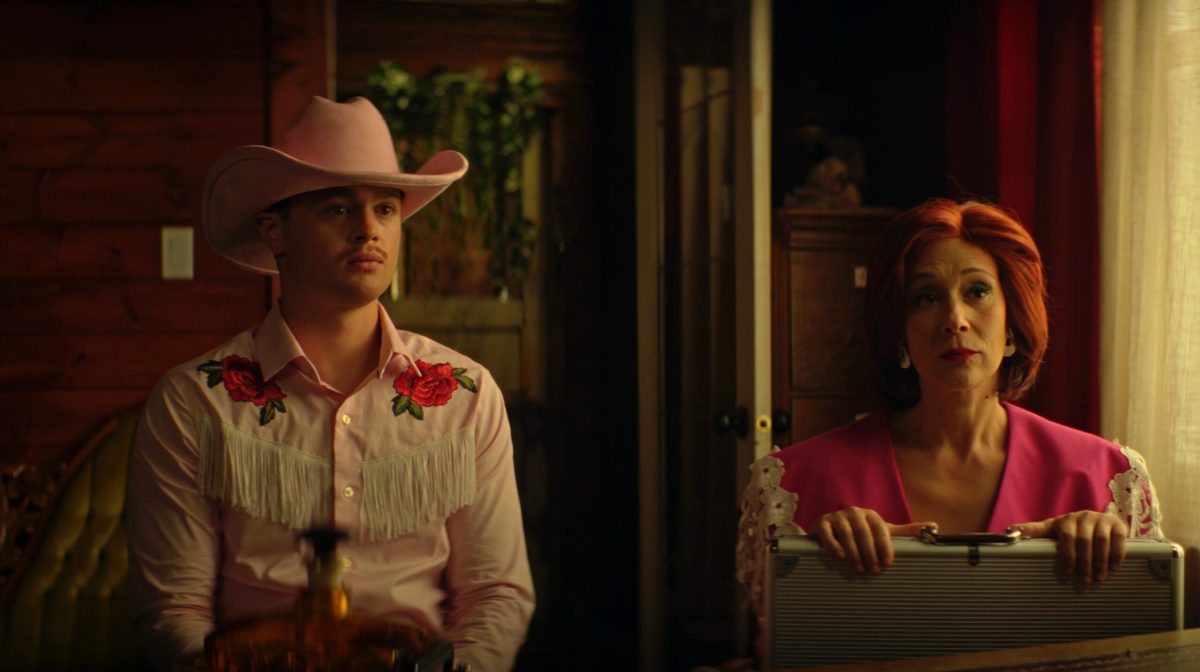
In a very Lynchian touch, Butler loads his film with surrealist Americana, most notably in a pair of pink-frilly Cowboy outfits that Cliff and Mar don as fake meteorite salesmen. It leads to some fabulous imagery and adds a layer of artificiality to a film that interrogates the authenticity of human relations.
Noah Parker also does admirable work in the lead role as he successfully balances Cliff’s confused and contradictory emotions, while cohering them into an identifiable whole. He is often charismatic and confident with a quick enough wit to hold his own. Yet at times he also appears meek and unworldly, someone out of his depth who leans so heavily on frontage.
In many ways, he embodies the modern-day Gen Z and millennial angst (In his most Gen Z move of all, Cliff even takes pills for his hair loss), offering up a scepticism that masks a wounded and bewildered core. This dynamic plays most enjoyably in Cliff’s interactions with his therapist (Andy Yu), involving some deadpan tête-à-têtes as each tries to outplay the other’s indifference.
Parker’s humanity, as Cliff also helps drive “Lunar Sway” past some of its more grating affectations. Butler displays a tendency to place importance on just about every single shot of his film, while also trying to wring out every last drop of symbolism he can. This leads to a near constant portent which proves fatiguing as we near the film’s end.
For example, an extended fantasy sequence which, amongst other things, involves Marg guiding Cliff towards a vagina-shaped hole is a heavy-handed signifier of their oedipal relationship. Cliff’s past relationship is also brought back to the fore for an emotional resolution that is too cloying.
Nonetheless, the film is laudable in how staunchly it remains committed to the abstract and the off-kilter, and how it remains steadfast in pursuing a singular vision. It is an admirable effort to capture widespread but ephemeral emotions and render them into an instinctive visual language.


![The Fabulous Filipino Brothers [2021] Review – A Personal Comedy That Fails To Hit The Right Spots](https://www.highonfilms.com/wp-content/uploads/2022/02/The-Fabulous-Filipino-Brothers-2021-768x432.jpg)


