
When I was at university, I was lucky to attend a talk given by a Holocaust survivor. It was a harrowing yet necessary talk, and a reminder that what we call history is within my grandparents’ lifetime. He had only been a child at the time, and what he had experienced still weighed on him and, in many ways, had defined his life. This weight and scars are the heavy subject matter “My Neighbor Adolf” (2022), the second feature film by director Leon Prudovsky, attempts to grapple with. However, except for a handful of moments, it feels utterly unequipped to do so.
The film opens somewhere in Eastern Europe in 1934, offering a brief glimpse of a peaceful family life that we know will soon be disrupted by tragedy. It is the film at its most sincere, the overlapping conversations and performances creating a believable feeling of familial love.
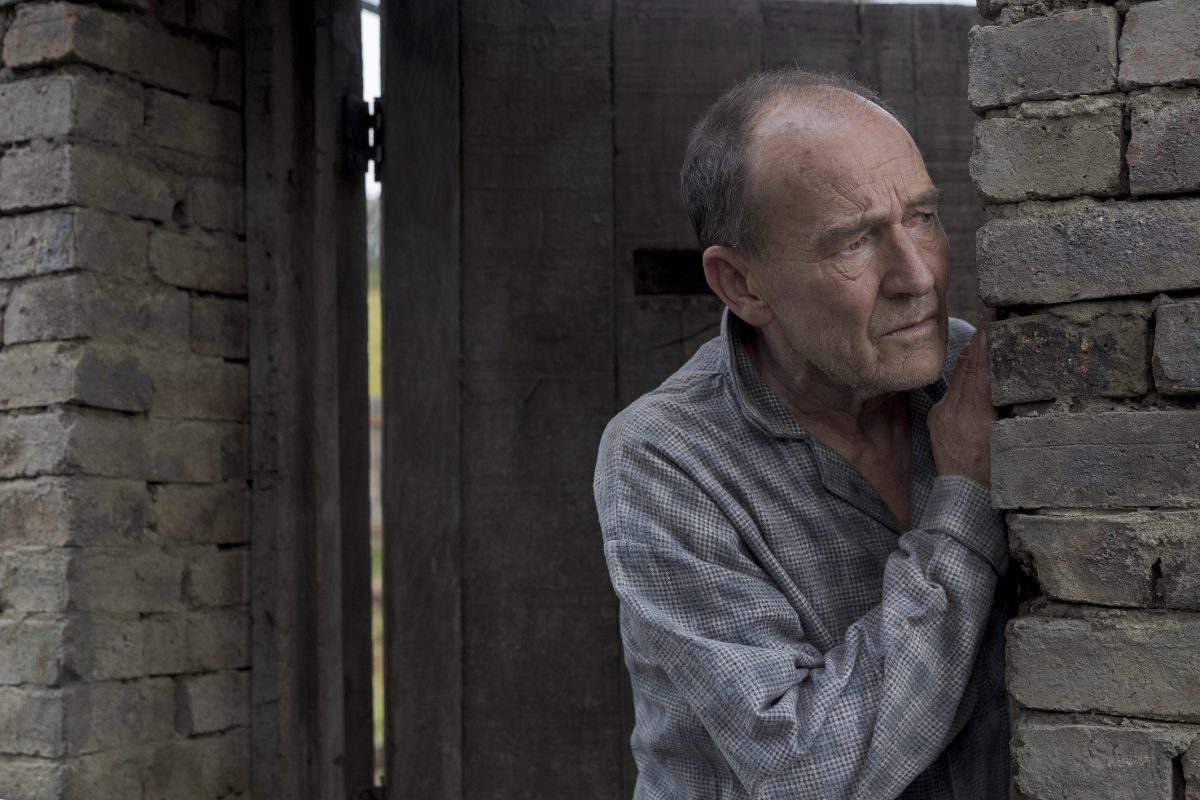
After that prologue, the film jumps to South America in 1960, where the Polsky family’s sole survivor, Marek (David Hayman), is an old man living in an isolated area. Hayman does a good job at conveying the scars the Holocaust has left, from moments of vulnerability when alone to his grumpy attitude toward anyone who tries to talk to him.
His discontented living is disrupted when the abandoned house next door is bought by a man moving from Buenos Aires, who at first keeps himself in the shadows and relies on his assistant, Frau Kaltenbrunner (Olivia Silhavy), to conduct business. But when the mysterious Mr Herzog (Udo Kier in one of his final roles) and Marek finally begin to interact, Marek becomes certain he is Adolf Hitler, alive and living in hiding.

What follows is neither a tense game of cat-and-mouse nor a comedy of unfortunate misunderstandings. There are dramatic moments, the highlight being Marek and Herzog’s first game of chess. There are also solid jokes and moments of fun physical comedy. And a painfully unfunny obsession with urine and testicles. The problem is that neither is meshed together well.
In any scene, it will either be a comedy or a drama, never both, which makes it seem uncertain in the direction it wants to go. The times it does appear to have an interesting direction to go, it moves on too quickly.
Much of the early second act unfolds as a procedural montage of Marek ticking off and striking through bits of evidence, slowly convincing himself that Herzog is Hitler. There’s a sketch of a character arc here, but it remains surface-level, gesturing at a man hollowed out by excess knowledge without ever truly inhabiting that damage.
At the same time, the film flinches from reckoning with the consequences of its characters’ choices, and whenever it gestures toward doing so, it rushes past the moment before it can land. This chronic hesitation is ultimately what causes the film to unravel. Even the central question — whether Herzog really is Hitler — is answered in an awkward in-between that functions neither as a satisfying twist nor as an idea given enough space to accrue thematic weight.
In terms of performances, Hayman and Kier are strong, but Leon Prudovsky and Dmitry Malinsky’s screenplay doesn’t give them much to work with. Their constant back and forth is meant to be the heart of the film, and there are solid moments there. But their rapport cannot carry the film to success. The rest of the cast has limited screentime, the third most important being Kaltenbrunner, but her main purpose seems to be a woman the old men objectify.
Kineret Peled’s unnamed intelligence officer faces a similar problem with the camera lingering on her breasts when examining Marek’s evidence. The intelligence officer and the performances of the rest of the embassy staff suggest they were cast for a different film than Hayman.
A case could be argued that’s intentional, as by the end, they’re more the antagonist than Herzog, demeaning and dismissing Marek and ignoring his pleas for help. However, they too often descend into melodrama and shouting that is neither dramatic nor particularly funny.
Visually, the film is competent, though it’s marked by a curious artificial sheen: what initially reads as an attempt to evoke nostalgic warmth in the opening scene reappears whenever the action moves into sunlight, flattening rather than enriching the image. There are flashes of strong camera work and a handful of genuinely striking compositions, but nothing that meaningfully pushes form forward, which may not have been the point in the first place.
More distracting are the baffling set-design lapses, most notably a visible copy of “Twilight: Eclipse” on Marek’s bookshelf. Given that the story is set in 1960 — forty-seven years before the book’s publication — the anachronism lands harder than any intentional joke the film manages to deliver.
The most frustrating aspect is that there was plenty of comedy and drama to be found in this film’s concept. Whilst it’s respectful of the loss Marek has experienced, it can’t turn it into a foundation for a compelling drama or dark comedy about how those events left scars that will never go away. “My Neighbor Adolf” ends on an optimistic note rather than a dour one, but by the time it arrives, the gesture feels hollow, far too late to redeem the film that precedes it.





![Linoleum [2022]: ‘SXSW’ Review – Jim Gaffigan, Rhea Seehorn Led Sci-Fi Film Is A Beautiful Looking Headscratcher](https://www.highonfilms.com/wp-content/uploads/2022/03/Linoleum-1-768x432.jpg)

![Heads and Tales [2021] ‘Zee5’ Review: An Average Tale of a confused addressal of a Serious subject](https://www.highonfilms.com/wp-content/uploads/2021/10/Heads-and-Tales-Zee5-Movie-Review-1-768x317.jpg)