There’s a dichotomy to “Pizza Movie” that would seem antithetical. While it has a whizzing, frantic style of humor that would immediately suggest that the filmmakers began in Internet-age short form comedy, the film borrows archetypes that have existed since the coming-of-age comedies of the ‘80s.
Nostalgic storytelling isn’t necessarily a bad thing when it’s not entirely based on references, but the cultural touchstones feel out-of-touch for a film that is supposedly about today’s youth, and frequently alludes to digital complications. There is, without a doubt, innovative filmmaking in “Pizza Movie,” but it’s infrequent that jokes are allowed to resonate before being run into the ground.
“Pizza Movie” is the story of the college roommates Jack (Gaten Matarazzo) and Montgomery (Sean Giambrone), both of whom have experienced significant embarrassments within their secondary education. Jack was involved in a prank at the expense of the school’s football team that cost them a victory, which subsequently caused the rest of the student population to despise him. Montgomery is socially awkward and can’t muster the confidence to talk to his crush, Ashley (Peyton Elizabeth Lee).
It’s after an evening in which they are both humiliated by the bully Logan (Marcus Scribner) and his cronies that Jack and Montgomery end up consuming a drug known as M.I.N.T.S., which they realize too late will give them more than a relaxing high. The hallucinogen has various nuanced side effects that can only be cured by eating pizza, but trying to order food in an incapacitated state has its complications.
Mismatched best friends are often the protagonists of stoner films, but “Pizza Movie” isn’t a goofball comedy in the vein of “Jay & Silent Bob Strike Back” or “Pineapple Express.” It’s tough to determine why exactly Jack and Montgomery are outsiders, other than the fact that they are just “weird.” The notion that they’d be targets simply because of social incapacities is lifted from an antiquated version of bullying that primarily existed in teen films of the ‘80s.
The issue is that these characters are in college. There would supposedly be more nuanced distinctions between different social classes and at least some signs of maturity. It would be one thing if “Pizza Movie” were riffing on these cliches, but there’s little that’s actually satirical about its familiarity.
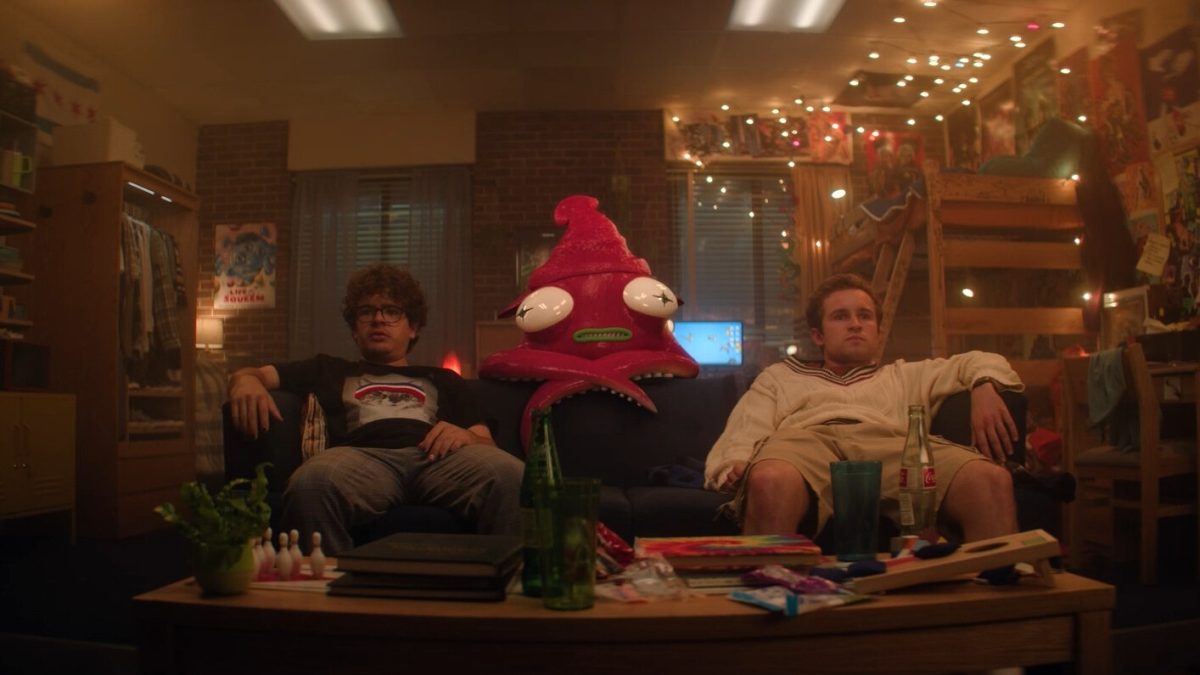
The other issue with the central dynamic is that there is an unclear sense of history. Jack and Montgomery are said to be best friends, but there’s no notion of how long they have been without each other, or when the friction between them first arose. Although they both seem inexperienced with the added responsibilities of college, they’ve both seemed to amass a reputation that would suggest they’ve been ingrained within the school culture for some time.
These may seem like nitpicks, but “Pizza Movie” feels like it was obviously intended to be set in high school, especially due to the main characters’ lack of experience with getting high. The decision to set the film in college may have been made to clean up logical loopholes, but it ends up raising more questions that make the leads harder to empathize with.
There are some fun jokes revolving around the effects that the drugs take, which are at least surreal enough to feel like more than standard stoner humor. The idea that taking the drug at the same time would give Jack and Montgomery some sort of shared consciousness does raise some logical questions, but the surreal nature of the visuals is enough to justify some of the weirder jokes.
However, there is a lack of a central goal that makes the plot feel aimless. The idea of hyperfixating on a menial task would be a lot funnier if “Pizza Movie” wasn’t pitched in an over-the-top register where a gang of ruthless bullies and an organized militia of RAs weren’t trying to hunt Jack and Montgomery down. Since the world of the film is established as being over-the-top, it’s less effective when the effects of the drugs kick in.
There’s enough evidence to suggest that filmmakers who originated as YouTube content creators can evolve into intelligent feature directors, with the Philippou brothers and David F. Sandberg being prime examples. However, what Brian McElhaney and Nick Kocher have is an aggressive style of sketch-based humor in which jokes are escalated, not modified.
It’s an approach that becomes exhausting because none of the humor is complex enough to merit the repetition, and the tension never feels tangible enough. Montgomery is in love with Ashley because the film says that he is, not because of any evidence of the pair’s chemistry. Similarly, Jack’s inability to fit in seems to be more of a personal problem, given that his behavior is highly obnoxious.
There’s no kind way to say that Matarazzo simply isn’t fit for the role, and makes a “likable underdog” part into a grating, high-wire buffoon. It’s not enough to suggest that the film is mocking Jack and empathizing with Montgomery, given that the characters are given an equal amount of screen time and development. Giambrone fares a lot better because there actually seems to be a path of self-discovery that Montgomery goes upon, specifically when he begins to reconnect with Lizzy (Lulu Wilson), a former friend who has now fallen in with the bullies.
The less said about the unnecessary, annoying performance by Caleb Hearon as a secondary antagonist, the better, but the film does have a hidden breakout star in Sarah Sherman. She plays Frankie, a former student at the same school who made a series of bizarre videos detailing her experiences with M.I.N.T.S. that Jack and Montgomery use as a guide. It feels taken out of a completely different film, but given the rest of “Pizza Movie,” it’s not a bad thing.
“Pizza Movie” caters to an Internet-savvy audience without distinguishing itself as a contemporary text, offering nothing that would approach emotional vulnerability. The excuse that it’s nothing but “so dumb it’s funny” escapism would only apply if there was any legitimate humor, and there isn’t anything so inventive that the narrative haphazardness can be forgiven. It’s perhaps fitting that “Pizza Movie” amounts to feeling like a bad trip.