Cédric Anger’s French-language series, “The Hunt” (Traqués, 2026), was expected to be released by the end of last year, but it got postponed due to plagiarism-related issues. A few months later, it is finally coming on Apple TV, now presented as an adaptation of Douglas Fairbairn’s 1973 novel, “Shoot.” Since the series takes place in present-day France, Anger makes some obvious changes to the story, introducing present-day political undercurrents and adding a few more layers to an already allegorical tale about a group of hunters. The allegory wouldn’t be lost on anyone who plans to watch it after reading its logline.
The show, first and foremost, is about a group of friends living in the rural suburbs who spend some of their free time hunting in the wilderness. None of them seems like the violent or murderous kinds, but they aren’t opposed to the idea of enjoying a good kill either. To them, hunting serves as a bonding ritual and perhaps an excuse to be away from their families.
On one such day, as they hope to enjoy hunting in a nearby woods, one of them gets grazed by a bullet. It happens out of nowhere and all of a sudden, which compels them to go on an immediate defense mode, much like their usual prey in that volatile space. So, in the heat of the moment, they end up shooting someone on the other side and killing him. After realizing the outcome of this escalation, they leave the crime scene immediately, planning not to say a word about it to anyone else. From that point onwards, the hunters get hunted on in some shape or form.
It’s certainly an interesting premise that can be milked till eternity. In part, it can also analyze the crooked power dynamic between the hunters and their hunt. In this case, both sides happen to include almost entirely middle-aged white men, which negates the aspect of race but invites discussion of class differences. The central protagonists belong to a bourgeois class, whereas their shooting opponents are working-class. One side sees hope in the future, while the other barely manages to make ends meet. Some of them consider violence as a necessity for survival, while others see it as a hobby in their thrillless lives.
Anger’s script revolves mainly around Franck’s (Benoît Magimel) family life to analyze the ripple effect of this unexpected tragedy. His usual life positions him more as a hero rather than an antihero, which makes his arc one of family men breaking bad out of unavoidable circumstances. So, it’s hard to dislike him right away, and even harder to dislike his wife, Dr. Krystel (Mélanie Laurent), even later, as she goes out of her way to help her patients, no matter the situation. The script gradually introduces cracks in Franck’s familial relationship to paint a more complicated portrait of this man, who seemingly wants what’s good for everyone.
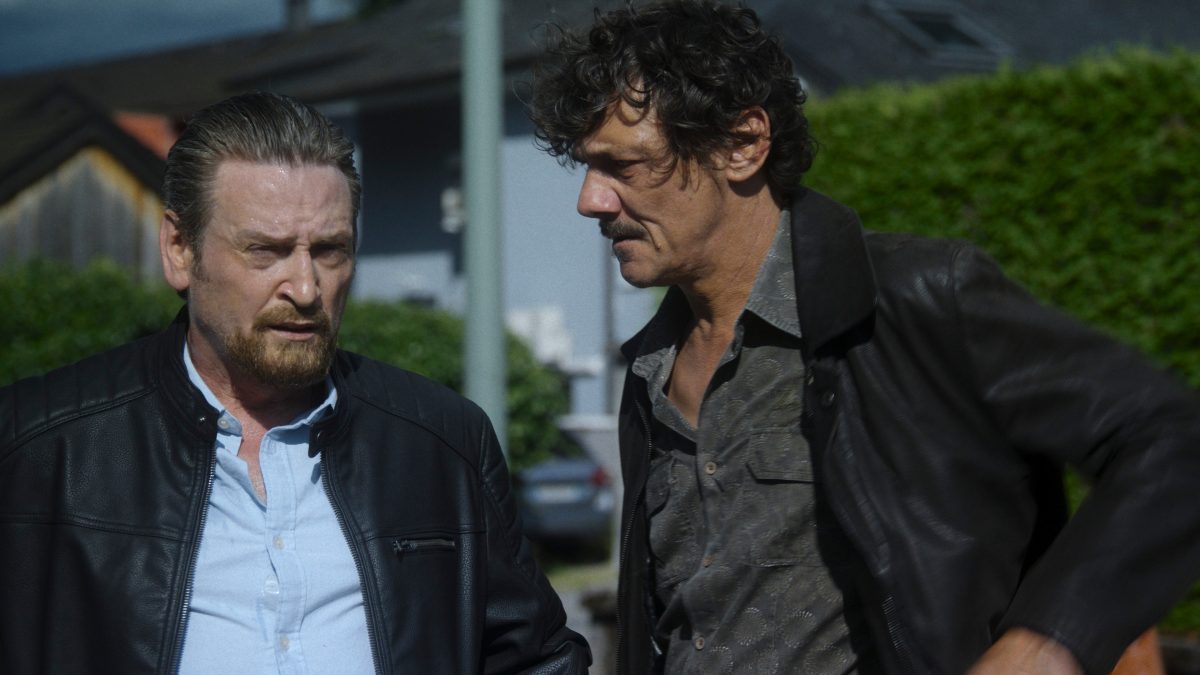
His three friends, Xavier (Damien Bonnard), Lucas (Cédric Appietto), and Giles (Manuel Guillot), do not get arcs as extensive or dimensional as his, which leaves them with no discernible traits. That’s why, when they all reach a point of no return against the hunters, it’s hard to predict or believe how they behave. Giles stands out from the rest of them due to his mental health concerns, but it doesn’t suffice for a character whom we barely get to know beyond that aspect of his behaviour.
In between Franck’s interactions with them and his family, the script introduces the agents of rising fear and violence in their peaceful community. Some people blame the white working class with no means of upward mobility, while others blame migrants. It’s an important discussion within the context of its central theme, but the show never develops these threads to their complete potential. They are occasionally introduced as interjections, revealing characters’ disillusionment or a general air of dissatisfaction, but they remain simply as footnotes in Franck’s journey toward redemption.
Unfortunately, his arc is so clumsily put-together that it’s difficult to feel much for him either by its climactic, final moments. The script also spends far more time on fleshing out his trivial concerns, which it could have used to address its more lucrative themes. What pushes people to be on a path of violence? Why does crime feel like a viable mode of survival to some parts of the population, while for people like Franck, it can only be a sign of moral degradation?
The script never gets into the nitty-gritty and instead shows it all through Franck’s projection, which, despite Magimel’s committed performance, dulls the show’s impact. Laurent is just as reliable in her role, and so are the central cast who play Franck’s friends. Yet, there’s nothing unique or memorable about their dilemmas, as they don’t make a considerable difference in their ultimate fate.
The show is somewhat enjoyable because of its occasionally well-executed cat-and-mouse chases. Yet, these moderate thrills do not suffice for the flaws in its underdeveloped script and muddled execution. It almost makes you feel bad for the squandered potential of its talented cast.