Maurílio Martins’ “The Last Episode” (O Último Episódio, 2025) finds its most interesting idea where many coming-of-age films would least expect it: not in first love, not in grief alone, but in the moment childhood begins to turn itself into images. The Brazilian drama follows three close friends in 1991 as desire, loss, and family pressure begin to loosen the world they once shared. Martins’s sharpest instinct is to understand growing up not simply as emotional change, but as a new distance from experience. Childhood begins to end here when life is no longer only lived, but staged, framed, and replayed.
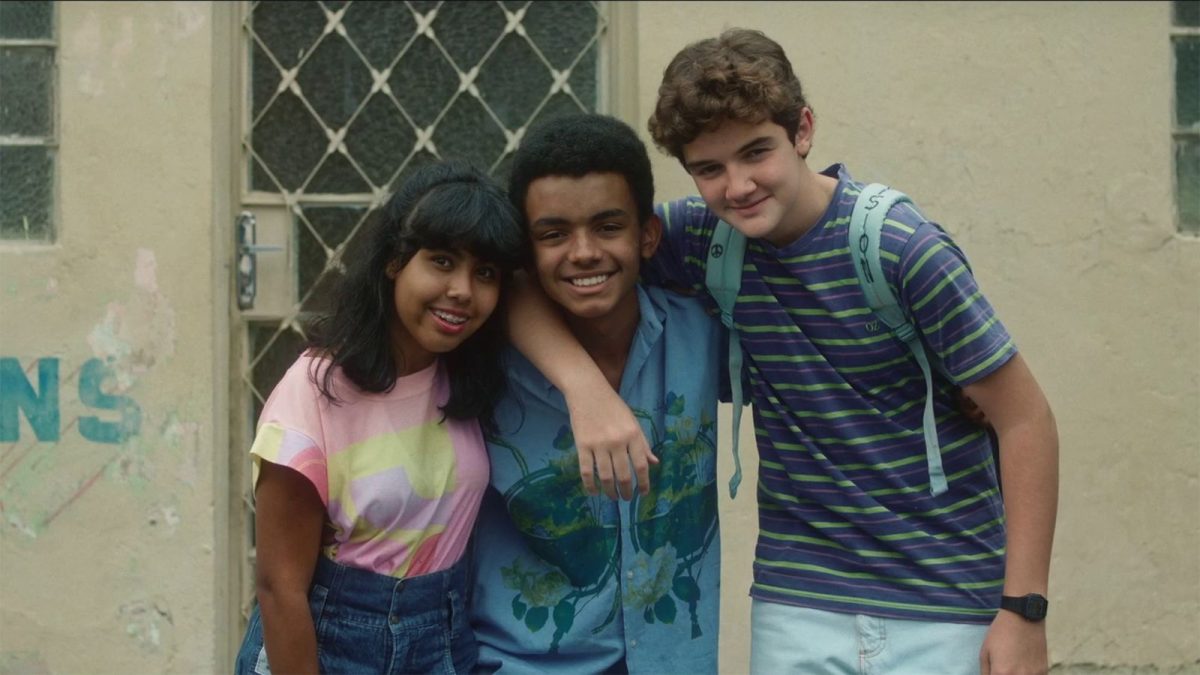
Set on the outskirts of Contagem, in the Belo Horizonte metropolitan area, the movie opens inside a world held together by proximity. Television, pop songs, modest interiors, and domestic repetition shape the rhythm of Erik, Cássio, and Cristiane’s days. Martins does not initially present them as three neatly divided protagonists moving along separate tracks. He lets them emerge first as a cluster, a shared emotional and social formation.
His framing repeatedly binds them together: on the couch, in front of the television, in movement, in play, in mutual performance. What matters is not simply that they are friends, but that the film gives their friendship spatial form. Before adolescence sorts them into separate destinies, they inhabit the frame as a temporary collective body.
That unity begins to give way when Erik, trying to impress the girl he likes, claims to own the final episode of the “Dungeons & Dragons” cartoon. The lie is small, but decisive. It shifts him from fantasy into fabrication. Soon, he decides to make a homemade film with his friends using the equipment left behind by his dead father, who was once a video producer. With that gesture, “The Last Episode” stops being only a film about childhood and becomes a film about what happens when childhood discovers the force of representation. Play hardens into form. Invention demands structure. The child who once merely inhabited the world now begins to arrange it.
The father’s camera is not just a convenient plot device; it is the film’s most charged object. It enters the story already marked by absence, carrying the trace of an interrupted transmission. When Erik picks it up, he is not simply borrowing a tool. He is stepping into a relationship with something unfinished. That is what gives the film-within-the-film its emotional weight.
The homemade production is not merely charming or symbolic. It is a way of touching what cannot be restored. In Erik’s hands, image-making becomes inheritance without full access, closeness through mediation, authorship shadowed by loss. He cannot recover the father, but he can inherit a gesture.
This is where Martins’ direction becomes genuinely perceptive. He understands that, for a child standing on the edge of adolescence, cinema is not simply a machine for recording. It is a machine for ordering. It offers the promise that bodies can be placed, actions repeated, scenes controlled, and meaning arranged after the fact.
Once Erik begins filming, his bond with Cássio and Cristiane subtly shifts. They are no longer held together only by shared experience, but by positions within representation. Someone now leads the scene, someone performs inside it, someone becomes material for another person’s vision. Without overstating the point, the film suggests that authorship can be one of the earliest forms through which hierarchy and separation enter childhood.
The best scenes in this film are the ones that grasp the gap between what images can hold and what life refuses to organize. Erik’s conversation with his mother about his father’s death is the clearest example. The scene matters less for the information it conveys than for the weight it forces Erik to carry. He tries to inhabit a seriousness that still exceeds him.
The homemade film has given him a taste of arrangement, of shaping events into something viewable. Grief does not cooperate so easily. Martins is smart enough to understand that the camera offers not mastery, but the fantasy of it. It can mediate pain, circle it, delay it, even translate it into action, but it cannot finally bring it into order. That failure is not a weakness in the film. It is one of its deepest insights.
Also Check: Landscapes of Urgency: Contemporary Brazil at the Travessias Brazilian Film Festival
At its strongest, “The Last Episode” sees adolescence as the moment immediacy begins to break down. The children do not simply age; they acquire distance from what they live. They begin to turn experience into story, image, performance, or projection. That is why the homemade film matters so much.
It marks the point where fantasy becomes construction, where play takes on form, and where childhood first catches sight of itself from the outside. Martins does not present this as pure excitement. There is pleasure in the discovery, but also estrangement. To frame the world is already to step slightly away from it.
And yet the film does not fully trust the harder implications of this idea. As it moves toward its final act, it begins to retreat into a softer, more forgiving mode. The same tenderness that gives the film much of its emotional charm also starts to blur its edges. Economic strain, maternal exhaustion, migration, and the pressure of survival remain present, but they are increasingly pushed toward the margins of the film’s emotional design. Martins notices these realities, but he does not always let them bite. Instead, he repeatedly folds them back into a register of retrospective warmth, as if memory were obliged to cushion what history made abrasive.
That softening becomes the film’s central limitation. Not because nostalgia is illegitimate, but because it begins to perform too much protective labor. The movie wants to preserve the sweetness of remembered childhood even when that sweetness was inseparable from shortage, fatigue, and loss. The result is not dishonesty, exactly, but gentling. The film rounds off tensions that are more interesting when left unresolved. It understands that childhood leaves marks; it is less willing to let those marks remain sharp.
The return of “Doce Mel” in the final school performance captures this ambivalence perfectly. The moment is affecting because it affirms continuity: some part of childhood survives fragmentation, disappointment, and drift. But it is also revealing in how quickly it converts a fracture into consolation.
By the end, the film prefers emotional continuity to disturbance. Secondary pressures recede, conflict relaxes, and the narrative settles into a harmony that feels more comforting than earned. What had been a compelling film about mediation, loss, and the first distance from experience becomes, in its closing stretch, a gentler act of retrospective repair.
Even so, “The Last Episode” remains a thoughtful and often moving work. Its finest intuition lies in treating cinema not as a decorative motif inside a childhood story, but as the threshold through which childhood begins to leave itself behind. Maurílio Martins understands that the first encounter with a camera can also be the first encounter with distance: the realization that life can be framed, replayed, and shaped into form, but never fully recovered once it has passed. If the film ultimately softens too much of what it discovers, it still arrives at something quietly resonant, the idea that growing up begins, in part, when a child first learns to look at the world as an image.



![Aviva [2020] Review – A gender-fluid enigma about the relationship we have with ourselves and others](https://www.highonfilms.com/wp-content/uploads/2020/07/Aviva-Movie-Holding-Dancing-HOF-768x427.jpg)