The high-stakes battle for the soul of Hollywood has reached a fever pitch. In a move that surprised few but shifted the legal landscape significantly, the board of Warner Bros. Discovery (WBD) has officially snubbed David Ellison and Paramount’s $108 billion hostile takeover attempt.
Despite the eye-popping $30-per-share offer, WBD leadership is doubling down on their existing merger agreement with Netflix. Here is an analysis of why WBD said no, the “red flags” surrounding the Paramount bid, and what this means for the future of the “Big Three” entertainment giants.
Why WBD Rejected the $108 Billion Paramount Bid
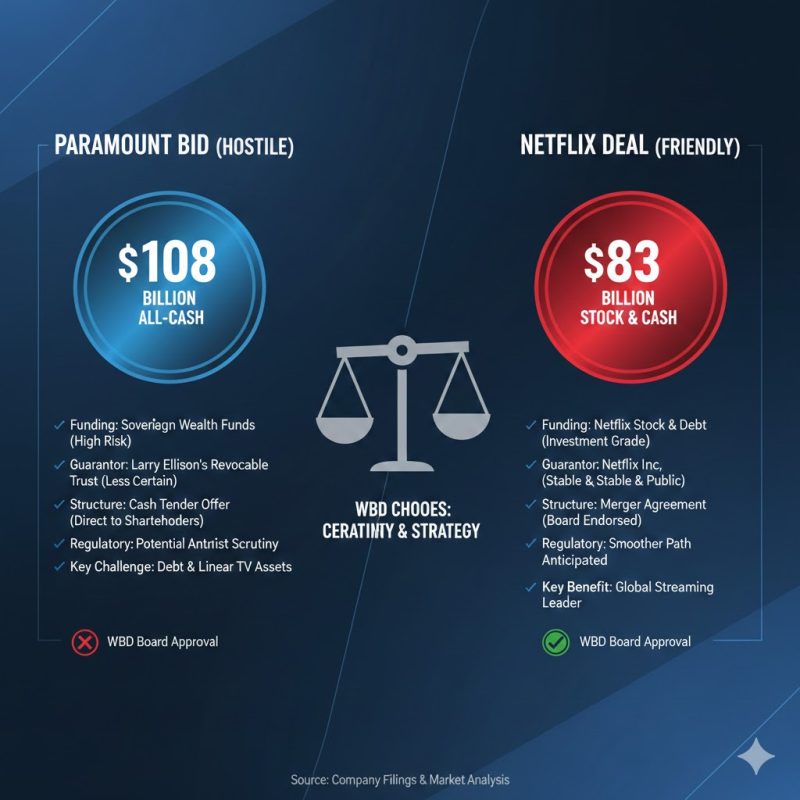
On Wednesday, WBD Board Chair Samuel A. Di Piazza, Jr. made the company’s position clear: Paramount’s offer is “inferior” and riddled with “significant risks.”
While the price tag was high, WBD leadership cited three primary reasons for the rejection:
Financial Reliability: The board expressed skepticism regarding the “backstop” provided by Larry Ellison’s revocable trust. Because assets in such a trust can be shifted or altered, WBD viewed it as insufficient compared to the stability of an investment-grade partner like Netflix.
Geopolitical Complications: The Paramount bid relied heavily on sovereign wealth funds from Saudi Arabia, Abu Dhabi, and Qatar. WBD raised concerns over the regulatory and reputational hurdles associated with such massive foreign financing.
Legal Posture: WBD described the recent communications from Paramount’s legal team as “highly litigious” rather than constructive, noting that even Paramount’s own advisors reportedly admitted certain legal threats were a “mistake.”
The Netflix Advantage: Why “Certainty” Wins
Netflix’s proposed $83 billion merger with WBD might be smaller in raw cash, but it offers what David Zaslav and his board crave most: certainty.
Netflix co-CEO Ted Sarandos has been vocal about his vision for the combined entity. Unlike a “hostile” takeover that could lead to years of restructuring, the Netflix-WBD deal aims to:
-
Preserve the Theatrical Window: Sarandos vowed to keep WBD’s movies in theaters, honoring traditional release windows.
-
Protect the HBO Brand: Netflix intends to let HBO remain the “crown jewel” of prestige television.
-
Ensure a Clean Close: Netflix’s simple deal structure avoids the complex debt and linear television baggage that a Paramount merger would entail.
Will David Ellison Launch a Counter-Bid?
The drama is far from over. David Ellison has already hinted that the $30-per-share offer was not his “best and final.”
What happens next?
-
The Tender Offer: Paramount must now convince WBD shareholders to bypass the board and “tender” their shares directly to Ellison.
-
The Bidding War: If Ellison raises his bid, Netflix will have the contractual right to match it.
-
The “Dispassionate” Response: Netflix co-CEO Greg Peters noted that while they are confident, they will remain “dispassionate” about the price. If the bidding war reaches irrational levels, Netflix could walk away with a $2.8 billion breakup fee.
The Bottom Line for Investors and Fans
We are witnessing a repeat of the Disney-Fox acquisition saga. Just as Comcast pushed Disney to pay more for Fox’s assets, Ellison is forcing Netflix to prove just how much they value the WBD library.
For consumers, the outcome will determine where you watch the next Batman movie or House of the Dragon. A Netflix win creates a global streaming hegemon; a Paramount win creates a legacy studio powerhouse with massive financial backing from the tech world.
Stay tuned—the regulatory review process has already begun, but the checkbooks are still open.