
Throughout history, people have fought for justice against forces that denied them their rights. They marched and protested on the streets with all their might, despite all efforts to weaken their spirits. That’s why even after their deaths, they lived on through their valor and resilience, leaving future generations with tangible or philosophical fruits of their labor. Several years later, they become an inspiration to some, while for others, their stories remain far more personal. After all, these activists and martyrs are also someone’s loved ones. As years go by, the survivors’ grief becomes more potent, potentially tinged with a hunger for retribution.
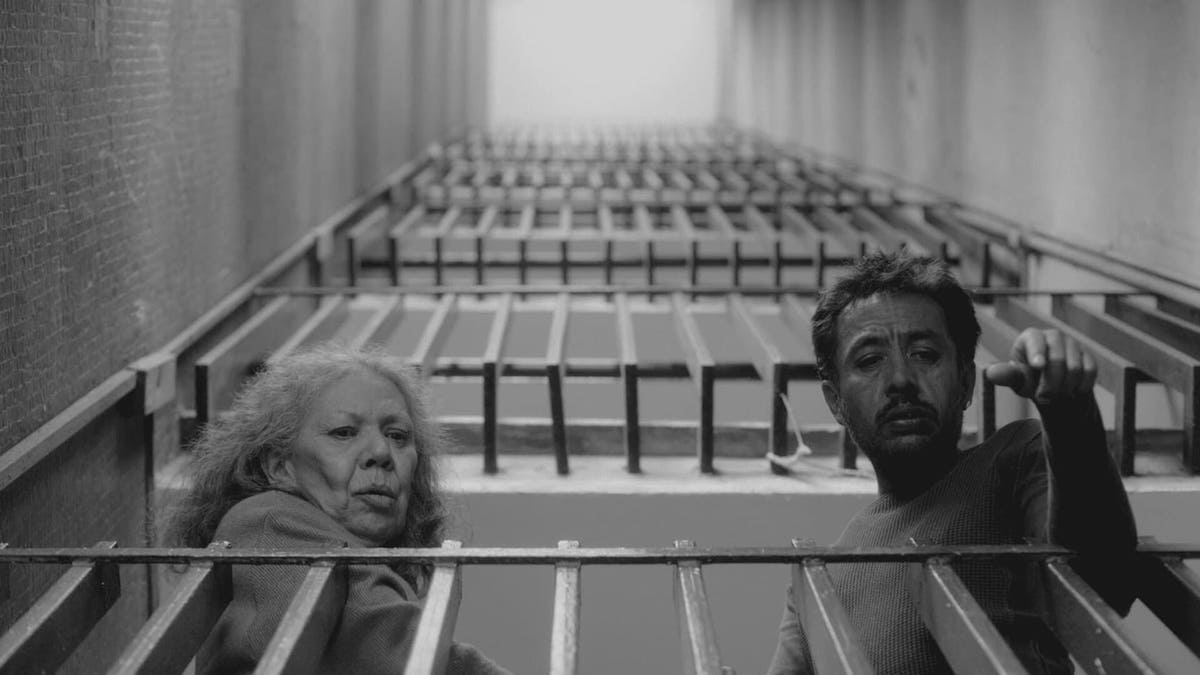
Pierre Saint-Martin Castellanos’ “We Shall Not Be Moved” (Original title: No nos moverán) traces similar reverberations through the experience of a woman who lost her brother in a protest. It centers around Socorro (Luisa Huertas), a 67-year-old retired lawyer, who is determined to find the man who killed her young brother nearly six decades ago. Castellanos, who co-wrote the script with Iker Compeán Leroux, presents Socorro’s quest for justice for one of the most painful chapters in Mexico’s history: the 1968 Tlatelolco massacre that took the lives of several students who were protesting against the oppressive forces at the city’s Plaza de las Tres Culturas.
Before tracing Socorro’s quest, the script introduces her in a present-day setting, documenting her monotonous life with her sister Esperanza, her son Jorge (Pedro Hernández), and his wife Lucía (Agustina Quinci). The film shows her almost entirely in her apartment, where her life seems to go at a snail’s pace. Although she has a pet cat and a pigeon for her company, her sister never speaks with her. Her silence stems from her resentment toward Socorro’s endless fixation on their late brother’s case. Through them, we witness different portraits of grief. It seems like Esperanza hopes to move on from the tragic loss, but Socorro’s fixation makes it impossible.
Socorro’s grief is layered with a survivor’s guilt. That might be the reason to pursue law in the first place. She may have wanted to help others seek justice after seeing her brother lose a battle he fought for. Decades later, her son became a journalist, likely inspired by her constant fight for truth and justice. Their collective grief makes the film inherently poignant, and the uneventful setting makes it even gloomier.
There’s also an air of ambiguity throughout the interactions between all family members. They hold secrets from each other and rarely say what’s on their minds. There’s always a wall between what they say and what they hope for. Their dejection feels even more depressing as we learn about the sorry state of their present lives. Whether in a job, marriage, or family life, they all face dissatisfaction and are made to confront it at the cost of their worth or dignity.
Recommended Read: 20 Best Black and White Movies of the 21st Century
Huertas brings a much-needed levity to this gloomy affair, painting Socorro with the kind of playfulness and enthusiasm that would put youth to shame. Thanks to her, we can easily sense Socorro’s openness to mischief through most of her interactions, leaving no room for the reservedness seen in many old-age portraits. Even at her age, she remains full of energy, no matter what the situation. Her eyes glint when she dances with her daughter-in-law as much as they do when she is plotting to trace the culprit.
Huertas strikes a tricky balance while portraying Socorro’s tragedies alongside her magnetic personality without letting either overshadow the other, thus offering a rounded portrait of a person resiliently dealing with grief. Castellanos’s film is an attempt to address the lasting emotional wounds of such tragedies. It succeeds mainly because of Huertas’s assured performance, other than the script elements that detail Socorro’s emotional arc toward almost becoming someone she used to fight against.
Visually, the film becomes striking when it captures the mundane aspects of Socorro’s life with deep focus and uses visual motifs (eg, spiraled stairs) to represent a growing distance between her and her loved ones. It pales in comparison when it presents her outdoors, where shallow focus dilutes its otherwise intimacy.
Yet, while the film comes from a good place, it falls short of greatness. It addresses the real-life tragedy behind Socorro’s eternal state of conflict, but it doesn’t offer insights beyond what’s crucial for its plot. An emphasis on the specifics of the actual tragedy and its socio-political ripples in present-day Mexico could have made the film cut far deeper.
Apart from that, Jorge and Socorro’s relationship is underdeveloped, which makes it hard to register the eventual devastation as their dynamic regresses from strained to broken. Lucía’s character is also a weak link in the script, who, despite Quinci’s emotional performance, mostly serves as a plot device to address the gaps in Jorge and Soccoro’s dynamic. That’s why “We Shall Not Be Moved” remains a well-intentioned but slight portrait of resistance in the face of oppression.




![Hugo [2011] Review: As Endearing As It Is Frustrating](https://www.highonfilms.com/wp-content/uploads/2020/02/hugo-cover-768x432.jpg)
![Dark Waters [2019] Review– A Conventional yet Compelling Account of Toxic Chemical Pollution](https://www.highonfilms.com/wp-content/uploads/2020/01/Dark-Waters-2019-768x567.jpg)


![Deep End [1970] : Blood, Bath & Beyond.](https://www.highonfilms.com/wp-content/uploads/2017/03/deep-end-player-1920x1080-768x432.jpg)