“H Is for Hawk” (2025) is a highly familiar examination of loss, grief, and the uncomfortable road to recovery that also touches on a highly specific experience. Although there are universal feelings related to the passing of a loved one that transcend any culture or period in history, someone’s background shapes the way that they choose to cope. While “H is for Hawk” is subdued to the point that it occasionally drags, it’s a film crafted with modest intentions that presents a more nuanced message than it may have initially seemed.
Based on the 2014 bestselling memoir of the same name, “H is for Hawk” is the story of the Cambridge professor Helen MacDonald (Claire Foy), whose didactic, highly organized life is upended by the unexpected loss of her father, Alisdair (Brendan Gleeson).
Alisdair had been a globe-trotting photographer who snapped incredible pictures until moments before his death, and the loss of such an adventurous presence is a threat to Helen’s reality that she begins a process of denial and refusal. While her mother (Lindsay Duncan) has come to fear for her mental health, Helen takes an unexpected route to recovery by choosing to take in a young goshawk, whom she names Mabel.
The notion of finding emotional catharsis through an animal is a tale as old as time, but a goshawk is by no means a typical pet. Transporting and tending to the creature is less a hobby for Helen as it is a full-time responsibility, and not one that is easily understood. Although Helen was never considered to be a typically personable academic on campus, her new interest begins to draw the suspicions of her co-workers, students, and family. It’s an interesting side to the mourning process that is not often touched upon in cinema. After a while, the person in question is expected to simply move on with their life as if the status quo has not been changed.
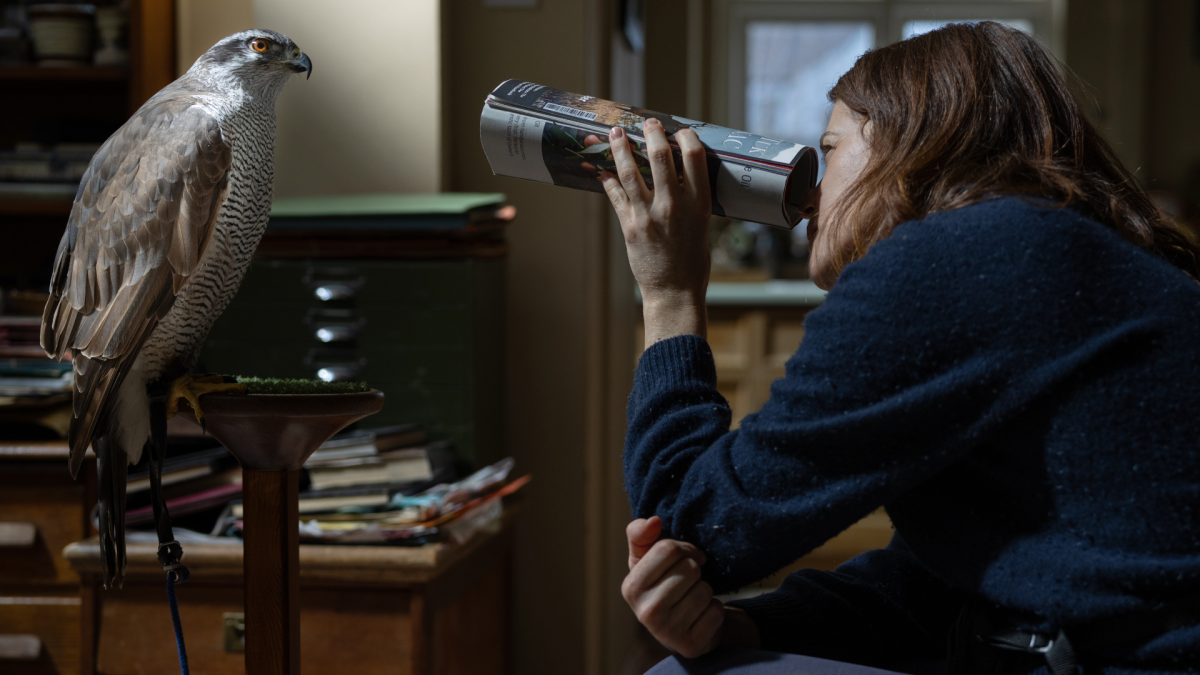
While there’s nothing flashy or stylistically experimental within the direction of “H is for Hawk,” the rosy, meticulous process that it takes to show Helen’s time with Mabel is refreshingly reminiscent of a British television production. Rather than forcing the narrative to conform to a typical structure, “H is for Hawk” gently examines the passing of time, exploring the “ordinary” moments in Helen’s life that are now altered as a result of her father’s death.
The decision to only briefly touch on what Helen’s dynamic with her father was like prior to his departure could have denied the story of emotion, but it actually makes for a series of rewarding reveals thanks to the use of flashbacks. Although Helen’s immediate thoughts surround the gap that now exists within her life, it’s only through time that she begins to understand how much her father left behind.
Also Read: The 35 Best Movies of 2025 (So Far)
Foy has now become associated with upstanding, courteous figures fighting back restrained emotions thanks to her award-winning work in “The Crown” and “Women Talking,” but there’s a modesty to her performance in “H is for Hawk” that doesn’t reveal itself in typical ways. One of the key aspects that makes Helen’s mental health struggles so strenuous is that she lacks the clout to speak for herself and struggles when forced to blatantly admit to her emotions.
The progression that the character makes isn’t as centered on unpacking her emotions as it is on finding clarity, particularly for an academic mind like Helen, who finds it a challenge to deal with ambiguities. Even if the dialogue is at times a bit too poetic to feel entirely authentic, there are instances towards the end in which Helen’s truisms on the inevitability of death are quite profound.

Foy’s work isn’t particularly showy, and the grace that she grants to her performance allows “H is for Hawk” to make use of its terrific ensemble. While a majority of the side characters do little more than fulfill the archetypes of a typical weepie drama, they’re all executed by terrific actors who have enough personality and emotional integrity to feel like they could exist beyond the confines of the story being told.
Particularly strong is Denise Gough in the role of Christina, the best friend of Helen’s who is the first to take her out in the aftermath of the heartbreaking news. Gough has earned raves for her terrifying work in this year’s excellent “Star Wars” series, “Andor,” which makes it all the more surprising that she’s also capable of being so quiet and supportive. Christina’s initial reluctance to accept her best friend’s active interest in goshawks puts Helen in the unique position of having to act like a leader, a skill that was prominent within her father’s life.
“H is for Hawk” is beautiful to look at, as the film’s willingness to forgo any overt references to current events and technology makes it feel somewhat timeless. That being said, this lack of specificity is also a hindrance when Helen’s vague emotional status is the only drive to the story. At 128 minutes, “H is for Hawk” is lacking in any real momentum and features far too many scenes that drag on for their own good. As much as the film underlines the idea that none of these issues can be solved overnight, it doesn’t help the pacing of a story that is already fairly insular.
The best thing that can be said about “H is for Hawk” is that none of the more predictable emotional beats feel manipulative, and that even the most obviously staged moments of culmination are enough to invoke genuine tears. There’s a sense that some of the more nuanced details of the novel may have been scrubbed away.
While the real Helen identifies as non-binary, Foy’s version of the character is female. Nonetheless, it’s striking to compare a film willing to accept the cycles of life without blowing up every painful moment to the point of melodrama, particularly when compared to this year’s other British family tragedy, “Hamnet.” Catharsis doesn’t always feel good, but in the case of “H is for Hawk,” it’s rewarding.