
Jessica Swale’s “Merv” (2025) holds onto its wholesome charm even as it carefully builds emotional tension. With Christmas drawing near, the story becomes less about the season and more about the people bracing for change, especially Anna Finch (Zooey Deschanel) and Russ Owens (Charlie Cox), whose dynamic shifts after their return from Sunnyside Dog Beach in Florida. At the heart of it all is Merv, the dog who has lived between them ever since their breakup, raising the question of what his future will look like as old wounds and new hopes collide. The film ends on a warm, comforting note, yet a few threads linger in the air.
SPOILERS AHEAD
Merv (2025) Plot Summary & Movie Synopsis:
“Merv” begins in the most wholesome way imaginable. As “Christmas Is Going to the Dogs” plays, the film sets its festive mood with snowy streets, decorated storefronts, and a city slowly preparing for the holiday season. This cheerful atmosphere quickly shifts when the story cuts to a cluttered apartment where clothes cover every surface, and nothing has been cleaned for days. The apartment belongs to Russ Owens, who has been drifting through life in this disorganized state for quite some time. Merv, the dog at the center of the story, is found sleeping on top of him.
Russ takes Merv across town to Anna Finch’s house, and it becomes clear that Russ and Anna recently broke up. Although their romantic relationship has ended, they continue to share custody of Merv. This arrangement exposes the emotional gap between them. Russ copes with the breakup by reminiscing online since he has created an Instagram account for the dog called “Mervinator,” and he finds himself scrolling through old Facebook memories of happier days when the three were together.
Anna, on the other hand, works hard as an optometrist and also throws herself into caring for Merv. She bathes him, pampers him, and tries to recreate the festive joy surrounding the city. However, it becomes apparent that Merv has no energy for any of it. His lethargy worries Anna enough that she brings him to the hospital. Russ meets her there.
What happens to Merv?
Once the doctor examines Merv, both are surprised to learn that the dog is physically healthy. Instead, he is suffering from depression. The diagnosis immediately triggers tension, and Russ and Anna begin blaming each other for Merv’s emotional state. Their argument ends with Russ taking Merv back to his apartment. Determined to help him, Russ searches online for places that might lift a dog’s spirits and discovers Sunnyside Dog Beach in Florida. He asks Anna for permission to take Merv on a short vacation, and she reluctantly agrees.
Although Russ hopes the trip will help, Merv remains withdrawn even as they reach the sunny beach. Meanwhile, Anna reconnects with her friend Rebekah after an unsuccessful Hinge date. During their conversation, Anna comes across Russ’s Facebook post filled with old memories, which stirs her own nostalgia. As a result, she decides to join Russ and Merv in Florida, explaining that she is doing so because Merv seems to want them together, and she wants the dog to feel happy again, at least for a week.
Who is Jocelyn?
During their time at the beach, Russ unexpectedly meets Jocelyn, who is intrigued that he is traveling with his ex-girlfriend. She invites them to the birthday party of her dog, Lolly. At the party, Russ and Anna encounter an animal healer named Gaia. While her interaction with Merv begins as a humorous moment, it soon grows more serious when she claims the dog feels heartbroken over their separation.
Although Russ and Anna try to dismiss her words, her comments linger. Later, Russ brings up their breakup and argues that it never needed to happen. Anna responds with a firm reminder that proposing to someone cannot instantly fix deeper issues in a relationship. This conversation is tense, yet it opens the door to a softer moment when Russ asks whether Anna would like to visit his parents. She hesitates at first but eventually agrees.
What Happens at the Dance Party?
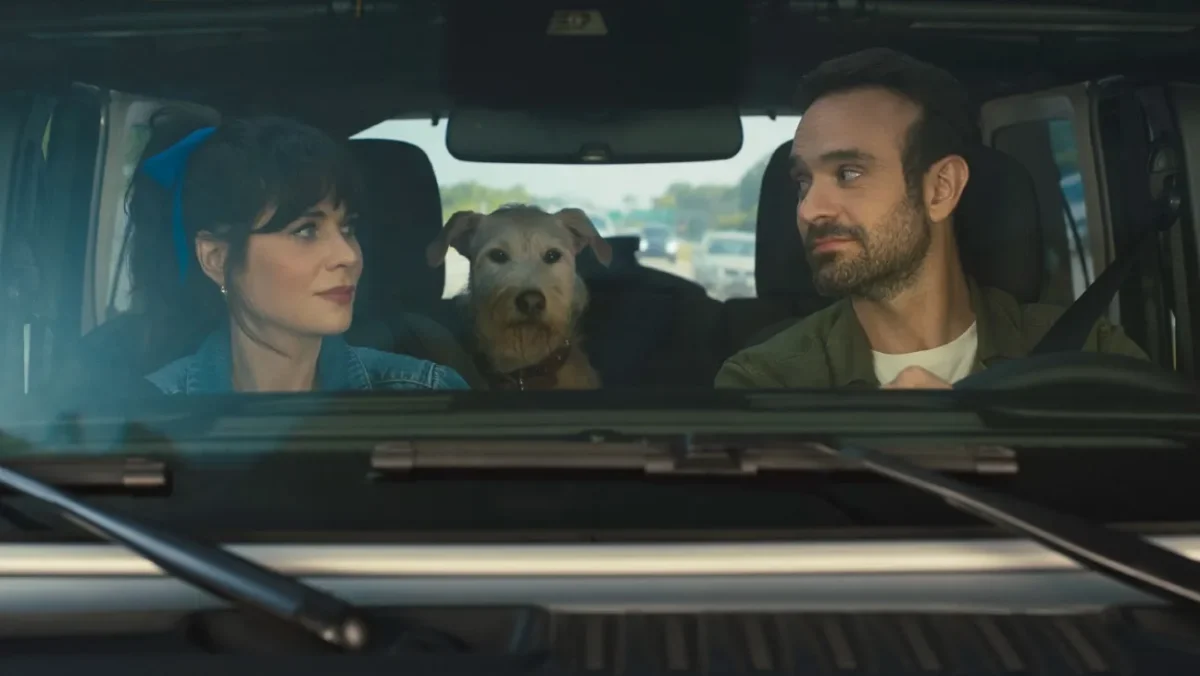
Once they arrive, the film’s tone becomes more tender. Russ’s mother, MJ Owens, who had previously blocked Anna on social media, offers an emotional apology. This leads to a night where Russ and Anna drink, dance, and rediscover a shared warmth together at a dance party.
On the drive back to the hotel, they sing “One Week” together, and Anna briefly places her hand on Russ’s, causing him a flash of nervousness that hints at their unresolved past. However, the sweetness of the evening does not last. What follows is a sharp and honest confrontation that finally forces both of them to confront why they broke up and what their future, along with Merv’s, will look like as Christmas approaches.
Merv (2025) Movie Ending Explained:
Does Merv Get Out of Depression?
Merv’s depression functions as the emotional engine of “Merv,” shaping every major decision that Anna and Russ make. His sudden withdrawal forces them back into each other’s orbit and becomes the reason they begin reassessing their lives. After their unexpectedly wholesome night at the dance party, both of them start wondering whether the feelings they once shared have quietly stayed alive.
Anna even calls Rebekah to confess that she might still care for Russ. Rebekah responds by affirming that the two have always complemented each other, which pushes Anna to consider the possibility of reconciliation. At the same time, Russ goes through a similar internal shift, although he tries to keep it under control.
Their growing uncertainty is interrupted when Russ runs into Jocelyn before their planned dinner. The encounter turns unexpectedly intimate, and they come close to kissing. Although Russ steps away before anything progresses, the moment exposes his confusion. He realizes that even the possibility of moving on feels wrong, which makes him reflect on how deeply Anna still affects him.
When they finally meet at the beach, the honesty they tried to avoid comes rushing out. Their conversation about the past begins tense and grows emotionally charged. Although Anna expresses a desire to start fresh, Russ is unable to accept the idea so quickly. The moment ends unresolved, and both return to their city with more emotional weight than clarity.
Once they are back home, Russ reaches a painful decision. He tells Anna that she should keep Merv because the dog constantly reminds him of her, and each drop-off reopens the emotional wounds he has been trying to handle. To move forward, Russ adopts a new dog named Angelina, who immediately grows fond of the “super gloop” Anna once made for Merv. This marks a shift in Russ’s life, yet his connection to his past remains present.
When Russ takes Angelina for a walk in Merv’s favorite park, fate intervenes. He unexpectedly encounters Anna and Merv. Although he tries to avoid conversation at first, he eventually gives in. Their brief exchange quickly becomes vulnerable, and Anna admits that her life has felt hollow without him. This moment finally breaks through the emotional walls between them, leading to a warm kiss that signals the beginning of a new phase in their relationship.
Because Anna and Russ reconcile, Merv’s emotional landscape changes as well. The dog’s depression was tied to the instability between the two people he loved most. With harmony restored and Angelina entering his life as a new companion, Merv is positioned to recover. The final scenes, which show all four celebrating Christmas with renewed joy, strongly suggest that Merv has finally found emotional peace.
Also Check Out: 15 Great Movies About Food That You Need To Watch
Why did Russ and Anna Break Up? What’s Next for Them?

“Merv” presents Anna and Russ as a couple who had once built a life filled with genuine affection, shared routines, and withheld a sense of belonging that extended beyond their relationship. Their friends saw them as perfectly matched, and Russ’s parents openly adored Anna. Because of this, the fact that they are no longer together becomes an emotional anchor for the entire film. The breakup is not explained at first, yet the narrative continuously offers clues that something deeper took place beneath the surface of their otherwise wholesome relationship.
The first significant hint appears during the dog birthday party, when the animal healer briefly touches upon emotional wounds that neither Anna nor Russ wants to discuss. Although this moment is played with humor, the discomfort between them signals that the breakup was tied to something far more vulnerable than incompatibility. The film then strengthens this implication when Russ later reveals that he had proposed to Anna. Anna responds sharply by saying that proposing did not repair anything, which indicates that there were already fractures in their relationship before the proposal took place.
Another key moment comes when Anna reacts quietly to seeing photos of Rebekah’s children. While the scene is brief, it exposes a layer of longing and heartbreak that she has not expressed openly. The puzzle pieces fall into place during her phone call to Rebekah, where she admits she still has feelings for Russ. Rebekah gently acknowledges these feelings, yet she also brings up the fact that Anna cannot have children. This detail reframes Anna’s emotional state throughout the film and reveals the silent struggle she has been carrying.
The beach confrontation between Anna and Russ serves as the emotional climax, where the truth finally surfaces. Anna explains that discovering she could not have children had devastated her. She felt she had failed Russ, and she convinced herself that staying with him would trap him in a future he did not deserve. When Russ proposed, she interpreted it as an act of pity rather than love.
Instead of comforting her, the proposal deepened her sense of inadequacy. For her, it felt like Russ was attempting to make the problem disappear with a gesture she could not accept. For Russ, however, the proposal came from a place of genuine commitment. The tragedy lies in the fact that both were acting out of love but reading each other’s intentions through fear and self-doubt.
Their breakup, therefore, was not the result of falling out of love. It was the result of a conversation they never allowed themselves to have. The emotional weight of infertility, the fear of disappointing each other, and the inability to communicate during their most fragile moment created a divide that neither knew how to cross. After the breakup, both of their lives drift into imbalance.
Russ, despite being an elementary school teacher who once maintained steady routines, struggles to keep his life together. His apartment becomes messy and directionless, reflecting his internal state. Anna, on the other hand, falls into a lonely rhythm where even her most cheerful moments seem incomplete. Merv becomes the silent link between them, carrying the emotional residue of their separation.
The turning point arrives on Christmas Day, when their misunderstandings finally dissolve. They both recognize that they had spent months punishing themselves for assumptions that were never spoken aloud. Their reunion is not portrayed as a magical fix, but as a willingness to approach each other with honesty for the first time since their breakup.
Going forward, their future appears grounded rather than idealized. They now have a clearer understanding of each other’s vulnerabilities, and they no longer hide from the difficult subjects that once tore them apart. With Merv recovering emotionally and Angelina joining the picture, their home gains a renewed sense of comfort and stability. The final scenes, filled with calm joy and wholesome celebrations, suggest a relationship rebuilt on communication, acceptance, and mutual resilience.
Merv (2025) Movie Review:
Comfort Food Cinema with Very Mild Flavor
“Merv” is the kind of breezy holiday rom-com that feels familiar the moment it begins. It is set during Christmas and features two conventionally attractive white leads, who carry the warm glow of seasonal marketing. The film invites eye rolls even before it reaches its opening credits, mainly because audiences have seen this exact template play out in various forms for decades. However, once you settle into it, the film does not actively offend or challenge you. Instead, it comfortably lands in the middle. “Merv” functions like a snack you reach for without thinking. It is a movie that does not satisfy any particular craving, yet it keeps you occupied for the moment.
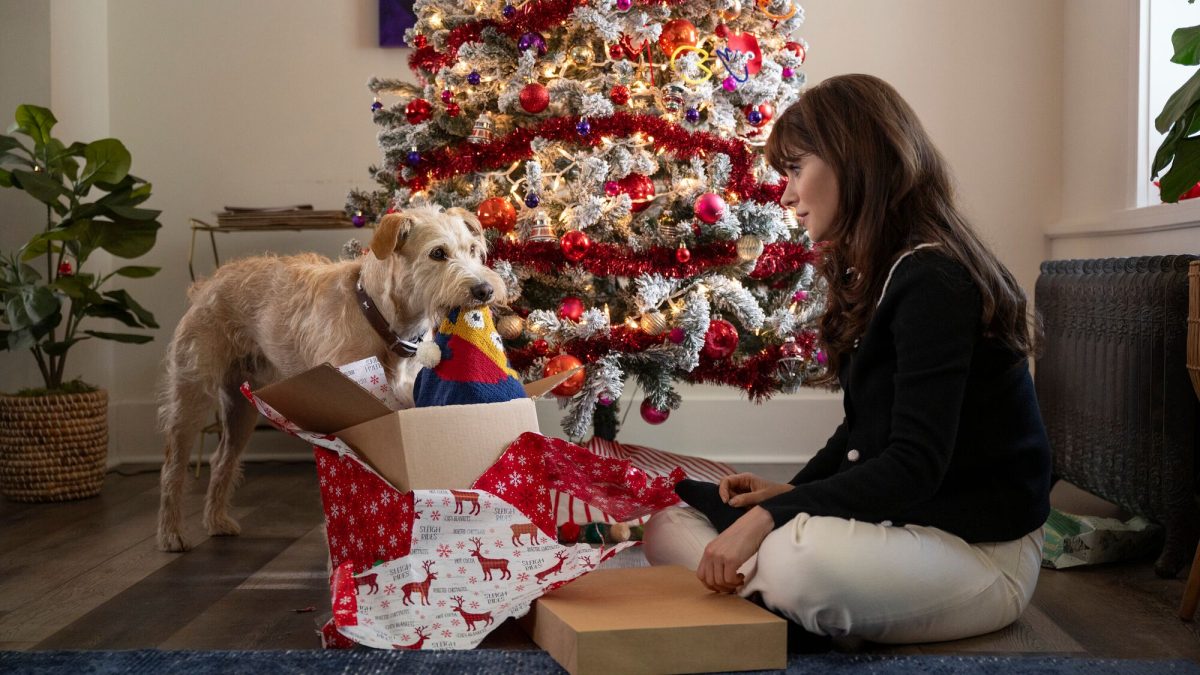
Jessica Swale’s direction follows a predictable route. There is nothing especially fresh about the way she handles either the romance or the holiday setting. Although the film is marketed as a dog-centric story, Merv himself contributes very little outside of being depressed enough to bring Anna and Russ back into the same emotional space. The dog’s presence mainly acts as the catalyst for plot progression, although he rarely shapes the film in meaningful ways. His depression, diagnosis, and eventual recovery feel more like narrative devices than genuine character beats.
The Florida dog beach sequence attempts to create a mix of jealousy, awkwardness, and comedic tension. Russ meets Jocelyn, and Anna meets Sheriff Tom Bentley, who happens to be Jocelyn’s brother. These interactions follow the usual holiday-romcom rhythm: brief flirtation, mild misunderstanding, and eventual irrelevance.
The story leans on situations that could be resolved within a short conversation, yet the script stretches them out to fill scene transitions and maintain the illusion of conflict. Hollywood has returned to this formula for so long that the film seems to follow the steps automatically. As a result, there is little that needs unpacking, since it fits comfortably into a genre routine that has existed for generations.
The film’s approach to supporting characters also exposes some of its limitations. Rebekah, the token Black character, is treated more like a narrative tool than a fully developed individual. She appears to serve a functional role in the story as she only nudges Anna toward confronting her feelings and encourages the emotionally necessary conversation that the script requires.
However, she is not even given a last name. She is just the wise friend who delivers prompting advice. Her presence highlights how certain rom-coms still rely on the same simplified patterns, especially when it comes to diversity. The lack of depth is noticeable, even though the film never attempts to hide its formula-driven nature.
Despite these shortcomings, “Merv” offers a mildly pleasant experience for anyone seeking a seasonal, low-stakes story. The performances from Zooey Deschanel and Charlie Cox are gentle and easygoing, giving the film a light charm even when the script remains generic. Their chemistry is serviceable enough to carry the scenes that explore their past, breakup, and emotional miscommunication. Since the film avoids leaning too heavily into melodrama, it maintains a steady tone that viewers might find relaxing after a long day or during late-night holiday streaming.
Furthermore, the movie occasionally taps into genuine warmth during the Christmas sequences. The scenes involving Russ’s mother, the family gathering, and the final moments with the dogs create a cozy atmosphere that aligns with the expectations of the genre. The film understands that many holiday rom-com viewers crave familiarity rather than innovation. Because of this, “Merv” plays it safe, staying within the soft boundaries of holiday comfort cinema.
Even though dog lovers may enjoy the lighter moments involving Merv and Angelina, the film tends to drift toward predictability. Once the credits roll, there is very little that lingers. The story does not offer memorable insights or unique comedic beats, and it rarely tries to deepen its emotional arcs beyond the straightforward obstacles placed in front of the leads.
As a result, viewers will likely move on from the film almost immediately after watching it. By the time December 26 arrives, “Merv” will probably fade from mind entirely. All in all, “Merv” is a movie that knows exactly where it wants to sit, right in the middle. It avoids risks, embraces familiarity, and settles for being good enough for the holiday season. For viewers seeking a harmless Christmas dog-com, it works well enough. For anyone expecting originality or a refreshing take on the genre, it remains entirely too comfortable being mediocre.






![Mithya [2022] ‘Zee5’ Review: Stellar Performances Amplify The Impact Of This Grotesque Crime-Drama](https://www.highonfilms.com/wp-content/uploads/2022/02/Mithya-2022-768x432.jpeg)