Adam Mason’s new documentary, “Amerigo,” is a celebration of perseverance and tenacity, reflecting a key spirit enduring across generations. Vagaries of time hold no candle to the scale and resolve defining the promise America waves to those arriving on her shores. It’s the shared American dream, welding together countless individuals irrespective of background. There’s a united vision limning the conversations the documentary weaves in. Mason covers vast ground. Inevitably, it leads to several things being short-changed.
There are concerns here about housing and communities banding together to make hospitals from scratch, which could have filled out entire episodes. Nevertheless, the sincerity of address infuses “Amerigo.” It has a probity that demands witness and careful consideration. There are regrets and warnings about a sense of joyful community vanishing, counterposed nevertheless with resilience and a stronger appetite for seizing the most from one’s circumstances, no matter how bleak or skewed.
Over email, Mason had a conversation with HighOnFilms’ Debanjan Dhar about the American dream’s evolution, poring through hundreds of interviews to flesh the film’s structure and ideals that kept bouncing back again and again.
Edited excerpts from the interview…
Debanjan: What drew you to this project? Did you wrestle at all before agreeing?
Adam Mason: I was initially curious why David McCourt and McCourt Entertainment chose me to direct “Amerigo.” But in many ways, I represent the American dream as much as anyone. I had always dreamed of moving to the United States and building a life and career there. Through hard work and perseverance, I finally achieved that goal in my late twenties, directing music videos and films.
America gave me an opportunity, just as she did for millions of people before me, and I realized the idea of creating the documentary with David spoke to me on a very emotional level. I began by talking to hundreds of everyday people on the street, and each one had something meaningful to say about their own American dream and what they wanted to achieve.
And that was when I realized something quite beautiful, that as divided as America feels right now, the American dream really continues to bond everyone together.
Debanjan: Early in the film, a distinction is drawn between it being about America, who we were and will become, not the American dream per se. Why was this important to establish?
Adam Mason: What’s fascinating about the American Dream is how much it’s evolved. The term itself was coined in the 1930s, and since then, major shifts in the economy and in community life seem to mark each decade. During the Great Depression, the dream was about survival. In the 1940s, it shifted around the war and its aftermath. The 1950s brought the familiar white-picket-fence ideal, though that vision was never equally accessible. The 1960s reshaped the dream again through the civil rights movement. Then came the tech revolution of the 1970s, Vietnam, and protest, followed by the rise of yuppie culture in the 1980s.
And every seismic moment since 9/11 to the financial crash of the late 2000s has continued to redefine what the American Dream looks like. What became clear to me was the sheer resilience of the American dream and just how much it means to so many people. That’s the core theme of “Amerigo,” to illustrate how that dream has progressed from the past, present, and future.
Debanjan: The doc also charts out the different definitions and imports the American dream as it holds to disparate people. How did you see your notion of the American dream shift over the many, many interviews? Was there any marked shift?
Adam Mason: I went into it thinking everyone would have their own definition of the American dream. I thought people would be angry, confrontational, or maybe cynical. I was wrong on all fronts. What I found was a country that reminded me of why I personally dreamt of living there in the first place. I found fundamental, universal proponents of the dream across all states and all people.
It was also inspiring to talk to everyday people on the subject. I was deeply moved by how emotional people became when talking about their own successes and struggles in the pursuit of achieving the American dream. You really got the feeling from each person on what their story meant to themselves and their families.
More than anything, I saw an America desperate to reconcile, sick of the division, and fed up with the media’s relentless drumbeat that everything is falling apart. I came away feeling that some Americans feel duped by banks, by politicians, and by a system that no longer works the way it promised. Homeownership was once a cornerstone of the American Dream, but it feels almost impossible for most right now.
Right now is the perfect time for a documentary like “Amerigo.”
Debanjan: Which of your own values did you sense reaffirmed in the interviews?
Adam Mason: I felt like directing “Amerigo” reconnected me to my own love of America through each subject’s story. America is more than a place. It represents freedom, opportunity, and resilience, the kind of dream worth fighting for. There’s still a real distance to go in creating a truly level playing field, but viewed through the lens of history, the country has been moving in the right direction since its founding.
I also found that “the dream” is really a global dream for many. America is such a young country, and the term melting pot is repeated many times in the doc for a good reason. The values that came up again and again were opportunity, community, and equality. What struck me was that, unlike in many other countries, Americans don’t really believe in a free lunch, and that skepticism cuts across party lines.
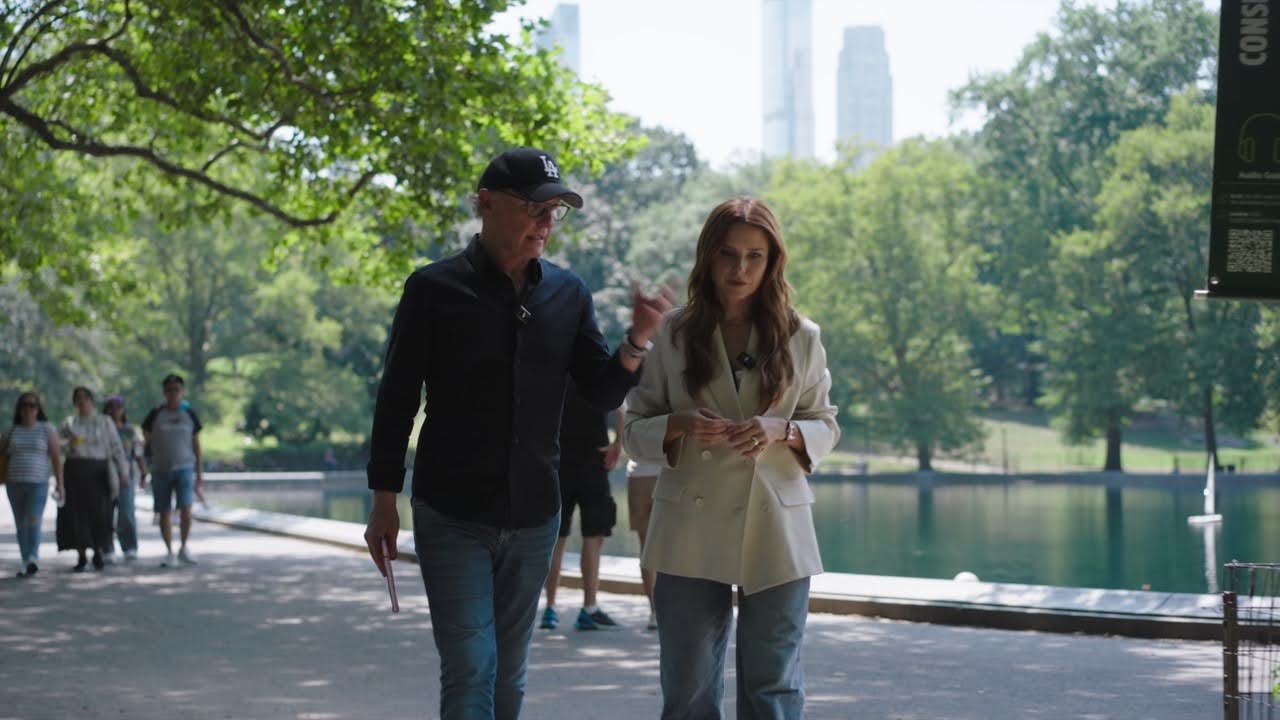
Debanjan: Given the sheer volume of hundreds of conversations the doc encompasses, what was the process of skimming, whittling, and drawing certain throughlines? What key/recurring ideas jumped out at you when you first cobbled through all the footage?
Adam Mason: When I watch it back now, I’m kind of bewildered by how we did it, because it was such a colossal undertaking. But gradually it started to take form… mostly because the same themes would invariably arise in every interview we did. Once I identified the structure of the doc, things started to take shape. David (McCourt) was really the driving force behind Amerigo. The story started through countless hours of conversations with him and his fascinating mind on how to blend his own story, but also make this documentary about everyone else’s story, too.
He represents a generation of Boston-bred entrepreneurs whose families carried that local grit onto a global stage and became true success stories. The contrast between his grandfather’s era and today becomes a powerful lens for understanding what’s changed and why the American Dream of building roots feels increasingly out of reach today.
It took our team three years to conduct more than 500 interviews across the U.S. and abroad. We spoke with voices including activist, actress, and podcast host Sophia Bush; journalists Charles Sennott and Megan Greenwell; and internet pioneer Vint Cerf, to build a layered portrait of how wages, housing, and shifting cultural expectations have reshaped what people now consider “a good life.”
I’m not going to pretend it was easy to capture all those interviews because it wasn’t. At first, I was channeling David’s desire to answer a question rooted in his grandfather’s legacy: How can someone own a home on an average income, support a family, and still hope to die debt-free? I initially saw myself as a director for hire, helping bring David’s larger vision to life. But as the days went on, those themes became personal to me. I came to realize just how much the American dream has shaped my own life and how much it still does.
Debanjan: What space did the format and structure hold in the assembling? Since this is so talky, how did you work at keeping a certain momentum and not turn it too dry? Was that ever a consideration?
Adam Mason: The ace we always had up our sleeve was the American people themselves. Whatever anyone wants to say about the documentary, I will defend the integrity of the everyday Americans who gave their time to us until the very end. What astonished me most is that, experts aside, the film is built largely on conversations with people who had zero prep time. We approached them at random, put a camera in front of them, pressed record, and every single person spoke with clarity, honesty, and power.
There wasn’t a single person who was rude or cagey. People wanted to talk. It really helped reaffirm for me what makes America special. The reality is that there really is nowhere else on earth that is as cosmopolitan as America. And sure, with that has come a lot of conflict… but at its heart, America is a deeply welcoming country.
Debanjan: Do you view the palpable loss of community as one of the biggest contemporary dangers?
Adam Mason: 1000%.
The internet has given rise to a new kind of toxic community, one that’s created and continues to widen, a seismic rift across society. That’s hard to deny. As David says in the film, we’ve never been closer together, yet we’ve never been further apart. To me, the echo chamber of the online world is the single greatest threat to the American Dream.
Debanjan: How vital was it to wrap on a parting note of radical hope in the youth?
Adam Mason: For us, it was vital. As a father to three young American kids, all I want is to see them given the same opportunities I was. Young people have so much to worry about these days. And the opportunity for them to own their own piece of America has become harder and harder for them to achieve.
But at the same time, the great melting pot continues to stir, and as a result, young people today are growing up with their minds open. I really believe it’s up to them to take the American dream they have inherited and mold it with their own hands.
Debanjan: Since we are called High On Films, we always ask our guests what, according to them, were like two-three films (it’s great if you can tell me five) where you thought cinema reached a high, say films that just did it for you…
Adam Mason: For me, the greatest achievement in film history is “Withnail & I.” That’s a movie that I’ve seen hundreds of times, and I never tire of it. It’s the most beautifully written, beautifully shot, beautifully acted film I’ve ever seen.
“Heat” is another movie I can just watch over and over. Same with “Man On Fire” and “True Romance.” Love some Tony Scott.
Then I’d say the “Before Sunrise” trilogy.