If there’s one thing Kim Byung-woo’s ginormous hit, “The Great Flood” (Original title: Daehongsu, 2025), has in surplus, it’s ambition. In an age where films are increasingly cutting down on appetite for risk and boundary-breaking leaps, it’s always pleasing to come across something that marks a departure, which does want to fly high and go for broke.
But it must be grounded in cohesive, coherent storytelling, else it’ll just scatter apart under its own lofty weight and unembarrassed flighty impulses. This film isn’t just a regular disaster flick, but wants to luxuriate in abstruse designs and narrative bends. A lot of it is kept wilfully foggy, out of reach, before you can piece together the shards.
Suddenly, the director senses a need to offer explanations and reasons that are hastily doled out. This doesn’t segue into a logical continuity; a jarring dissonance remains in place, which furthermore puts the film through its undoing. To achieve mystery and lace clarity is always a delicate balance; too much of either ends up sullying the mix. The film batters the viewer but also douses them soon after. There are too many loose ends, and the tussle between ambiguity and overdone explanations doesn’t quite gel here.
The Great Flood (2025) Plot Summary & Movie Synopsis:
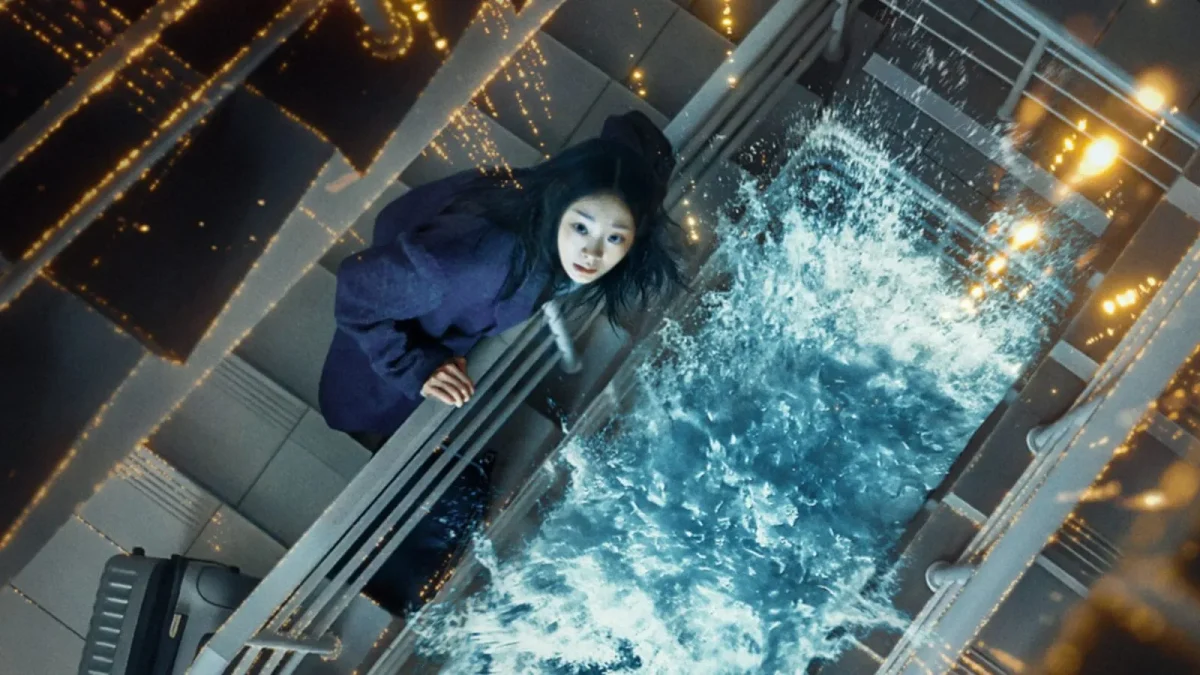
The film opens with a massive flood threatening the planet. It’s an apocalyptic situation that is poised to end the entire world, wipe out generations. We’re taken to Seoul, specifically a mother’s situation. Gu An-Na (Kim Da-mi) and her young son Ja-In (Kwon Eun-sung) struggle one morning to see a flood rendering all their lives precarious. The neighbours are rushing to get away. But the floods seem indomitable for the mother and son. Thankfully, a mystery man, Son Hee-jo (Park Hae-soo), steps forth and extricates them from the scene. It will soon be clear that the mother is more of a person of priority than she initially appears.
The problem with the film is its escalating incoherence. There are ideas here about family, identity, what it takes to weather the worst odds, the race for survival. But they get swatted aside by the over-reliance on CGI-streaked sequences that are progressively overstretched and exasperatingly one-note. Like every other disaster film, this winds up in a climax of overexerting scale. Hence, even when the early stretches are promising and taut, it becomes increasingly defused by overkill, unalloyed, unchecked indulgences of its distress mode. The ambition it had initially waved gets muted by dullness.
How does An-Na get separated from Ja-In?
Much of the first half is a hurried scramble for a place of safety. An-Na has to bear the tragedy of her parents being ripped away. It’s her child whose concern anchors her. It’s for him she keeps breathing. Worry over him lends her life agency and priority. She is impelled to be a certain way because apprehension over him grounds her. She does whatever she can to make the best of their circumstances, driven by thoughts of how he will pull through. The mother-son duo is kicked by the most terrifying situations, crises that threaten to shatter everything.
Also Read: The 40 Best Korean Movies of the 21st Century
Whether Ja-In is a real boy gets increasingly blurred by a slew of situations. An-Na manages to resurrect him with orange juice. The bizarreness gets progressively heightened. An-Na conjures human infants and transfigures them through developmental experiences. This is tied to events that precede the film by five years, linked to happenings at the Darwin Center.
Against her initial knowledge, her colleague Hyeon-mo wasn’t killed by the flood. She was unwilling to part with her child and thus fled. She knew the lab would steal the child, and couldn’t risk it. Hee-jo turns the mother and son over to the lab’s personnel. An-Na is devastated at the separation and suggests that Ja-In hide in the closet. Hee-jo is bumped off by the guards.
What grief has An-Na been holding?
An-Na volunteers to prepare a simulation of a mom. It’d fulfil her fantasy of being reunited with Ja-In. In that emotion engine, she’ll search for the child, and hopefully, there’ll be a reconciliation. When the original counterparts have been put through stakes and annihilated, at least the simulated layer is vested with wish-fulfilment. The real An-Na dies soon after her child’s death.
Therefore, the simulated selves will carry forth the desires and aspirations. The simulation becomes a form of course-correction, a manner of righting the wrongs and redoing whatever things had gone awry in the real world. In this manipulated, manufactured reality, there would be more kindness and a chance of remaking destiny.
All An-Na is certain of this time around is that she must stick by her child. She cannot afford to lose him yet again. We watch several sequences of loops. It’s only in later iterations that An-Na pulls Hee-jo in to her side, and the two embark to rescue Ja-In. As much of a reprieve the loops promise the mother, it’s a sustained illusion. An-Na has to stumble too many times before she can pull herself up, use tact and intelligence to pre-empt familiar blocks, and grab what she has long sought. The tension over togetherness is what propels the film.
The Great Flood (2025) Movie Ending Explained:
Is An-Na reunited with Ja-In?
The mother has to go through umpteen loops and come up against the most wrenching circumstance of her child being taken away. In the climax, she rushes to the rooftop and finds Ja-In immobile in the closet. Somehow, she rouses him with orange juice. She promises to be with him, beyond the bounds of reality and human configurations.
The mother-son bond is indeed intact. In the middle of the credits, another scene pops up. An-Na gets out of the engine and simulation. They are all set for Earth. It’s revealed that the entire planet was not wholly submerged. An-Na taps the data and creates a human AI mother. The film problematizes the differences between humans and manufactured AI. What does the engine really aim to save?
Humans or technologically moulded variants? The film dismantles the boundaries and replays it vis-à-vis the narrative structure. It might get confusing and too convoluted for its own good. The journey via the multiple loops is designed to extract accruing emotion, which only defuses due to unnecessarily jumbled narrative logic.
This is what occurs, and the flaws are never fixed or tamed. The narrative complications aren’t served well or put in consonance with any emotional throughline. Just the notion of a mother continually staring at a fate where her child is taken away is horrifying and depressing, but it never finds any abiding, consistent rhythm. Where is the grief, desperation, the elemental tragedy, the very circumstance holds?
All the jumps in timelines don’t ever lead to a place where real emotional meaning is forged. The mother-son duo makes their way on the spaceship to earth and you only hope they will be safe wherever they land. It’s a pity the film pushes them through endless convolutions but never a space where sincere emotions are well-earned.




![Sometimes in April [2005]: A Hard-Hitting Docudrama](https://www.highonfilms.com/wp-content/uploads/2016/01/95c5f123-50fd-4337-a056-e18d697be565.jpg)