
Modern dating and intimacy are increasingly intricate, where subtle details now carry more weight than ever before. Independent individuals seek space to understand their desires, while personal beliefs and viewpoints lay the foundation of any relationship. Physical attraction, too, is more openly acknowledged as a way to deepen mutual understanding.
Vaibhav Munjal’s debut feature “Scenes from a Situationship” engages with these evolving dynamics, using its protagonists to strike a measured balance between what liberates and what constrains, not just the people involved, but the very idea of a relationship itself. The movie is about two people, Udit (Vaishnav Vyas) and Tanisha (Shreya Sandilya), who are trying to build a relationship amidst their conflicting ideas and lifestyles. The dichotomy of conviction and commitment forms the axis of the story.
The Noticeable Anomaly
The film opens with a tight focus on Udit as he explains the formation of oregano to Tanisha. She is gradually introduced into the frame, signalling her effort to engage in a conversation that neither interests her nor aligns with her expectations from the date. The scene employs a wide frame only twice. But with the gaining momentum of dialogues, the frame becomes individualistic, which creates a sense of emotional distance between the audience and the characters.
In Damien Chazelle’s “Whiplash,” the date scene between Andrew (Miles Teller) and Nicole (Melissa Benoist) unfolds with fluid dialogue, sustained body language, and responsive reactions that keep the emotional rhythm intact and draw the viewer into its trajectory. In contrast, this film often breaks that continuity whenever one protagonist speaks, the other slips out of the frame, making the interactions feel less authentic.
The director’s pop-culture references and cinephile sensibility come through both actors, lending the scene a playful tone, though it ultimately resonates with a niche audience familiar with those cues. In the same sequence, Udit attempts to break the ice verbally but repeatedly looks away, giving the moment a rehearsed quality, which he partially redeems through his conviction. Tanisha delivers a more assured performance, marked by controlled intonation and nuanced dialogue delivery. Still, the screenplay loses momentum when their attempt to bridge differences relies on referential commentary rather than a genuine, evolving exchange.
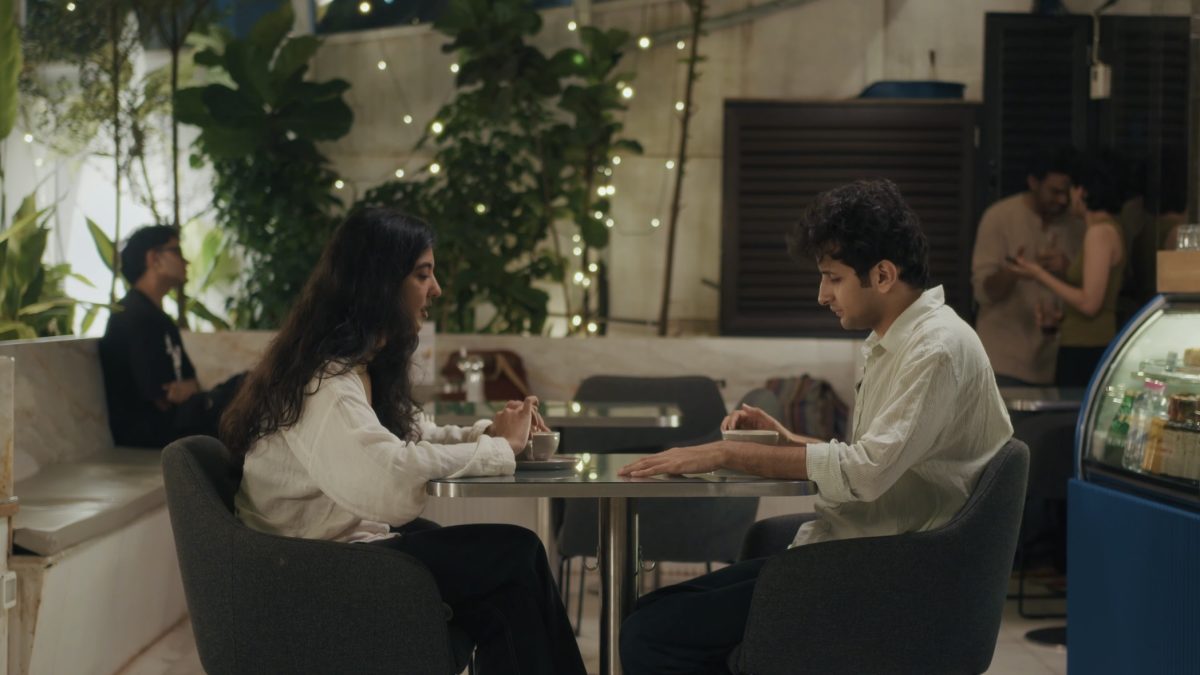
English dominates the film’s dialogue, yet the screenplay and direction provide no sense of place, weakening the social context behind this linguistic choice. Hindi appears only in fragments, suggesting an attempt to universalize the dating experience rather than anchor it culturally. The smoking scenes feel staged, performed for the camera instead of emerging organically from the situation, which distances the audience from the moment. While shifts between static and mobile camerawork can be effective, here they occur within the same scene and space, rendering them visually redundant.
The absence of long shots in multi-character frames further limits immersion. Additionally, aside from Udit and Tanisha, other characters are introduced without narrative grounding, despite their importance to the film. Abrupt cuts and the sudden insertion of unrelated scenes weaken the narrative logic.
For instance, following Udit’s rude voice note, the film immediately cuts to an intimate moment between him and Tanisha – a transition that feels unearned and incoherent. The setting of this scene is also left undefined, raising basic questions about whether the space is a home, hotel, or homestay. This confusion deepens when the room does not resemble Udit’s, yet the two decide to book a homestay the following day. Such inconsistencies highlight the film’s weak editing and disrupt narrative continuity.
The Figured-out Goodness
The film confronts several vital yet often overlooked aspects of love with notable courage. From male insecurity to a fear of commitment, Munjal examines these themes with striking honesty. Words spoken in moments of anger or vulnerability are rarely reconsidered, even though their consequences linger – a truth the film captures effectively.
During Udit and Tanisha’s conflicts over personal autonomy, the narrative invites empathy for both perspectives, regardless of individual bias. Sexual dynamics are also explored, revealing how, even within a modern outlook, patriarchal conditioning often centres male desire. Through moments of both intimacy and emotional distance, the film underscores the urgency of looking beyond masculinity and its inherited impulses.
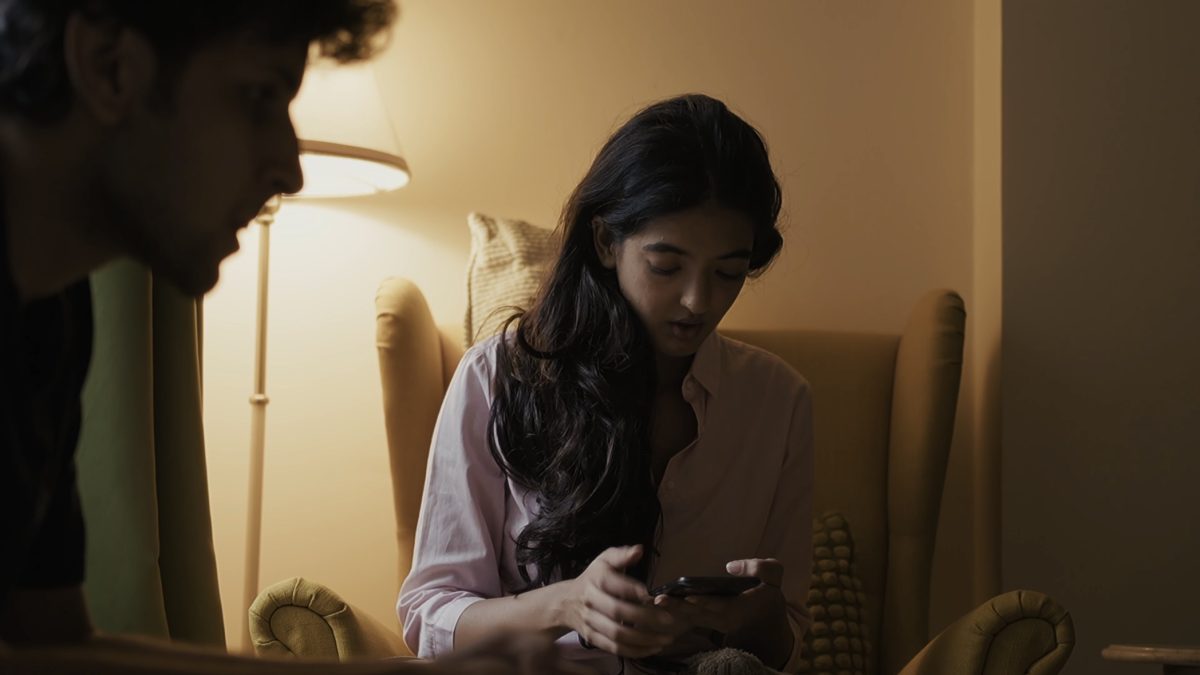
We live in an age where content has a fleeting lifespan, and relationships, along with individual freedom, often dissolve before emotions can fully surface. Both Udit and Tanisha become casualties of this heightened self-awareness. In a key moment, Udit is shown at his most vulnerable, seated on a couch with a bookshelf behind him – a visual echo of Christopher Nolan’s “The Dark Knight,” where a similar composition conveys the concealed truth and inner conflict of Commissioner Gordon.
The wide frame, paired with muted tones of the sofa and cushions, lays bare Udit’s fragile state: anxious, insecure, and riddled with self-doubt. While a few scenes feel stretched, they mirror the lived reality of couples struggling to understand the shifting dynamics of their relationship. Labels in relationships are natural, even inevitable, yet they often overwhelm one or both partners. The intensity they carry is shaped by the human mind and can gradually erode the core of love itself. Despite its technical shortcomings, the film ultimately presents two people in love, striving to move beyond labels, repeatedly succeeding and failing in equal measure.
The film’s open-ended conclusion falls short, as dialogue overwhelms the characters’ internal conflict rather than revealing it. “Scenes from a Situationship” speaks primarily to those navigating relationships shaped by digital validation and diminished accountability. It shifts between restraint and intensity, succeeding only when an emotional connection forms between the viewer and the narrative. While the film carries echoes of many others, it also attempts to assert an individual voice.
Whether audiences engage with that originality or get lost in its familiar reverberations remains uncertain. Although it addresses the complexities of modern dating and intimacy, its understanding of love, nostalgia, and emotional nuance remains largely linear, reducing the layered realities of contemporary relationships.



![Lair [2021] Review: Horror Lies in Subjecting Yourself to This Film](https://www.highonfilms.com/wp-content/uploads/2021/11/The-feet-3_1-768x566.jpg)
![Hostages [2017] – Tense and Tragic Drama Set Behind the Iron Curtain](https://www.highonfilms.com/wp-content/uploads/2017/12/cover-768x432.jpg)
![Plan B [2021]: ‘HULU’ Review – Been There, Done That](https://www.highonfilms.com/wp-content/uploads/2021/05/Plan-B-1-highonfilms-768x512.jpg)