
It’s hard to articulate the nature and intent behind “Two People Exchanging Saliva” (Original title: “Deux personnes échangeant de la salive”), let alone explain its plot in simple terms. This French short film, written and directed by Natalie Musteata and Alexandre Singh, takes place in an alternate version of contemporary society.
Yet, it operates on hierarchies similar to those we observe in our world. Even here, some exist to serve, while others exist to benefit from that service. It creates a wall that separates their lives, making it seem like they live in completely different realities. One side is not allowed to mingle with the other, unless through clearly defined and regulated relationships.
Even here, the privileged lead their lives to enjoy their riches, while others lead theirs through monotonous routines, hoping that it will help them with upward mobility. Thus, it’s not difficult to see ourselves in these characters based on their hopes, dreams, or societal status. That, however, becomes challenging once the film reveals the absurd norms that separate them from us. In this world, pain and pleasure are perceived far differently than how we do. Even an intimate act, as explained in the title, is considered taboo, while pain is strangely desirable.
We witness it as Angine (Zar Amir Ebrahimi) decides to pay for some products at a department store that she frequently visits. She faces Malaise (Luàna Bajrami), a cashier on her first day at work. Malaise is young and inexperienced, as opposed to Pétulante (Aurélie Boquien), who’s known for her wealth of experience.
She prides herself on accruing the highest commission for any salesperson in that store. Over time, she has developed a unique bond with Angine, which makes her think that she knows this sophisticated customer like the back of her hand. She can push just the right buttons to make Angine spend a considerable amount. At least she believes she can.
Also Read: 10 Best Movies That Poignantly Explore Girlhood
That certainty begins to fade as Malaise starts her first day at work. During the introduction, Pétulante assumes that Malaise isn’t attuned to the ways of this world as she is. Malaise seems too candid to put on a performance that can win over a customer. You notice Pétulante’s smug disdain as she observes Malaise, thinking her inability to be anything but herself would get in her way. It also leaves her with heightened confidence about her own competence, believing no one else can achieve nearly as much as she does, especially not Malaise. Yet, Malaise smashes her self-perception, that too, by winning over a client who has been under her spell.
The drama that unfolds between these two employees, although thoughtfully rendered, is only a part of what makes the film memorable. Instead, the film appeals through the way it portrays repulsion and desire. It paints a world where desire invites humiliation, while pain becomes a form of currency that the privileged consider almost as a badge of honor.
They walk around with signs of wounds without any shame or embarrassment, but refuse to express their romantic desire through any form of representation, let alone acknowledge it. The titular description itself is laughingly matter-of-fact, revealing the act in detail, almost like it’s a sex ed chapter for teenagers, or how an alien would describe it if they happened to see it for the first time.
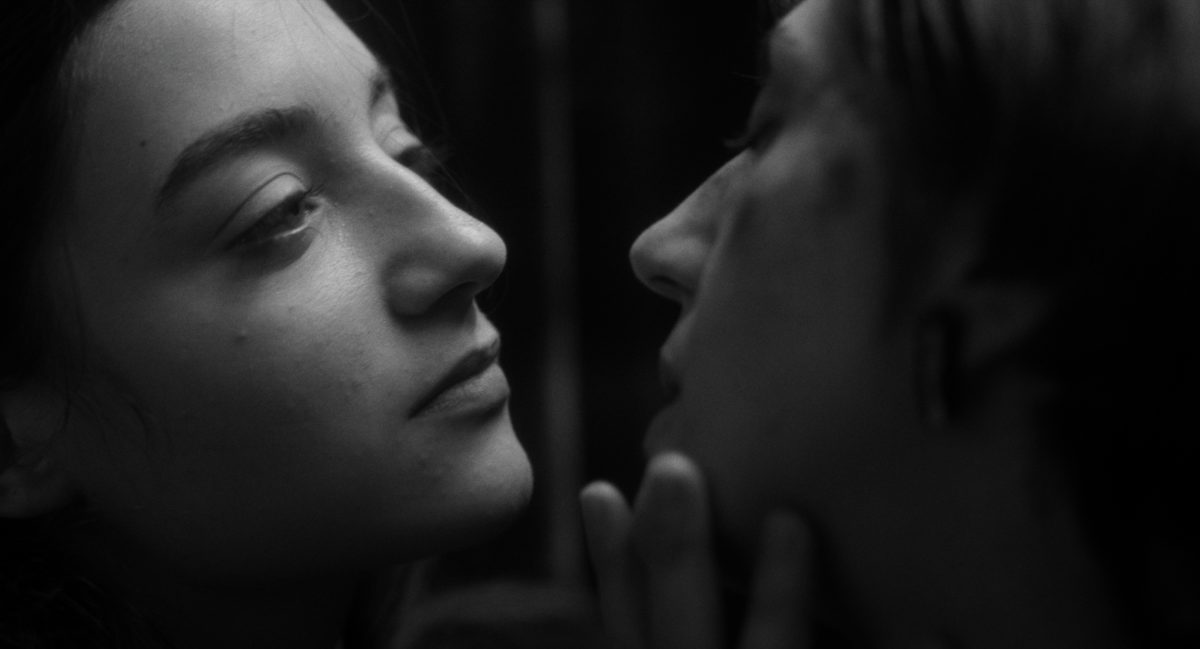
Musteata and Singh use this otherworldly premise to build an intricate drama about sexual frustrations and romantic maladies. Throughout its 36-minute duration, the film doesn’t show an act of romantic union. Yet, it somehow becomes a deeply sensual film simply through the way it presents yearning and forbidden desire. That’s why it feels stylistically closer to Jim Jarmusch’s “Only Lovers Left Alive” or Ana Lily Amirpour’s “A Girl Walks Home Alone at Night.”
Also Check: 20 Best Black and White Movies of the 21st Century
Of course, there are no vampires in its world, nor does the story unfold only at night. Yet, it is drenched in a similar nocturnal haze, where characters feel as lonely and desperate as the bloodthirsty creatures. Their hunger feels as intense and palpable as Jarmusch’s film, while their world seems as haunting and unsettling as seen in Amirpour’s film. On the surface, they perform sophistication as an inescapable ritual, but it feels like a veneer, trapping and forbidding them from experiencing their most primal instincts.
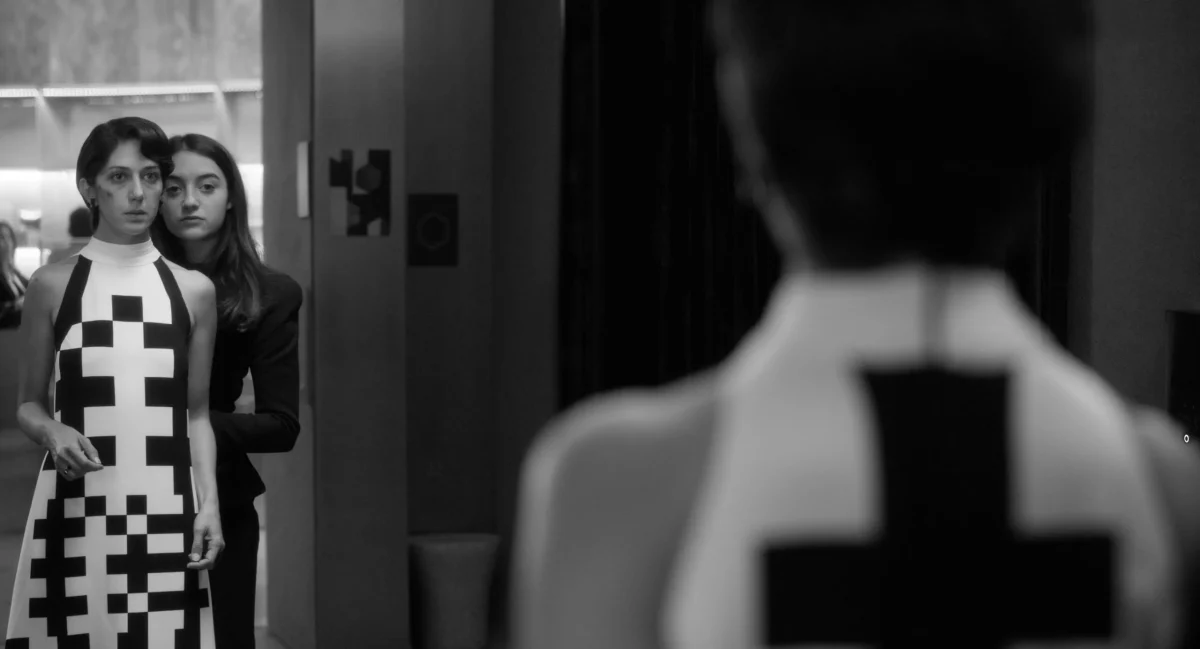
Alexandra de Saint Blanquat’s gorgeous black-and-white cinematography draws our attention through an elaborate play of lights and patterns that convey their haunting state of mind. Rezvan Farsijani’s costume design serves as a catalyst in this process, revealing psychological layers through the simple contrasts in shades and silhouettes. Their contribution, along with Anna Brun’s production design, helps create a gloomy cityscape devoid of warmth or color, while utilizing visual motifs to convey their emotional state.
Bobak Lotfipour’s score of gentle string arrangements pairs seamlessly with those visual elements, while maintaining their inherent lyricism. Furthermore, Ebrahimi, Bajrami, and Boquien, who play the central love triangle, hold our attention through their delicate, reserved, but magnetic performances, inviting us into the emotional mess of their characters, while leaving enough room to entice us with thematic layers beneath their facade.




![Josep [2020] Review – Portrait of an Artist through Fading Memory](https://www.highonfilms.com/wp-content/uploads/2021/02/Josep-2020-768x425.jpg)
![Counterpart [2018–] – A Captivating Otherworldly Premise that Burrows Deep into Human Self](https://www.highonfilms.com/wp-content/uploads/2018/04/cover-1-768x432.jpg)

![The Happiest Day in the Life of Olli Maki [2016] – The Existential Struggles of a Fighter](https://www.highonfilms.com/wp-content/uploads/2017/01/Olli-Maki-Cover-768x403.jpg)