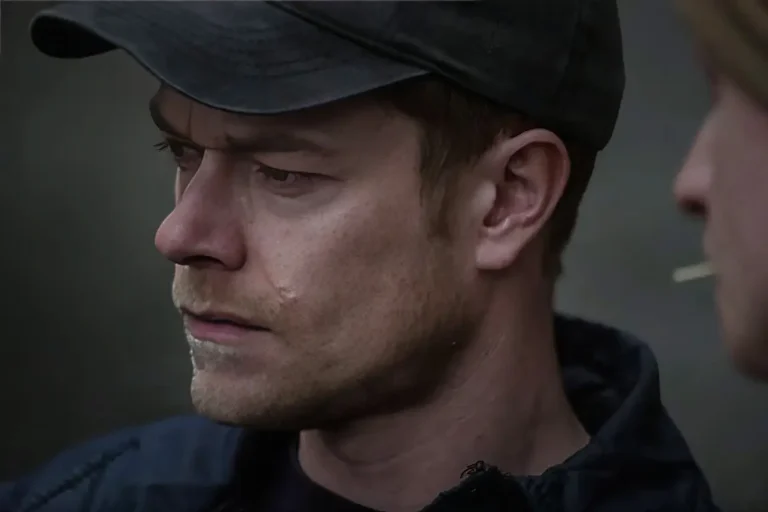
“The Dutchman” (2025) is a fascinating work of adaptation, given that it is both a cinematic recreation of a stage play and a meta-commentary on forms of expression. The original stage play “Dutchman” by Amiri Baraka was a biting commentary on race relations that debuted amidst the Civil Rights movement in 1964. Although much of the context is changed for Andre Gaines’ film adaptation, many of the themes remain more relevant than ever.
“The Dutchman” is expressly structured in a way that could never be delivered on stage, and goes beyond the original material to examine the recurring indignities suffered by Black men over the course of generations. While it sometimes has a hard time developing its themes without stating them outright, “The Dutchman” has so much on its mind that it’s consistently worthy of consideration.
“The Dutchman” begins with a therapeutic session between the married couple Clay (Andre Holland) and Kaya (Zazie Beetz), who meet with the professional Dr. Amiri (Stephen McKinley Henderson) to discuss the wavering loyalties within their relationship. Clay, who is expected to give a speech on behalf of his friend Warren (Aldis Hodge), a candidate for City Council, is plagued by feelings of insecurity as he considers the notion of “double consciousness,” a concept developed by W. E. B. Du Bois, when discussing the dilemma faced by Black Americans.
It’s during a trip on a New York subway that Clay is approached by the enigmatic woman Lula (Kate Mara), who targets him for seduction. Although Clay attempts to resist her alluring presence, Lula is determined to draw Clay into a path that begins to feel strikingly familiar.
Those familiar with the New York theater might be able to identify familiar hallmarks in the story. The layered conversation of a dinner party, lonely walks down empty streets, and intimate encounters on public transportation have been depicted many times before in the art produced by the city’s arts department. However, Gaines seems aware of these repetitive tropes and uses them to make a larger point about how little society has changed since “Dutchman” was first written.
Even if Clay is a respected and hard-working member of society, he’s still trapped in an awkward position where any success on behalf of local infrastructure will be folded into the power of the white establishment. He’ll never be treated equally by the real decision-makers, but attempts to climb the social hierarchy also deplete his reputation in the eyes of his community. There’s also the frustrations that he feels based on his wife’s infidelity, as society has not been able to empower Black masculinity without treating it as a threat.
These ideas are often conveyed through prolonged conversations, as it’s in Clay’s nature to articulate the multifaceted turmoil he’s feeling. It’s a fair way to depict the character, given his expertise as a speechwriter, even if it does begin to feel overstated when this willingness to self-analyze is shared by the entire cast of characters.
However, “The Dutchman” is an impressionistic story, not a realist one, and Gaines finds some creative ways to convey Clay’s double consciousness by questioning the nature of his reality. The flashes of different paths, timelines, and decisions can sometimes feel jarring, but do succeed in heightening what would have otherwise been a series of extended conversations.
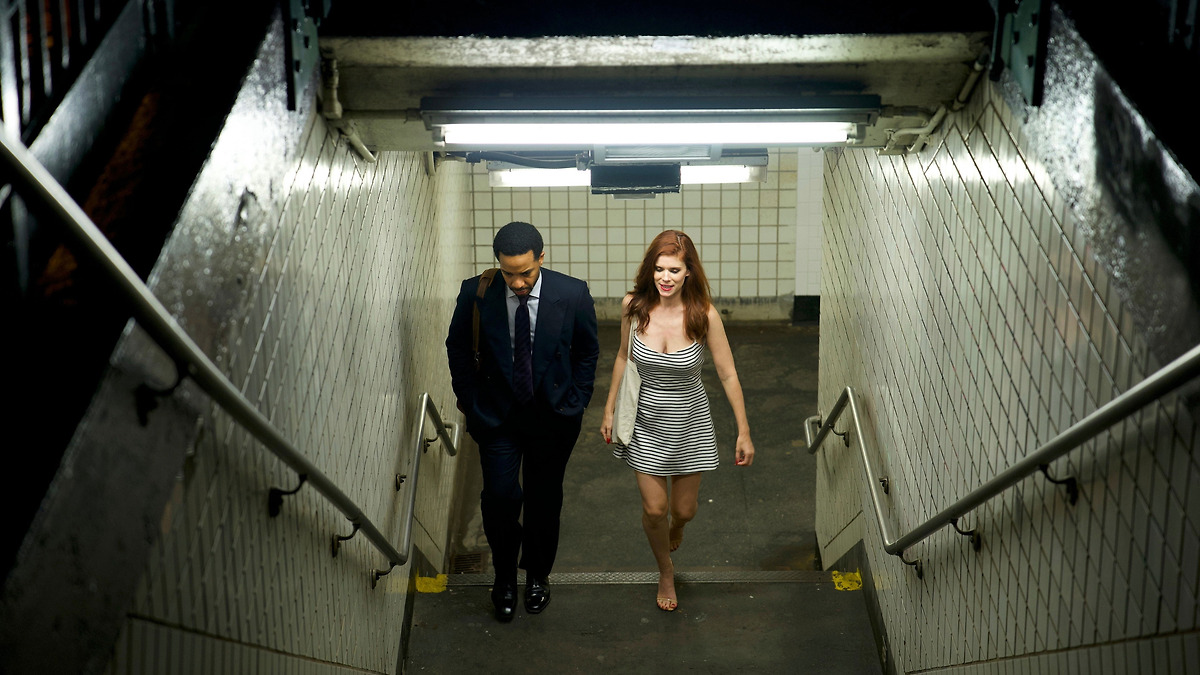
Despite the indications “The Dutchman” makes towards where and when its climactic moments will air, there is a sense of unpredictability within the malleable relationship between Clay and Lula. There’s a deliberate choice to remove any sense of attraction between them, as Clay has been so lost in contemplation that he’s almost become a non-sexual being. Alternatively, Lula seems only interested in provocation and doesn’t seem to consider Clay as anything other than an object to bother.
The frank sexual politics regarding a white woman who feigns victimization are intended to be disconcerting, but Mara’s performative choices are nothing if not intentional. Whether or not the film’s justification of why Lula appears in this way is satisfying, Mara seems aware that the character she is playing is intended to provoke strong reactions.
Holland is reliably excellent in a role that mirrors his performance in last year’s “The Actor,” another psychosexual drama based in New York’s theater district that reflected on art and performance. Although “The Dutchman” is reliant on its audience’s willingness to engage with its subtext more than its characters, Holland brings to life a fully-formed person in Clay, who just so happens to be at a breaking point both personally and professionally.
The desperation, frustration, and inability to accept rage that Holland finds within the role certainty adds to the suspense of “The Dutchman,” which certainly comes in handy during its clumsy third act. Although the story reaches a point at which any literal interpretations are incomprehensible, Holland doesn’t fail to find emotional truths within the material.
The meta-textual qualities that “The Dutchman” has are intermittent in their effectiveness. On one hand, the exploration of how Black trauma has been preserved, translated, and occasionally tokenized by artistic expression is a fruitful concept that challenges the viewer to determine the differences in film, theater, and memory.
However, the film’s decision to develop such a sprawling commentary on repetitiveness in art does make it harder to identify a specific time, place, and context to the story at hand, which does make it harder to buy in emotionally to the facets of Clay’s reality. The decision to depict the story entirely from Clay’s perspective does lead to some compelling, visceral choices, but it does leave some of the supporting characters with underwritten roles. Beetz, who had excellent chemistry with Holland in the underrated Steven Soderbergh film “High Flying Bird,” feels particularly underutilized.
To say that “The Dutchman” is more compelling to think about than to view isn’t necessarily meant to be derogatory, as the ideas that it introduces could only be done so as a result of the specific ways that Gaines chose to tell his story. Although the logic of the film can get tiresome thanks to some unusual third-act reveals, it does find palpable ways of identifying uncomfortable societal issues that are frequently considered too taboo to discuss. The shortcomings of “The Dutchman,” as glaring as they may be, stick out because of how much the film gets right.





![This Is Not Berlin [2019]: ‘Tribeca’ Review: The Outsiders](https://www.highonfilms.com/wp-content/uploads/2019/05/this-is-not-berlin-1-768x385.jpg)