A quietly interrogative Marathi film, “Sangala” (“Bottom Water”) draws its strength from the slow beats of its plot and the lively stillness of its frames. There isn’t always much happening in the frames, but they offer a lot to think about. Set in the drought-stricken region of Marathwada in Maharashtra, India, the film puts the audience in the midst of the scorching summer sun imposing itself on the dry grass and cracked earth.
Produced and directed by Raoba Gajmal, the film takes its name from a deeply symbolic idea, sangala—the water which is accumulated at the bottom of a well. This water at the bottom represents many ideas of the film. It represents the condition of the people currently living in the villages of the region, as well as the relationship of Bali (played by Anil Dabhade) with his son, which has now gone to irretrievable depths.
The inaccessible water at the bottom of the well also represents the last hope, which is very much personified through its protagonist, Bali, an aged and self-respecting farmer, who refuses to give up in life. “Sangala” follows his story and shows how he refuses to surrender to the harsh circumstances that have broken everyone else around him.
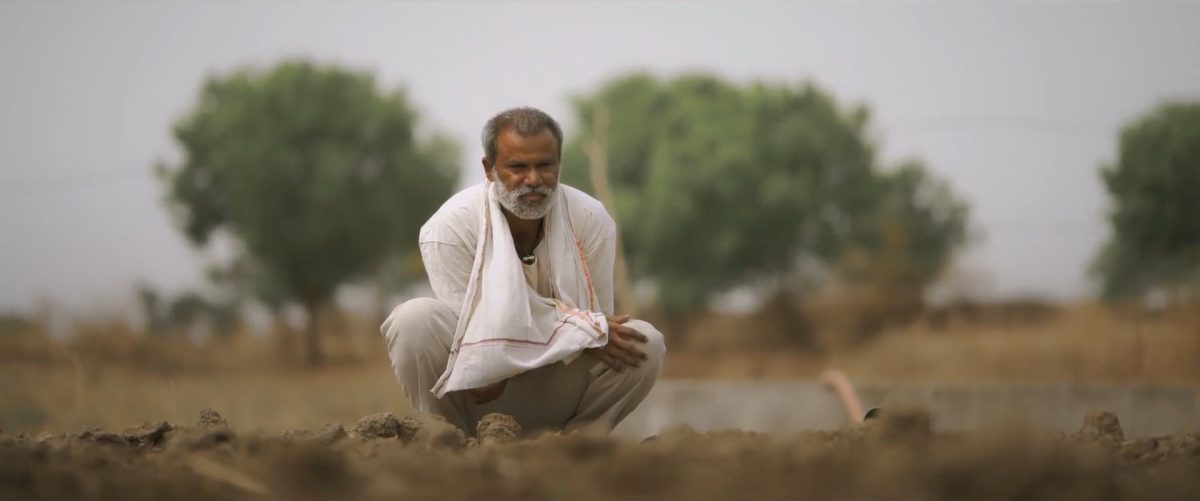
The drought, as mentioned above, has emptied wells, cattle sheds, and also the consciences of the people. The villagers are struggling not only to provide food and water for themselves but also to meet the dietary needs of their domestic animals. Amidst rising expenditure and unfavourable natural situations, many villagers have also sold off their agricultural lands to commercial establishments for their survival. Some people have also moved on to the city.
Bali’s son is also lured by such prospects, and hence he repeatedly pressures his father to do the same. But Bali disagrees, and this becomes the basis of a silent conflict between the two. The crisis of the barren land, which can no longer be cultivated, is so severe that the son has already sold parts of their property to pay for his pregnant wife’s medical bills. But Bali is firm in his decision. He won’t give away his land, however extreme the situation may be. And his stubbornness is born out of a belief – a belief in land, labour, agriculture, and hope.
In such a situation, even his wife, exhausted by household work, hunger, and responsibility, turns to nagging him at the slightest inconvenience. She constantly scolds him for lying idle at home and not helping her with the chores. One morning, she also forces him to arrange some water and fodder for their pregnant cow. To fulfil this task, he arrives at the well located in the midst of the barren fields, only to discover that the water pump is broken.
The rest of the narrative follows Bali as he struggles to fix the pump and reach the water at the bottom of the well. He repeatedly puts his life at risk in his determination to obtain water. This also pumps up the stakes of the plot as his actions keep the audience on the edge of their seats. His struggle for survival is turned into a tense, life-or-death ordeal. In the process, he also realizes his helplessness and his inability to provide for his family.
The film’s narrative is kept very gentle and simple, and it takes place over the duration of a single day. Almost the entire story revolves around the various possibilities of repairing the water pump placed inside the well. This slow unfolding is where “Sangala” (2025) finds its unhurried yet emotionally imperative flow. Each failed attempt to fix the pump mirrors the repeated failures of society—to help, to understand, to stand by someone who chooses their self and dignity over popular convenience.
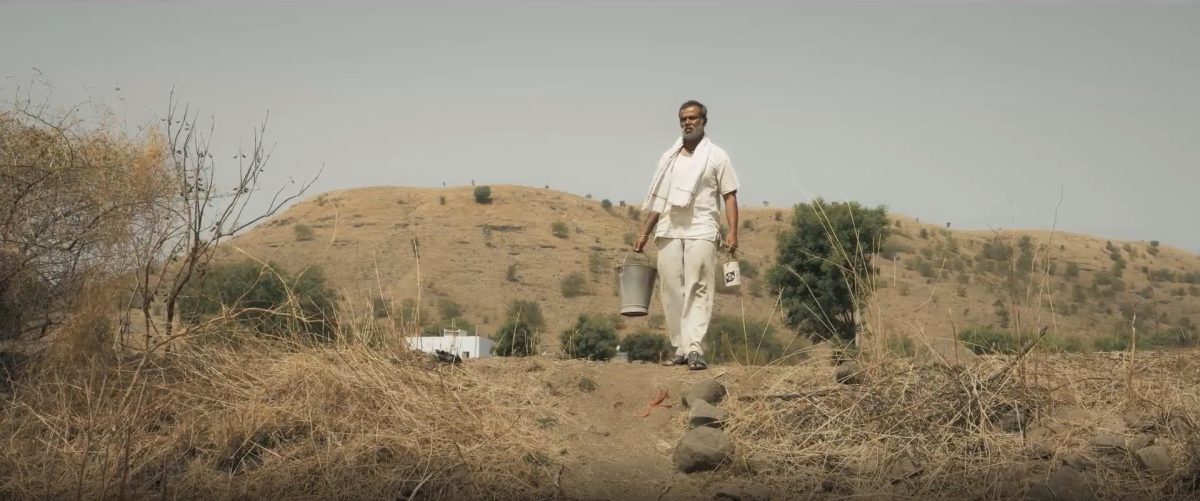
In other ways, the well itself becomes the film’s most powerful symbol. It represents a source of life, as well as the depth of the struggles that the farmers in rural India face. As Bali descends into the well, alone, abandoned by every passerby, and even ignored by his own son, the act also becomes a sign of resistance and protest. He is only helped by one individual whose identity is reflected by his white cap rather than a name. The film, written by Raoba Gajmal, also tries to shape a moral tragedy through the simple tale as it reflects on the harsh truth of survival.
After considerable struggle, the water finally begins to flow, yet this moment opens up pressing real-world questions about agriculture, environmental responsibility, and the ecological future of village life. These are uneasy questions, often pushed aside and left buried beneath the economic logic of so-called progress. The realist, immersive storytelling of “Sangala” (2025) never raises its voice over farmer distress, drought, or policy failure. Instead, it draws these concerns closer to the audience through intimate themes of isolation and moral resistance.
“Sangala” (2025) and its lead, Anil Dabhade, were felicitated at the 23rd Pune International Film Festival 2025, winning the Sant Tukaram Best International Marathi Film Award and Best Male Actor Award, respectively. Besides, it was also screened at the 17th Habitat Film Festival, 2025, and the 22nd Third Eye Asian Film Festival, 2026, among other film festivals. It is shot by Anil Appasaheb Bade and edited by Bharat Jadhav Umapurkar with sound and music by Prashant Kamble and Asit Sakpal, respectively.


![Needle in a Timestack [2021] Review – An original sci-fi premise ruined by bland execution](https://www.highonfilms.com/wp-content/uploads/2021/10/Needle-in-a-Timestack_Still_17-768x512.jpg)
![Phantom Thread [2017]: The Kiss of Sickness](https://www.highonfilms.com/wp-content/uploads/2018/02/Phantom-thread-768x432.jpg)
![Badlapur [2015] : An Exercise in Rage](https://www.highonfilms.com/wp-content/uploads/2017/05/327227-badlapurnew700q.jpg)