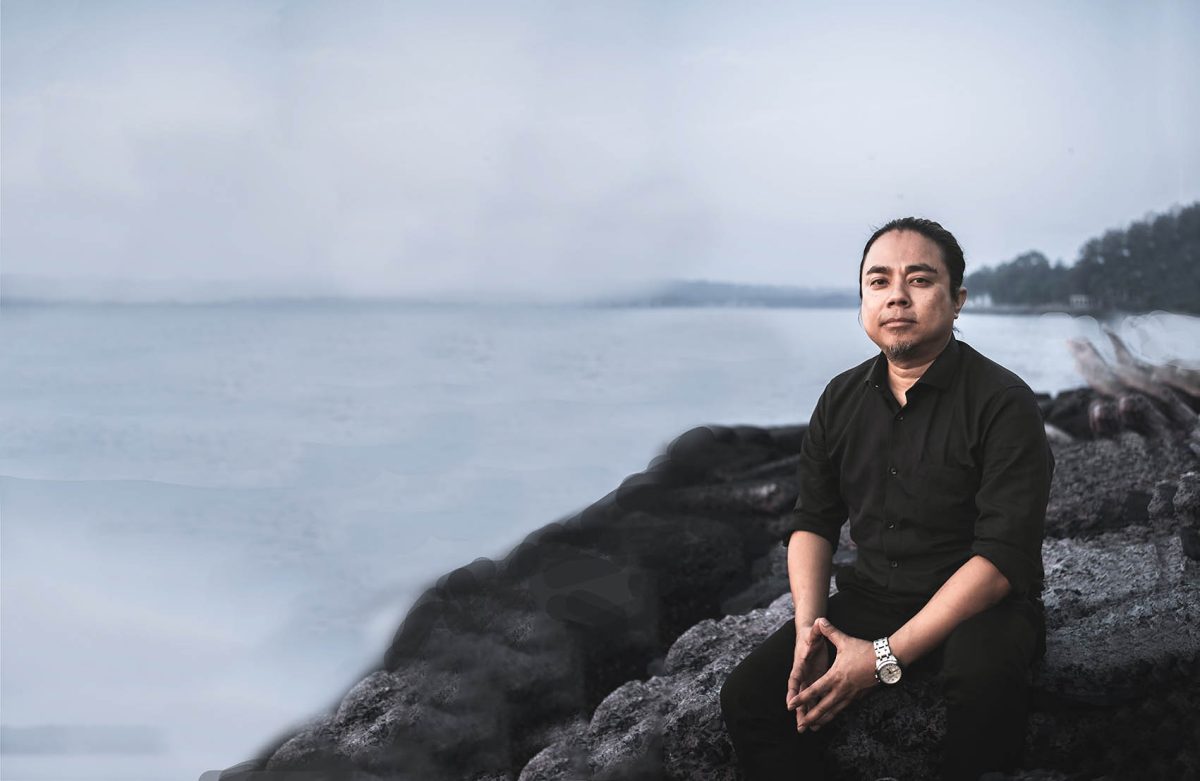
Borun Thokchom, who hails from Manipur, is well known for his documentaries, which grapple with social realities. His latest documentary “Battlefield” opened to positive audience response at the 56th International Film Festival of India (IFFI) held in India’s Goa. Borun takes a meditative look at the nature of war and its legacy as he explores the forgotten Battle of Imphal, which took place in 1944. It’s a battlefront that saw Imperial Japanese and British Allied forces indulge in a bloody war, which left the then-independent kingdom of Manipur devastated. In our phone conversation, we delved into his philosophy and filmmaking choices, which drove this project. Hope you enjoy it.
Monish Upadhyay: World War II has been widely discussed, and its lore has often been mythicized in both feature films and documentaries alike. However, not many people know about the Battle of Imphal and its impact on Manipur. How did the idea germinate in your mind and finally turn into this beautiful visual piece?
Borun Thokchom: See, every family has a story of the Second World War; people from the generation that witnessed the war often refer to it as ‘Japan Laan’. However, many in contemporary times have not really heard these stories. My father told me how, as a child, he saw villages being forced to get embroiled in the war. I met Yumnam Rajeshwor Singh, who is also a major character in the story, around 10 years ago while working as a journalist. He told me how they have started to dig for things such as bullets, unexploded bombs, and other such remnants from the battle in Manipur. We gradually got acquainted over tea, and naturally, I got curious as well.
I had heard stories of the war but had not seen its physical evidence. At the time, I was working on another documentary which follows the life of athlete Sarita Devi, and later I got to know about Rajeshwor’s success in their diggings. Initially, I just followed them but had no idea about what I wanted to convey through my story. Actually, a man named Phillip had contacted Rajeshwor to find the remains of his father, who had lost his life in the battle. So, I used to accompany him on such expeditions. Many years passed by, but they never found anything. However, the story slowly started to come to me. Although in the beginning stages, the theme of the documentary was somewhat different as I wanted to show the search for Phillip, it did give me creative direction, and eventually it turned into what we see on the screen.
Monish Upadhyay: When you were ideating and conceiving the documentary, did you know that you would find many elders who were once witnesses to the bloody war, many of them to this day scarred by the experience as they recount incidents in such fine detail, even decades after the fact?
Borun Thokchom: Actually, I always wanted to feature the voices of people who were eyewitnesses to the war. So, we interviewed many people in their twilight years, older patriarchs and matriarchs of remote villages. Our objective was to talk to as many people as possible. We were also aware that memories can sometimes be foggy or even contrived …such is the nature of memory. So, we used to cross-check these testimonies with war records, memoirs, and diaries.
The interviews and experiences that are finally showcased in the documentary are thus verified after a long process. Unfortunately, all of the older people who were interviewed have now passed away. As the audience can also see in the documentary’s final act, we have a grandmother who lost her family to the war. What we did not show was the fact that all her life, she had carried bomb shrapnel embedded deep in her skin. We thought maybe that would be a voyeuristic approach and decided to just use her very moving experience. We felt that she had gone through enough trauma in her life.
Monish Upadhyay: While you were working on this documentary, even in the initial stages, you always knew that the voice of Manipuris should also come to the forefront?
Borun Thokchom: Yes, yes, exactly, otherwise what is the point of making such a documentary? I wanted to drive home the point that we, the people of Manipur, were never part of the war. Something which a character in the story also observes. Even though initially we discuss the roles of the Japanese and the British, after a somewhat intermission in the story, it takes a turn, and we start to focus on the war’s effect on us. I mean, at the time, Manipur was an independent kingdom, and we were basically invaded by these superpowers.
We still do not have proper records as to how many Manipuris lost their lives to this senseless war. The British and the Japanese are having their reconciliation efforts, but where is the apology and grief for us? I mean, the official record only says 300 natives were killed in the war. But we all know that cannot be the real number. But you know, I just let my film speak out and not bring forth my individual biases.
View this post on Instagram
Monish Upadhyay: The documentary also explores the memory of war and how it percolates culture itself. You have showcased folk songs that describe scenes from the war itself, just like how one of the featured songs describes the sounds and movements of British and Japanese fighter jets. What was the process behind finding them?
Borun Thokchom: Yes, actually, we wanted to feature what are called ‘songs of war’. I reached out to many folk artists in an attempt to trace such songs. I even tried and could not find such oral histories within my own Meitei community, so I looked towards tribes that were maybe very remote. At first, we had thought of maybe writing the lyrics and tunes around a song describing an aerial bombardment by Japanese jets during the war.
Even the legendary Manipuri folk singer Bedabati Lourembam had agreed to lend her voice. However, later we felt that the inclusion of a constructed song felt superficial, felt fake. It was tough to find such oral memories, but it was worth it. We finally found these songs in some pockets bordering Burma, as well as Manipur’s Ukul district.
Monish Upadhyay: Can you tell us about the kind of challenges the team faced during the shoot?
Borun Thokchom: The terrain definitely posed a problem, and just how remote certain villages were. For example, there is a sequence in the documentary where Rajeshwor finds the site of a plane crash during World War Two. For many years, we were targeting the location but simply could not make it since the area is so inaccessible, especially during the rainy season. Also, I was trying to find a producer for my project at the time. So, you can say that there were both terrain and financial constraints. Many soldiers who served during the war make mention of Manipur’s rough terrain, the jungle, the insects, the infections, and diseases. The jungles have more or less remained the same, and thus, in a sense, we were facing the same difficulties that these soldiers must have faced almost eighty years ago.
Monish Upadhyay: What did the editing process for the documentary look like, since the production lasted a decade?
Borun Thokchom: So initially, after we had all the footage, I made a rough cut that spanned around four hours. It had very long and somewhat slow sequences as well. After the cut was made, I decided to subtitle everything into English as the documentary features Manipuri as well as other tribal languages. After this process, I handed it over to my editor, who is based in Kolkata. We would then consult with each other on the edit online. Even during the editing process, since the documentary took a decade to complete, it was somewhat nice and shocking to engage with such old shots…certainly made me reminisce.
Monish Upadhyay: The documentary also talks about a lesser-known legacy of World War. Something which Manipur has been grappling with for decades after the war…. undetonated ordinances. Can you tell us more about this dangerous problem and how it made it to the documentary?
Borun Thokchom: In the last sequence of the documentary, we covered an incident where two civilians were killed in Moreh as they tried to cut one such bomb for use. Actually, we had visited the family after we got to know from the news that a bomb had been found in the village. Although we did not put that part in the documentary, we had warned them about not touching the bomb. However, in Manipur, people often cut such bombs to retrieve metals and TNT. They even make IEDs (improvised explosive devices) made from this unexploded TNT for purposes such as fishing.
In far-flung villages, people even use the metal retrieved from these bombs to make everyday items such as church bells, as we showed in the documentary as well. However, the catch is that these bombs need to be cut by hand or manual tools and not by machines such as grinders and such. In the unfortunate case of the Moreh family, after a few days, we got the news that the brothers had used a machine to cut the bomb, and it had exploded, killing them instantly. Just imagine our people are still losing their lives to this vicious legacy.
Monish Upadhyay: The documentary’s sound design is particularly striking, especially the use of aircraft sounds over peaceful landscapes. What was your philosophy behind such decisions?
Borun Thokchom: Such choices usually came as we explored the nature of memory. Many people in Manipur sustain themselves through farming, as was true at the time of the war as well. We heard stories about how farmers working in their fields would get absolutely spooked as they heard military aircraft flying overhead. I wanted to recreate that sense of fear. Thus, we used such foley sounds over peaceful and lush mountain landscapes.
We also used archival footage from the Imperial War Museum, but at six euros per second, it was a very expensive proposition with licensing constraints. So, I had to be prudent and decided to include only those older newsreels from the archive that were absolutely needed. It is funny how history is preserved but sold back at a cost to those who actually suffered from it. We cannot even see the war for free.
Monish Upadhyay: Borun, your documentary is a deep and reflective meditation on the nature of war and speaks subtly but strongly against it. However, Manipur is yet again in a situation where it is embroiled in violence. How do you see this present conflict?
Borun Thokchom: It is all a big political game. You know we can no longer visit many of the areas that we featured in our documentary. I am also unable to talk to many of my Kuki friends anymore…such is the consequence of conflict and violence. There is also no voice of the public… of the common man. Only the common man suffers. To provide some kind of medicine, we must first know about the nature of the disease, no?
How can we do that if areas in Manipur are still not accessible to community members, both Kuki and Meitei? We should also keep in mind that Manipur is a mineral-intensive area, and just look at resource-rich countries in Africa or even bordering Myanmar, how unstable they can be. Let me tell you…nobody can win this conflict; the only thing it can bring is pain and suffering. But again, I do not blame communities; I only blame leadership and politics.
Monish Upadhyay: How do you hope audiences will engage with your film in the long run?
Borun Thokchom: This film is like my child. I’ve said what I needed to say. If historians, students, or future generations watch it and understand what happened here, that is enough for me. I wanted to preserve a memory before it vanished completely from collective consciousness.


![Interview with Ronny Sen [Cat Sticks]](https://www.highonfilms.com/wp-content/uploads/2019/12/Ronny-Sen-Cat-Sticks-768x403.jpg)