
Losing someone can be frightening and painful. Whether that person has moved on to a different life or a different world, the sting of their absence can feel pervasive. It’s almost like the world comes to a standstill because you are not exactly sure how to move on with your life. That’s the core thought behind Hirota Yusuke’s new animated film, “Chimney Town: Frozen in Time” (Alternate title: Entotsumachi no Poupelle – Yakusoku no Tokeidai). Here, a world exists where time has literally come to a halt because someone has found it difficult to carry on with their life.
Since the character in question takes care of a watchtower, the feeling manifests in a form, with a clock getting stuck precisely at 11:59. The script, written by Akihiro Nishino, explores this world through the eyes of Lubicchi, a young boy who works as a soot sweeper while struggling with the loss of his close friend, Poupelle. If you have seen Martin Scorsese’s “Hugo,” it may remind you of Asa Butterfield’s innocent, wide-eyed character, orphaned at a tragically young age. Unfortunately, that’s not the only time the film reminds you of another project.
Shortly after the character’s introduction, the film shows him entering a strange new world, where he meets a motley crew of vaudevillesque characters. He is supposed to finish a task, and if he succeeds, he can return to his own world. So, it’s hard not to think of Hayao Miyazaki’s 2001 release, “Spirited Away,” when you are seeing it all unfold on screen.
There’s also a frame that shows a child getting into a magical train ride with a big, part-frightening, part-endearing creature, which again looks strikingly similar to a shot from Miyazaki’s masterpiece. The whimsical, otherworldly, and adorable character design, although not identical, may occasionally remind you of the film as well.
Moreover, the film employs soaring musical crescendos in its emotional scenes, which, although not exclusive to Makoto Shinkai’s work, are reminiscent of his sentimental style. In an alternate storyline in the script, there’s also a bar/club, similar to Mos Eisley Cantina from the “Star Wars” universe, featuring a smug and handsome male character who may as well be deemed a stand-in for Harrison Ford’s Han Solo.
Even the overall character design in this story, with its pointed shapes and costumes, can be placed in some similarly geeky universe. Besides him, another character, a young female singer who lives with a group of piglet-like orphans while barely making ends meet, feels quite similar to “Snow White and the Dwarfs.”
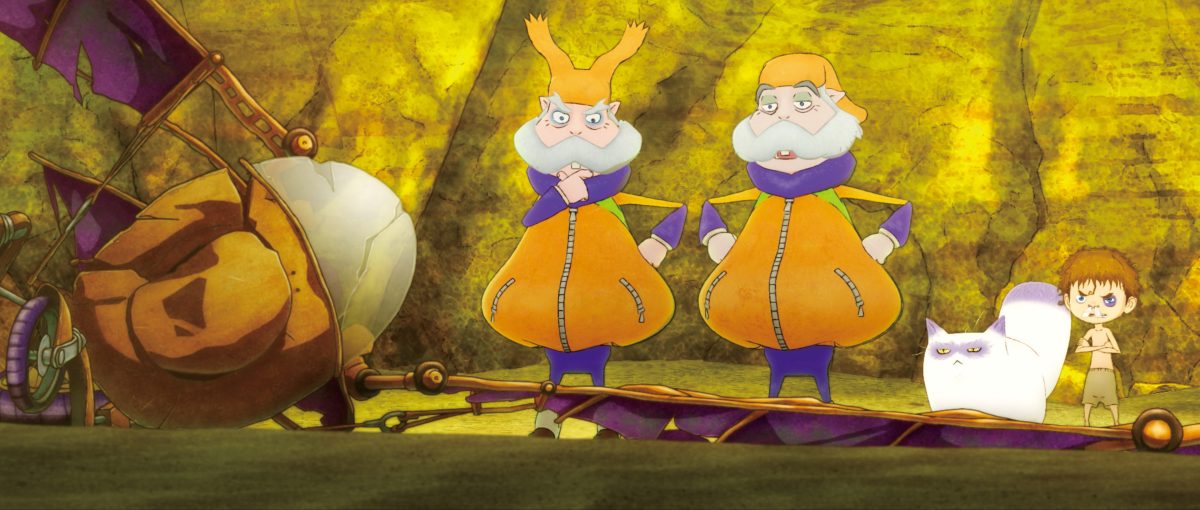
Some of these things share surface-level similarities, whereas others seem somewhere between derivations and homages. No matter how they appear, they dampen the film’s overall impact. If these references do not bother you, the film may be a delightful romp, as its heart is in the right place and it presents a resonating depiction of the power of connection and the pang of loss.
The central story follows Lubicchi going on an adventurous ride with a cat, whom he endearingly names Fluffette. Their comedic banter from the clash of their opposite personalities, with Lubicchi being cheery and Fluffette being peevish and nonchalant, is the finest part of this comedy-drama. The writing, in that regard, finds a good balance between humor and personality. Even the bits of rollicking adventure are as thrilling as you would want them to be. However, that isn’t the case with the other story or its execution, where it leans too heavily on melodrama.
The second storyline centres around the aforementioned singer, Nagi, and the smug man, Gus, who works as the keeper for the watchtower. Their mutual arc trades into the usual motions of romance, which in itself isn’t a matter of concern as much as its presentation. It does include some impressive bits like some country music flourishes, which sound similar to the ones that sometimes appear in American Westerns and blend seamlessly in this wildly different and colorful world. Yet, the silly, adventurous other half of the film overshadows this one, owing to its saccharine narration.
Overall, it is a sweet film that makes plenty of use of its whimsy to flesh out entertaining bits and gags. It also isn’t dull even for a moment. However, its simplistic lesson isn’t as appealing to an adult as it may have been as a child. For a kid, it’s a delightful charmer full of wonder and whim, backed by an infectious chemistry between the child and his buddy cat, who offer enough of a friction to make adults stick by for the journey till the end.



![Inside Llewyn Davis [2013] Review: Wings of folk singer’s desire](https://www.highonfilms.com/wp-content/uploads/2017/08/insidellewyndavis-012.jpg)
![Johnny Guitar [1954] – An Extraordinary Mythical Western Classic](https://www.highonfilms.com/wp-content/uploads/2018/03/1-yZql55oG1iPfXK4Q6Ifmyw-768x575.jpg)
![The Bombardment [2022] Netflix Review: Smart and balanced look at an obscure calamity](https://www.highonfilms.com/wp-content/uploads/2022/03/The-Bombardment-3-1-768x535.jpg)

![Netflix & Chill : Gandu [2010]](https://www.highonfilms.com/wp-content/uploads/2017/01/Gandu1-768x330.png)