David Maler’s “Zumeca” (2026) revolves around the birth of the New World (the Americas) and the transitional period that led to this cultural shift. He presents that historical chapter through a love story between a Spaniard man and a Taino woman, who meet by what seems like a stroke of chance.
The man arrives in the American part of the world to cross paths with the woman’s indigenous community and to realize their ways of being. That’s where he begins to learn about her rich cultural heritage while his past remains a mystery. She offers him food, shelter, and more than what he may have sought at the time.
Based on an eponymous novel, Maler’s script explores an evolving relationship between two parts of the world through a clash of their distinct worldviews. Miguel (Rubén Ochandiano), the Spaniard conquistador, does not show any sign of valor the first time he meets the native tribe. He looks puzzled and traumatized by his past.
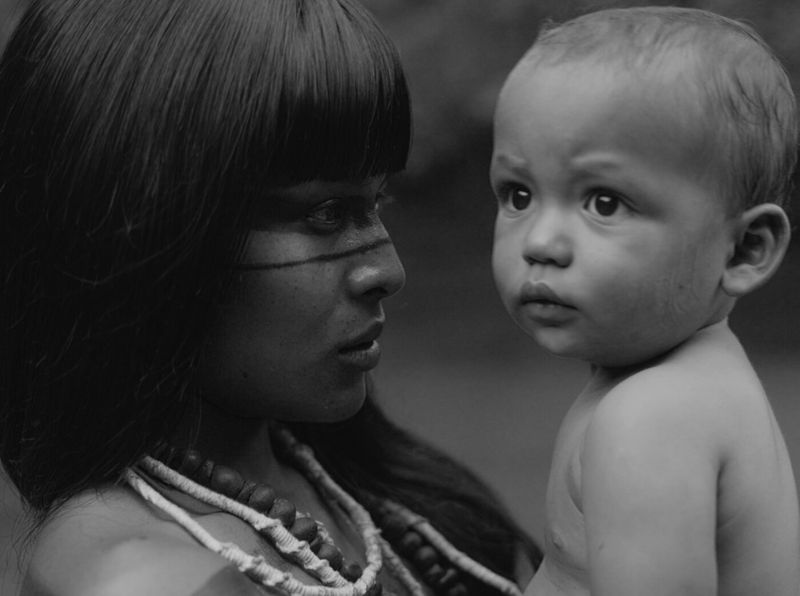
Unlike him, Zumeca (Angela Cano), the tribe princess, appears secure in her own skin. She also holds more power in their relationship during those early stages when they try to figure out the intricacies of their relationship. Her kindness and grace allow him to see hope in a future, be it any kind.
Maler’s direction shines in this initial chapter that leads to their union. He relies on wordless moments and gestures to convey the gradual motions of intimacy through a string of beautifully lit and composed shots. The narrative unfolds at a relatively slow pace, but lets his visual language communicate their emotional state and move the story forward. Unfortunately, after that chunk of the script, he leans heavily on exposition through dialogue, thus losing the mystery that made its early moments so gently rewarding.
The following chapters deal with growing outside intervention that reminds Miguel of his cultural roots. Some of these visitors want to spread their faith, seeing it as the only meaningful way to lead a life. Their attempts at indoctrination essentially dictate Zumeca and the tribespeople’s arcs, as they receive only conditional kindness from those visitors. It’s a tragic part of history where the indigenous wisdom gets crumbled under the self-serving ideologies of the greedy or powerful, who preach only their beliefs while refusing any other faith a chance to breathe.
While not identical, it’s the type of narrative arc we have seen in projects like Martin Scorsese’s “Killers of the Flower Moon,” where the European settlers used sweet talk to hide their greed for wealth and land. The native population remained generous, only to be betrayed by those who benefited from that generosity. While a critical success, the film also received criticism for focusing on white guilt far more than on indigenous perspectives. Despite those valid concerns, the film was psychologically penetrating because the script went beyond cursory observations about the characters’ plight.
In Maler’s film, the indigenous protagonist receives more screentime than in “Flower Moon,” but it falls significantly behind in analyzing that character’s interiority. We see the titular character on screen for a long time, but we get barely any understanding of her emotional state as the visitors try to gain control over her tribe’s mode of living. She is left almost as a muted vessel, observing the changes around her and reflecting the bare minimum, while revealing bits of ancestral wisdom. It’s in stark contrast with Miguel’s emotional arc, which is far more detailed in analyzing his endless urge to be in control of his own life.
Ochandiano’s performance as Miguel is subtle and ideal for Maler’s directorial approach, which emphasizes sustained tension over rushing through its plot points. The Spanish actor conveys plenty of detail, even in brief moments when Miguel wonders who he has become in a twisted game of fate, where love is pitted against his shallow ambitions. Yet, it doesn’t suffice for a film that is supposed to be more about the titular character. She appears woefully inert, especially when compared to him.
Speaking about the film’s pre-colonial story, it overexplains a lot of its plot details instead of trusting the audience with its cinematic language. These expositions are often unnecessary and redundant, as they appear shortly after fairly self-explanatory moments. Instead of overexplaining, the film could have expanded on them further.
Even the visual language, which is always gorgeous to look at, becomes dull and repetitive. In the end, the film does lead to a salient point about the existence of indigenous beliefs after suffering through all these cycles of exploitation, but it comes so late and after a largely vapid journey. That’s why, although well-intentioned, it offers a tepid look into this part of history.




![Black Panther [2018] : An Allegorical Representation of Afrofuturism](https://www.highonfilms.com/wp-content/uploads/2018/02/Black-Panther-TChalla-768x405.jpg)