
John Hillcoat’s The Road (2009) is a cinematic adaptation of Cormac McCarthy’s Pulitzer-winning survival novel. Set in a post-apocalyptic world, the story follows a father and son on their last walk as the world around them frays.
While it may feel like another dystopian piece that comments on the doomsday situation with its desolate snowed and ashed-down landscapes and the survival of the fittest theme, the film, over the course of its runtime, evolves into an ageless commentary on human relationships, particularly between a son and a father, and between the ideas of good and evil.
While the setting is distinctly dystopian, the core of the film remains decidedly human, seen through the coming-of-age lens of a nine-year-old boy. The film is bleak and evocative, leaning more toward a philosophical open-world exploration than toward the standard three-act structure.
The Road (2009) Plot Summary & Movie Synopsis:
How Did The World End?
There is no clear answer to how the world ended in this world. The plot loosely follows a father and a son duo in a post-apocalyptic landscape, making a journey southwards to the shore for a chance at survival. The resources are scarce, and threats loom large in the form of cannibal headhunters and other people who want to survive at the cost of others.
While one part of the plot focuses on their journey, another does cursorily trace the origin of this doomsday. It tries piecing together fragments from a past life through the father’s memory, where life was seemingly normal, until one day it was not. However, we always only have limited information about the end of the world.
We just know that it happened one day at 1:17 PM, with a flash of light that ended the idea of home for humans. I take the liberty of writing “humans”, because the father and the son are a nameless duo in this film, almost symbolically representing every and any father and son that may be roaming till the world drops dead around them, or they do.
The narrative follows them as they encounter gangs who have made cannibalism a survival strategy, hunting for food and weapons. The father does just enough to keep both alive, but with the option for an exit strategy. He has a gun with exactly two bullets loaded to take them both out of this mess. While the film did keep an easy escape as an option, the tone shifts when the father uses one of these bullets to take down a man when he holds his son hostage. The bullet meant to kill oneself becomes a bullet to choose survival, and that is where the journey of hope begins.
The situations to fight against the odds arise many times during the course of the film: the duo has to fight tooth and nail to escape cannibals in a basement, people who follow them for their food, and gangs who are mercilessly hunting other humans for food. None of the events blow out of proportion, but they shape the journey. Every encounter feels tougher than the one before, since it tests the human limits of survival, inducing anxiety in the viewers that at any moment, the two can cease to advance. Yet, the two are looking for the most ironic symbol in the bleakness– a shoreline.
The father and son continue to journey towards the beach, in the hope that there may be other people like them there. This raises an important question: why? Would it not be wiser to stick to isolation and make the most out of the resources? Or is it because even at the end of the world, human beings crave community, they crave a mirror in others where they can identify themselves.
What are the Father and Son Searching For?
Throughout the journey, we see the father trying to recreate the semblance of a ‘normal’ life for his son. Yet, the definition of ‘normal’ has changed for this generation. When they reach a house with supplies, where the father gives the son a proper bath, shampoos his hair, and sits him down for dinner, he does realise that his son probably feels like he is from a different generation altogether.
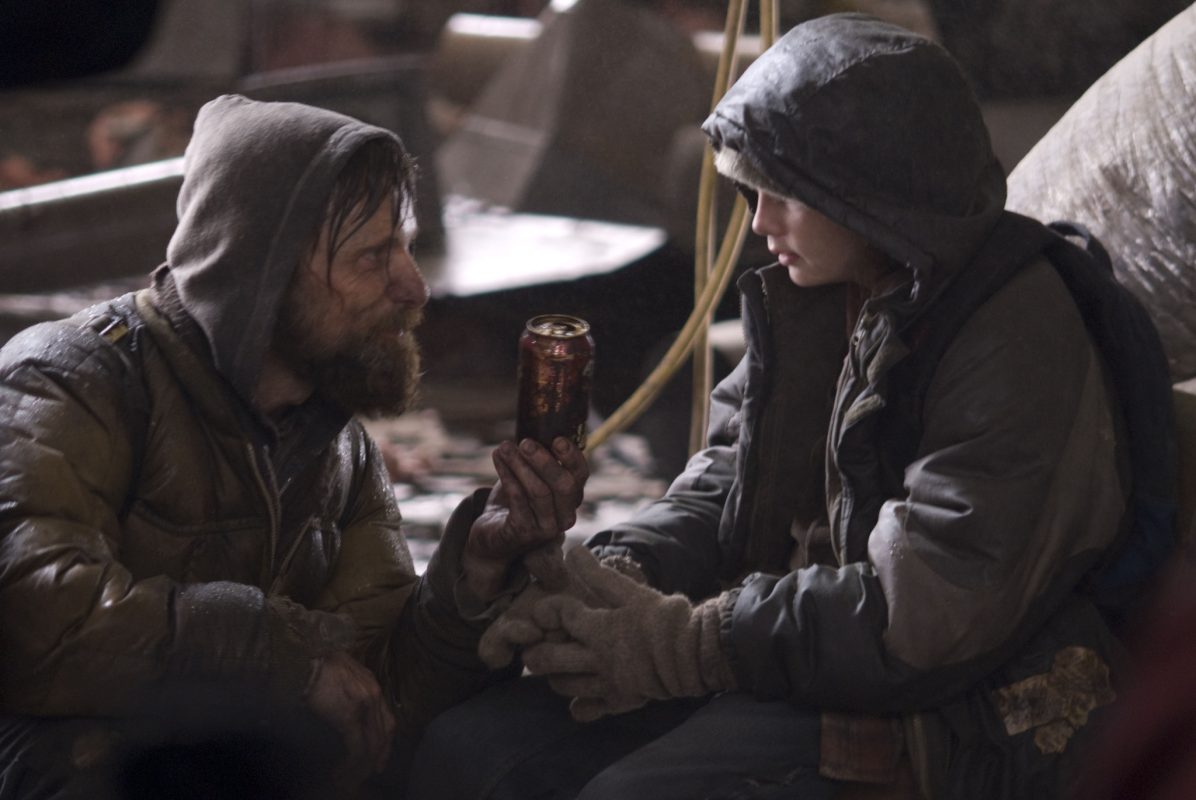
The film builds this carefully; even the language that he speaks seems dead to his son. When he speaks of distance as ‘crow’s fly’, his son does not know what he is speaking of. He does not know it means the shortest possible distance. He has not even seen a crow. It is not just the world that is dying. The language and the referents are fading away, too. That brings us to the question: what survives?
The answer lies in the father’s memories. While one part of the narrative pushes forward as the duo explores the dystopian grey-scaled earth, it is coupled with another narrative that goes backward into the memory of the father, which moves inward. Charlize Theron plays the role of the boy’s mother, and the film shows us, through flashbacks, how the boy is born. Their marriage in the fraying world becomes a site of disagreement where survival and death exist on both sides of the same coin.
Eventually, the mother wants to choose a quiet ending. She wants to kill herself and take her son with her, but the father becomes the resistance. After she disappears into the night, the boy and the man embark on a journey away from home, but likely in search of another home. The stops that they make along the way, revisiting the father’s old house, visiting abandoned apartments, and sitting down for dinners when they come by a large food supply, show how desperately they are trying to reach out to a past that is forever gone. It is in the small moments of opening a can of soda, or the father smoking a cigarette, that the urge to return to the old world as we know it comes through.
The Road (2009) Movie Ending Explained:
Do the Father and Son Survive in the End?
As this long-winding, arduous journey unfolds, the father looks at his son as the last hope. It is evident that the son is indeed the last proof of humanity in how he keeps raising ethical questions. He does not want to turn to cannibalism, wants to help people on the way with food and shelter, and keeps the fire alive. In a way, this becomes the moral stake of their journey until one of them falters.
Also Read: 10 Movies to Watch If You Liked ‘One Battle After Another’ (2025)
When the black man steals their tent and food, the father hunts him down, and in addition to taking away the loot, he also starts to dehumanize him. He seems tired of the constant survival mode, and his fangs come out as he leans towards paying the man back in the same coin. He does not believe his words that he was not following them, not out of caution but out of exhaustion, and humiliates him by asking him to strip and leaving him by the side of the road.
Later, at the son’s request, he returns with a can of food, but perhaps by that time the “god” has left him? The humanity that he kept referring to as the “fire” is barely burning at this point. As a punitive action, he is struck down by an arrow. His wound becomes fatal, and in death, he has no other option but to leave his child to fight for his own in a world that does not get better. While the father takes his last breath on the beach, the son does find a family.
Even then, his focus lies on whether they are the “good people”. The boy sees the dog travelling with the family, and the children, and the compassion in the mother’s voice, all instinctively telling him that perhaps he has finally come across the “good people.” The world will not get easier for any of them, but they will still have that fire that they are carrying to keep them warm, even at the end of the world.
The Road (2009) Movie Themes Analyzed:
Hope, Community, and the Fire that Keeps Humanity Alive
I was wondering why “The Road” feels so profound, even with a sheer lack of information about the world’s end and what follows. The film feels less about the disastrous climax of human mistakes and more like an epilogue that looks back at humanity. The climax, the end of the world, has already happened. It simply recounts the story of what remains after, asking the critical question whether any epithet of humanity is salvageable from the ruin that we made out of this earth. It does not go into the question of whether it was preventable, nor does it explicitly blame humans or aliens for causing the end of the world.
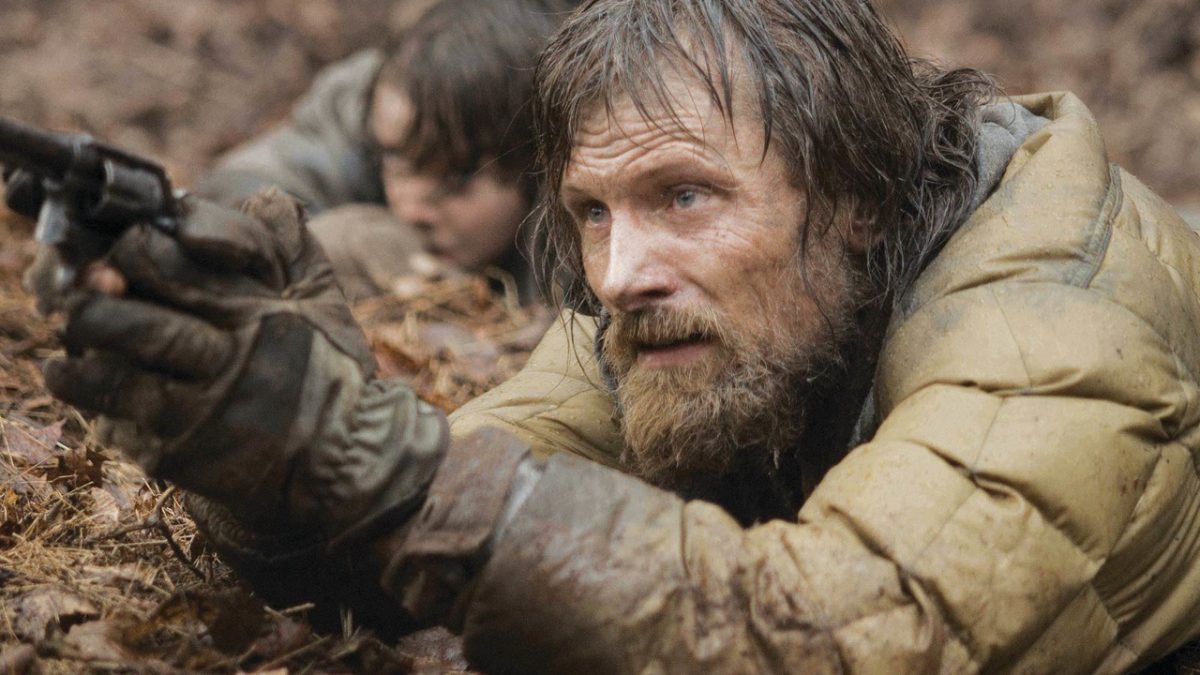
Rather, it is more interested in what follows, and what follows is a tale of resuscitation. “The Road” is a film less about humanity’s redemption and more about the cyclical nature of hope. It does not take much to wipe off the material existence of a species, but the film proves that humanity’s footprint exists far beyond its material existence. Even with the civilisation collapsed all around the father and the son, the thing that keeps them going is hope.
While primarily choosing the path of hope in the father-son journey, the film also does not shy away from showing what is on the other side of the coin. The boy’s mother does not choose to survive against all odds; she chooses to walk into the night. In this post-apocalyptic world, the fractured family looks very different. Separations and custodial fights are not only about keeping the child, but also deciding between whether the child gets to live or simply ceases to exist. When Charlize Theron’s character decides to walk into the night, she asks her husband to keep her son safe, to take her south, and to keep him warm.
While the family breaks into two, with the father and the son on the road, their entire journey is in search of finding community. The normalcy of domestic human lives is a thing of the distant past now, and the entire journey that the father and son take is a search for its residue. I’d say this hope still lies in finding community, in finding people alike who look just enough human to laugh, cry, and fight together.
Another central theme the film reinstates is how divinity lies in maintaining humanity during a crisis. At the beginning of the film, the father mentions the son as ‘god’s last warrant’. While it is thematically minimal at first, the idea of the son as the “last god” returns when they meet Ely, and the father reinstates that he is on the road with the “last god”. So what does he mean when he emphasises that?
While the father and son start as a singular unit, as the film progresses, there is a stark ethical polarisation. The father is focused on survival, which involves stealth, blood, killing, and immoral acts to keep themselves alive; the son is leaning towards holding the compass in every situation. It is the son who asks the father for the reassurance that no matter what, they would not turn to cannibalism. Moreover, it is the son who, at every turn, wants to share the food, wants to extend his hand to help others.
In a way, this is also a symbolic coming-of-age tale, not just about a father-son duo who face this kind of polarisation during an apocalypse. At any time and place, the sons lean towards idealism, morality, and righteousness when the previous generations slowly submit to a kind of moral bankruptcy for survival.
This is a tale as old as time, but also a tale of hope that keeps the story going. When he meets the man from the other family who asks him to join them in their journey, he asks a few precise but ethical questions. He enquires whether they eat humans, whether he has kids too, and lastly, whether he is keeping the fire alive. The other family does not know the referent of this language– “the fire”, but perhaps there are some concepts that are so universal that they bind humanity. And some of them are non-verbal too.
The film brings us to the resolution that in a landscape stripped of language, moral codes, and humanity, hope survives in small acts of compassion. While the father’s journey ends, the son eventually learns to keep the ‘fire’ alive. He makes a conscious decision to remain on the side of the ‘good people’. Even when civilisations cease to exist, the film gives us reason to hope that humanity will keep thriving in the remotest corners with its stubborn refusal to abandon compassion, keeping a small fire burning against a cold, unforgiving world.

![The Wild Pear Tree [2018] Review – An Ode to the discarded dreamers](https://www.highonfilms.com/wp-content/uploads/2019/01/The_Wild_Pear_Tree_HOF-768x432.jpg)
![Imperium [2016] – An Effective Thriller about the Multifaceted Extremism](https://www.highonfilms.com/wp-content/uploads/2016/08/Imperium-2-768x511.jpg)