
Birthdays rarely invite debate. Other “special days” can be argued over—culturally, politically, even ideologically—but a birthday tends to sit outside that noise. It marks origin, identity, and the simple fact of existence. Yet the world has a way of layering history so violently over the present that even something as gentle as a birthday gathering can begin to resemble a crime scene. That unsettling inversion forms the core of “The Birthday Gift,” a fifteen-minute short directed by longtime stage and film actor Arianna Ortiz.
To understand the weight the film quietly carries, it helps to look at the history it draws from. The Argentine Dirty War remains one of the most brutal periods in Argentina’s recent past. During the military junta, pregnant political dissidents were held in secret detention centres until childbirth. Once the babies were delivered, the mothers were drugged and thrown from airplanes into the Atlantic Ocean—what came to be known as the “death flights.” The children were taken, handed over to military families or regime sympathisers, and raised under fabricated identities. For decades, organisations like Abuelas de Plaza de Mayo have worked to locate these stolen children and restore their histories.
On paper, this context feels worlds apart from the film’s surface texture. “The Birthday Gift” carries an ease that almost disarms its pacing, its conversational pauses, and even its tonal warmth resemble the kind of intimate, low-stakes drama one might casually slip into on a quiet evening. The performances lean into that familiarity. Paula Pizzi’s Soledad, an outgoing Argentine mother, carries the energy of that loud, overfamiliar matriarch archetype popular cinema has exhausted for decades.
Opposing her is Gabriela, the musician daughter, played by Cruz Gonzalez-Cadel, who brings a slightly uneven but practiced restraint to the role. Margarita Lamas’s Carolina, older and faintly unsettling, operates in a register that suggests certainty without tipping into caricature. The men, interestingly, land more cleanly. Nate Santana’s Marty finds a relaxed rhythm within limited material, while Ignacio Serricchio as Cesar leans into expressivity with precision. These are types, clearly drawn, contained within a single domestic space that functions almost like a chamber.
The film’s real intelligence lies in how it begins to disturb that chamber from within. Ortiz understands the genre’s grammar well enough to manipulate it quietly. The arrival of uneasy guests, combined with hints of a shared but unspoken past, establishes a tension that never announces itself loudly. It simply settles into the room. The idea that political discourse begins at the dinner table is not treated as a metaphor. It becomes a structural device. conversation, glances, tonal shifts—these carry the burden of revelation.
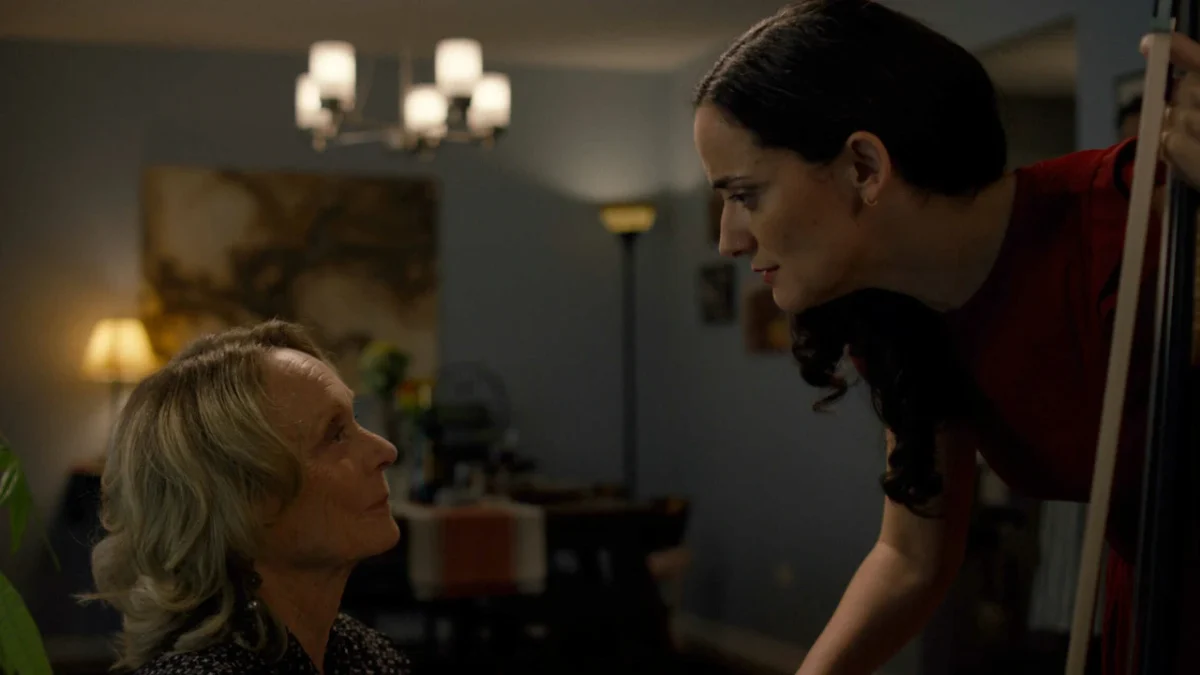
The title itself begins to mutate as the film unfolds. “The Birthday Gift” stops sounding celebratory and begins to feel ominous. Within the historical context of the disappeared—the desaparecidos—a birthday is no longer a marker of joy. It becomes evidence. a trace. almost a site of violence. The “gift” being delivered at this table is not an object but a truth, one that destabilises identity at its core. The film stages this revelation with a calculated restraint. Its politeness, its carefully insulated comfort, functions as a Trojan horse. When the rupture arrives, it does so without theatrical excess, which is precisely why it lands.
This commitment to minimalism largely works in the film’s favour, but it also exposes its one significant misstep. The decision to break away from the chamber through an explicit flashback undercuts the very tension the film spends so long building. The premise thrives on claustrophobia. Horror exists in real time—in the tightening of expressions, in the shifting energy around the table, in the body’s instinctive recognition of truth before language can catch up. Cutting away to visualise the past, to show a car and a deathbed, feels like a lapse in confidence. It externalises something that is far more powerful when left internal.
The film is at its strongest when it trusts stillness, when it allows faces to carry the weight of history pressing in. Remaining within that dining room, forcing the audience to sit with the slow collapse of constructed identities, would have intensified the experience. The flashback, by contrast, diffuses that pressure, offering clarity at the cost of immediacy.
Even with that hesitation, “The Birthday Gift” remains an engaging and sharply conceived short. It functions as both a contained narrative and a compelling proof of concept for a larger feature. Its most interesting turn lies in how it reimagines familiar genre mechanics. This is, in a sense, a reverse home-invasion story. The intruders do not arrive to take something away. They arrive to return something that was stolen long ago. The violence lies not in the act of breaking in, but in the truth they bring with them.


![Restless [2022] Netflix Review: Cop Drama Under-delivers on the back of Lackluster Execution](https://www.highonfilms.com/wp-content/uploads/2022/02/Restless-2022-Netflix-768x374.jpg)


![Secret Obsession Netflix [2019] Review: A Thrilling Drama That Barely Holds Together](https://www.highonfilms.com/wp-content/uploads/2019/07/Secret-Obsession-Netflix-1-768x432.jpg)