There’s a point in “Spider-Man: No Way Home” (2021) where the scale of everything, multiverse, villains, magic, quietly fades into the background. What remains is something much smaller and much heavier. A boy realizes that fixing things sometimes means removing himself from the equation entirely. Peter begins the story trying to protect his life. He ends it by letting go of it.
Spoilers Ahead
Spider-Man: No Way Home (2021) Plot Summary & Movie Synopsis:
Why Does Peter Struggle So Much after His Identity is Revealed?
When Mysterio exposes Peter, the problem isn’t just legal trouble. It’s that Peter no longer gets to decide who he is in the world. That choice has been taken away from him. The interrogation scenes carry an uncomfortable energy. It’s not fear in the usual superhero sense. It’s closer to being watched too closely, like every action might be misinterpreted.
Even when Matt Murdock clears him legally, the feeling doesn’t lift. People don’t stop looking. What unsettles Peter more is how quickly the consequences spill over to others. MJ and Ned lose opportunities that have nothing to do with their own abilities. Aunt May becomes collateral in a situation she never chose. Peter starts to see something he hadn’t fully grasped before: being Spider-Man doesn’t just put him at risk. It rearranges the lives around him. That realization pushes him toward a solution that feels simple on the surface, making everyone forget.
Why Does Peter See the Villains Differently from how Doctor Strange Does?
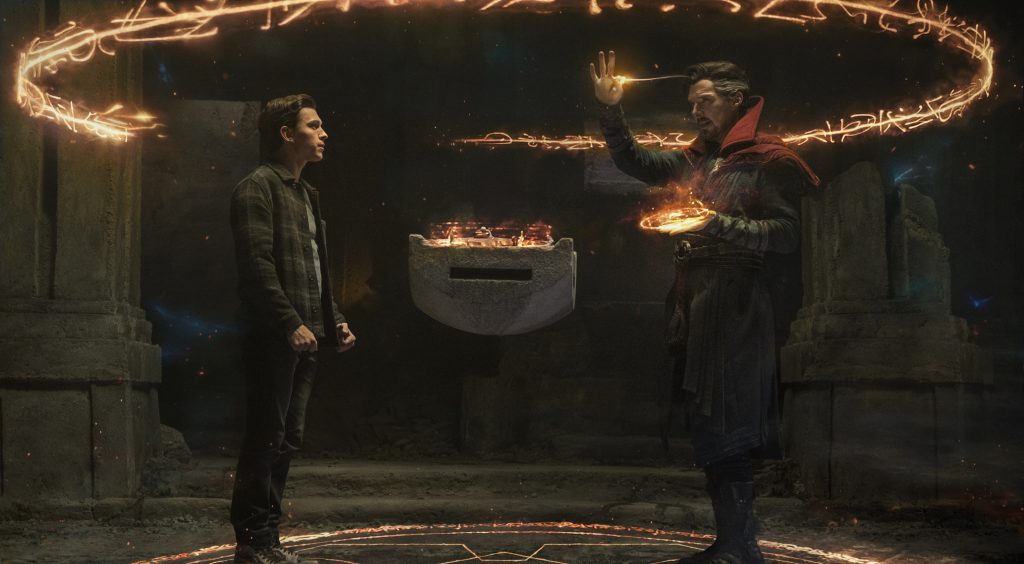
Peter goes to Doctor Strange not as a hero seeking guidance, but as someone hoping for a reset button. There’s a kind of urgency in him, like he’s trying to undo something before it settles into permanence. The spell itself isn’t unstable at first. What complicates it is Peter’s inability to commit to the cost of it. He keeps reaching back into it, adjusting, reshaping, trying to preserve the relationships that matter most.
Those interruptions aren’t just technical mistakes. They reveal hesitation. Peter wants a version of reality where consequences can be selectively erased. But once the spell begins to fracture, that illusion falls apart. The universe doesn’t negotiate in fragments. It responds as a whole. And what arrives through that fracture isn’t random chaos.
It’s people connected by a single thread, each one tied to Spider-Man’s identity at a moment where their story was about to end. When the truth about the villains surfaces, that they were pulled from their worlds just before dying, Peter doesn’t process it as a logistical problem. It lands as something more personal.
These are people who never got the chance to step back from who they had become. Strange approaches the situation with distance. His priority is restoring order. Sending them back completes the disruption. Peter looks at them and sees unfinished moments. There’s a quiet belief in him that if they can be helped, then their endings don’t have to remain fixed. It’s not entirely rational. There’s a hint of denial in it, too. Helping them would mean that loss, in general, might be negotiable. That tragedies can be revised, that hope shapes what comes next.
How Does Norman Osborn Change the Direction of the Story?
Inside Happy’s apartment, Peter’s approach begins to take form. He starts working on cures, one by one, using whatever tools he has left. The success with Doctor Octopus reinforces his belief that he’s on the right path. It gives structure to his instinct. If one can be saved, maybe all of them can. There’s also something else at play. Peter isn’t just trying to help them.
He’s trying to prove something to himself, that choosing compassion won’t lead to more damage. For a brief stretch, the plan feels stable, then it shifts. Norman Osborn carries a kind of unpredictability that the others don’t. When he first arrives, there’s confusion in him, almost relief. He seems like someone who has stepped away from something darker.
Aunt May responds to that version of him. She sees someone who needs help, not containment. Peter follows that lead. But the Green Goblin isn’t something that disappears with clarity. It returns without warning, and when it does, it doesn’t just attack physically. It dismantles the space Peter thought he had control over. The shift is sudden, but not random. The Goblin doesn’t believe in redemption. He treats Peter’s attempt to help as something naive, almost insulting. That clash of belief, help versus chaos, collides in one of the film’s most painful moments.
How Do the Other Spider-Men Change What Peter is about to Do?
May Parker doesn’t die in the middle of a grand battle. She dies in the aftermath of a choice Peter made, and that detail lingers. Peter had the chance to send the villains back earlier. He chose not to. He chose to help instead. May understands that choice. Even in her final moments, she doesn’t question it. Her words don’t offer comfort in the usual sense.
They carry weight, something Peter now has to carry forward. The idea that responsibility comes with power isn’t new to him. But here, it stops being a lesson and starts becoming something lived. Grief changes the way Peter looks at everything. The plan that once felt hopeful now feels reckless. The same compassion that guided him begins to feel like the reason he lost someone.
That confusion leads him somewhere dangerous. After May’s death, Peter’s sense of direction disappears. What replaces it is sharper, more immediate, anger that doesn’t ask for reflection. He’s not thinking about saving anyone anymore. He’s thinking about ending the person who caused this. That shift doesn’t happen all at once. It builds quietly until the idea of stopping the Goblin starts to feel insufficient. He wants something final. This is the closest the film brings him to losing himself, and it’s also where something unexpected enters the story.
When the two alternate versions of Peter, Peter Parker and Peter Parker, arrive, they don’t interrupt the story’s momentum. They slow it down. They carry their own histories. Losses that didn’t resolve cleanly. Regrets that didn’t fade with time. When they speak to Peter, it doesn’t sound like advice. It feels like recognition.
They’ve stood where he is standing now. They know what happens if he lets anger decide what comes next. There’s a shift in Peter, not immediate, but gradual. The urge for revenge doesn’t vanish, but it stops being the only direction available to him. Together, they move toward a different kind of ending for the villains.
Why is Forgetting Peter Parker the Only Way Forward?
At the Statue of Liberty, the confrontation plays out differently than a typical showdown. The focus isn’t on overpowering the villains, but on reaching them. Each cure represents an attempt to undo something that went wrong long before this moment. When Electro is stabilized, when Sandman returns to his human form, when Octavius steps in to help, it starts to feel less like a battle and more like a series of corrections, but the Green Goblin remains outside that pattern.
The final confrontation between Peter and the Goblin carries a different weight. It’s not just about stopping him. It’s about what Peter chooses to become in that moment. When Peter finally faces the Goblin with the chance to end him, everything leading up to that moment converges. The anger is still there. The loss hasn’t softened. For a second, it looks like he’s going to follow through. What interrupts him isn’t a speech or a realization formed in words.
It’s the presence of another Peter, the older one, stepping in quietly, taking the impact, holding that moment in place. It creates space, and in that space, Peter makes a different choice. He doesn’t erase the anger. He chooses not to act on it in the way he was about to; instead, he completes what he started earlier. He cures Norman. The outcome matters less than the decision. In choosing not to kill, Peter steps back from becoming something he wouldn’t recognize.
As the spell begins to collapse further, the boundaries between universes start thinning beyond control. Figures begin to push through, people who know Peter’s identity, drawn in by the same broken logic that started all of this. There isn’t a technical fix left. The only option that remains is broader, more absolute. If the problem is that everyone knows Peter Parker is Spider-Man, then removing Peter Parker from memory entirely closes that loop. This time, Peter doesn’t hesitate in the same way he did earlier. He understands what it will cost, and he accepts it.
Spider-Man: No Way Home (2021) Movie Ending Explained:
Why Doesn’t Peter Tell MJ Who He is Again?
After everything resets, Peter finds MJ again. The familiarity is still there for him, even if it’s gone for her. He starts to speak, begins to reintroduce himself, to rebuild what was lost, then he pauses. There’s a small moment where he notices her injury from the earlier battle. It’s not dramatic, but it carries weight. It reminds him that being part of his life comes with risks they can’t see yet. He chooses to step back, not because the connection meant less, but because it meant enough for him to leave it untouched. It’s a quieter kind of sacrifice. No one sees it happen. No one acknowledges it, but it holds.
In the final scenes of “Spider-Man: No Way Home” (2021), Peter moves into a small apartment. He sews a new suit himself. The world doesn’t recognize him anymore. There’s no audience for what he does now, and yet, he continues. That’s where the shift becomes clear. Earlier, Peter was trying to hold together two lives, his personal world and his responsibility as Spider-Man. Now, those lines don’t compete in the same way. He has let one go to protect the other.
The ending of “Spider-Man: No Way Home” (2021) doesn’t feel triumphant in the usual sense. There’s no celebration waiting for him, but there’s a kind of steadiness in it. Peter understands what he’s chosen, and he keeps going. On the surface, it leans toward loss. The people who defined Peter’s life no longer remember him.
The connections that shaped him are gone in any recognizable form, but underneath that, there’s something else taking shape. Peter isn’t trying to undo what happened anymore. He isn’t looking for a way back to how things were. He’s moving forward, even if that path is quieter, lonelier, and uncertain. The film leaves him there, not fully resolved, not entirely at peace, but clear about what matters, and that clarity, more than anything else, is what he didn’t have at the beginning.


![Malmkrog [2020]: ‘MUBI’ Review – The Talking Cure for Elites](https://www.highonfilms.com/wp-content/uploads/2021/04/Malmkrog-1-highonfilms-768x433.jpg)