Though long familiar with “Chandramukhi,” it was only very recently that I finally watched its Malayalam-language original, “Manichitrathazhu,” when, due to missiles flying over our heads, I was locked down in a Doha living room with two Malayali families. In the frenzied adoration it provoked in them, it was apparent to me before it even began that this was no run-of-the-mill film. They didn’t just sing each of the songs word-for-word, but could quote pretty much all its dialogues & laugh at the memory of the comedy track before it even appeared on screen.
I invoke this scene not only to demonstrate the immense value of “Manichitrathazhu” to modern Kerala’s popular culture, but also to point to something broader about Indian film culture. Writing from the UK, I find that such a reception is now rare in the West: a work of popular art that cuts across age groups, becoming a cultural touchstone—frequently quoted and continually returned to by Malayali audiences.
Yet this very status only makes such films all the more demanding of sustained exegesis. It must be stated here that the ensuing discussion is only a modest attempt to provide a counterpoint to the safe assumptions that many a lover of the film has with regard to its brilliance. For there is no doubt that “Manichitrathazhu” is technically masterful, with class performances, a stunning score, and ingenious writing.
Indeed, ignited by the shared screenspace of Mohanlal & Shobana, key to the hearts of many a Keralite, “Manichitrathazhu” has become the emblematic Mollywood film. Director Fazil and team deftly blend the ‘something-for-everybody’ style of mainstream Indian cine-practice with Kerala’s renowned parallel cinema tradition, exploring the uniquely Malayali tales and histories that underpin Kerala today.
We also see this latter approach in the work of Jeyamohan, a Tamil writer of Malayali ethnicity and upbringing, who, like the film’s core, emerges from the Tamil region of the former State of Travancore. Later iterations like “Chandramukhi,” with its Rajinikanth-led star cast, and Vadivelu-fuelled slapstick comedy, lean heavily towards masala action spectacle and water down a specific tale of caste oppression and patriarchy for a generalised, and as a result, insipid, story of an overzealous king and seductive courtesan.
Setting these aberrations aside, the primary tale that ignites “Manichitrathazhu,” its very core, is this: a Thampi, an aristocratic satrap of the erstwhile Travancore State, related to the Maharajah by blood and in possession of vast swathes of land, spots a beautiful devadasi, Nagavalli, on a trip to Thanjavur in Tamil country.
Though she is reluctant, he is insistent that he marry her, and kidnaps her to his tharavad, a large homestead traditionally inhabited by high-caste Nair & other aristocratic communities. There, Nagavalli installs her lover, a dancer, in the small lodging opposite, through which she is able to continue relations with her true love. When the Thampi comes to know of this, he murders them both, after which Nagavalli’s ghost haunts the Tharavad seeking revenge.
“In the present day, Nakulan, a descendant of the Thampi lineage, returns from Kolkata with his newlywed wife, Ganga, to his family-owned tharavad, long reputed to be haunted. Fearing for the young couple’s safety, his extended family joins him there, and from hereon the film skillfully manoeuvres between comedy, horror/thriller, and drama.
In its turn to folklore, Manichitrathazhu reveals itself as a film deeply engaged with the past. It grapples with the clash between modernity and tradition—the inescapable pull of the former and the enduring force of the latter. In doing so, Fazil seems to position the film not merely as a cornerstone of the Malayali cultural psyche but as a work of serious cinema that invites sustained engagement with its many-layered questions.
Yet it may be worth assessing whether Fazil succeeds in this endeavour and whether this endeavour is genuine at all. Across the film, we float across themes of weight and significance, some of which were supposedly to have been novel for contemporary audiences: mental illness, a wife yearning for more time with her unavailable husband, and the inescapable consequences of patriarchal and caste-related abuse. But do these ideas serve as a means for the audience to assess further their own position, or do they instead exist within a closed circuit, starting and ending within the film’s two doors? That is, does “Manichitrathazhu,” in its quest for pan-Kerala veneration, dilute itself?
Also Check: The Film Industry’s Gender Parity, Ending Unsubstantiated Discrimination
The film does reckon with a fundamental aspect of Kerala’s – and India’s – past: its intense casteism. One is reminded here of a comment by Vivekananda, terming Kerala a ‘mad house’ or ‘mental asylum’ for its caste practices, beyond what the wandering ascetic had previously seen in his years of India-wide travel. Yet we are little impelled to assess how this angle may relate to us today. Caste is introduced as a practice of the past, one that in the present day we can wash our hands of. What are the specific conditions that enable Nagavalli’s abduction, wherein an upper-caste man assumes a Devadasi woman is his due, claiming her as casually as one would a souvenir?
It is an action sanctioned by the prevailing patriarchal and caste-hierarchical social system of the 19th century. Yet fast-forward 150 years, and we see that the underlying structures that enabled this remain. Male chauvinism continues to run rife: the women labour within the household while Nakulan remains absorbed in his engineering project, and the other men idle away their lives, sustained by inherited land.
Even Dr. Sunny Joseph (played by Mohanlal in one of his most iconic roles), the psychiatrist who arrives midway to restore order, ‘jokingly’ suggests that Nagavalli’s striking beauty warranted her fate at the hands of the Thampi. Later, the film raises no questions about how or why he is able to confine Nakulan’s cousin, Sreedevi, to her room, even if framed as a ‘noble’ act.
Taking a closer look, the means – the tharavad, the land, the social standing – by which the Thampi was able to kidnap, oppress, and murder Nagavalli, remains in the ownership of his descendants throughout the film and ostensibly after the credits roll. That Ganga, Nakulan’s wife, develops her obsession with Nagavalli based on her empathy for the latter as a woman, with her specifically female plight as identified by Dr. Sunny Joseph in his investigation, does not result in a single shred of motivation in any of the characters to perhaps address their own attitudes.
One almost wants to see Nakulan donate the house to a charity for abuse victims to atone for the sins of his not-so-distant forefather. Neatly avoided are these essential parallels between the Thampi and the present-day characters, who are in many ways, not just his genetic descendants but his spiritual ones, too.
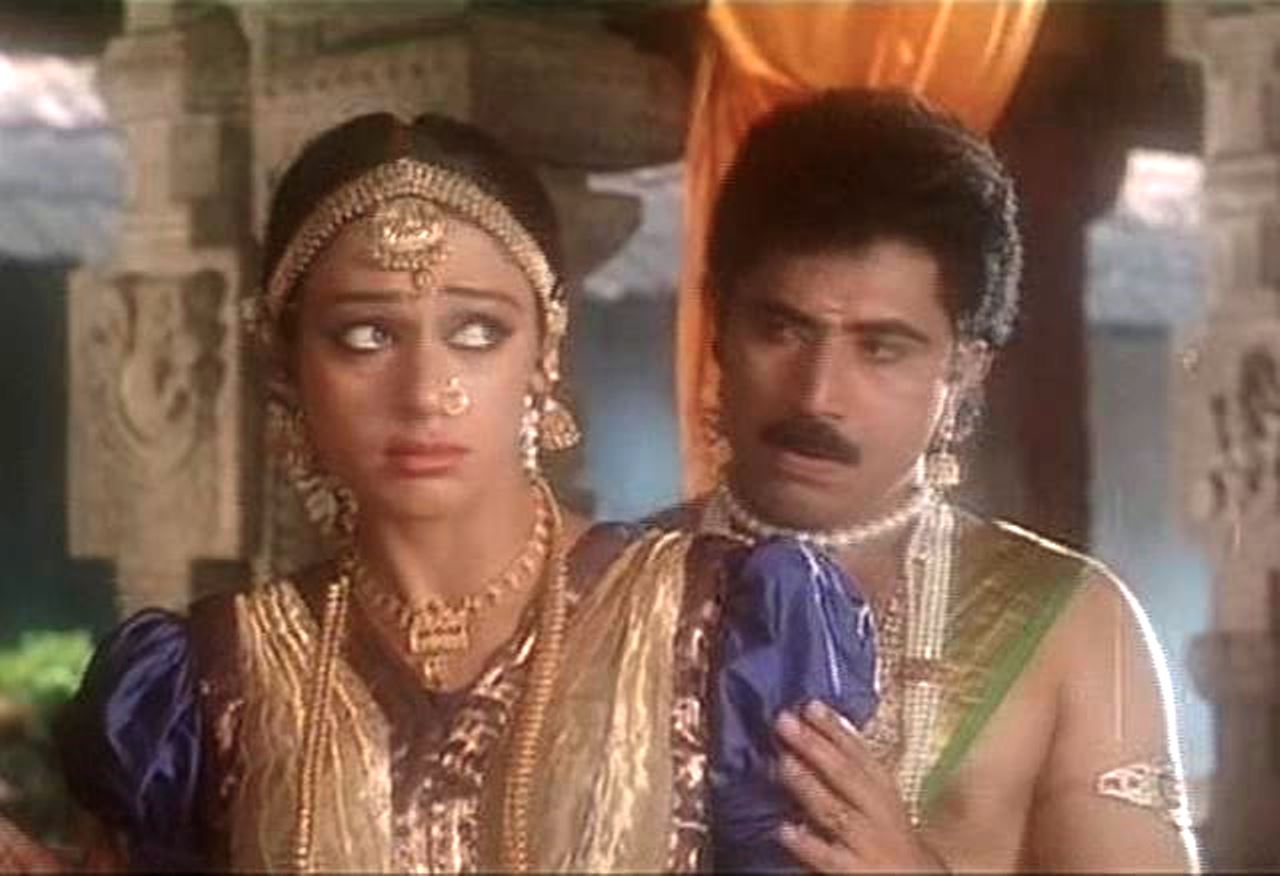
One sees here a resemblance to aspects of Kerala’s contemporary attitude to caste, often framed as a problem that has been overcome—a relic of the past, so to speak. Certainly, Kerala, recently described as the first Indian state to eliminate extreme poverty, has made remarkable strides across human development indices, far surpassing much of the country, and caste discrimination today is far less overt than in its darker past.
Yet literature complicates this narrative: “A Covenant of Water” (2023) recalls, through scenes set in the 1930s, a Dalit (Pulayar) boy beaten by an upper-caste teacher for attempting to attend school, while” The God of Small Things” centres on an inter-caste relationship and the brutal police killing and cover-up of a Dalit man.
Yet one need not look that far back. 2025’s Chennai International Film Festival featured Unni KR’s brilliant Malayalam film, “The Pregnant Widow,” which narrates the story of a pregnant widow fighting for justice after her husband’s caste-bias-related death. Though at times didactic and clunky, the film is rooted in the sort of social realism that need not stray too far from Kerala’s urban centres to locate a story of damning inequality, and a recent scandal at a Kannur medical college wherein dental student, Nithin Raj, killed himself due to harrassment around his caste, including a faculty member calling him a ‘slum dog,’ only adds credence to the charges that Unni KR’s film lays at the doors of Kerala society.
In neighbouring Tamil Nadu, the situation is no better, with Aayna’s strident documentary “Punishing the Professor,” released by People’s Archive of Rural India (PARI) in 2025, detailing the unfair dismissal of P Senrayaperumal, a history professor and folk dancer from the Arunthathiyar community, from Madurai University, potentially due to his caste. Of course, no one claims that Kerala has entirely shed caste discrimination. Yet closer scrutiny suggests that much remains unresolved in how caste operates within its society, and any film aspiring to a radical or novel engagement with the subject cannot afford to ignore these present realities.
Interestingly, it is the more commercial “Chandramukhi” that offers a more rounded engagement with the story’s caste dimension. Ganga, played by Jyothika—in a performance often maligned by many Malayalis, though one I find deeply effective—expresses empathy not only for Chandramukhi’s oppression as a woman but also for the Devadasi’s subordinate social position. In the Tamil remake, Ganga is the child of an inter-caste marriage and bears the humiliations and punishments imposed by a village society that forbids such unions.
Also Read: 15 Great Movies About Caste Discrimination, Dalit Resistance, And Ambedkarite Politics In India
In both films, in scenes that will have scarred many a youngster, Ganga becomes Nagavalli/Chandramukhi at night, due to dissociative identity disorder (DID). Credits must go to “Manichitrathazhu” for its early and honest reckoning with mental illness, though at times strange phrases like ‘psychic vibrations,’ ‘psychic state,’ and ‘Brad Lee (or is it Bradley?) the psychiatrist,’ are bandied about in an attempt to appear scientific. But an unavoidable consequence of Fazil’s film is the sense that it may have set off a chain reaction in which mental illness is treated superficially in South Indian cinema.
This tendency runs through S. Shankar’s “Anniyan,” where multiple personality disorder somehow enables a timid lawyer to single-handedly defeat an entire cohort of trained fighters;hrough A. L. Vijay’s “Deiva Thirumagal,” which implicitly normalises the idea of an adult man with the mind of a child fathering a child; and culminating in “Moonu”, whose depiction of bipolar disorder reduces it to a spectacle of extremes, with Dhanush oscillating between feral outbursts and muted withdrawal in the name of ‘sensitivity,’ yet reproducing its most damaging stereotypes.
Is “Manichitrathazhu” partly responsible for such trivialisation? In the film, psychiatry—embodied in Dr. Sunny Joseph—arrives primarily by locating the problem within the individual rather than the social world. Contemporary realities suggest the limits of this approach: even in countries like the UK, where nearly one in five adults is on antidepressants, such prevalence can scarcely be understood as purely individual. What is required, then, is a framework that treats mental distress not simply as a personal pathology but as a political condition, shaped by broader socioeconomic structures.
These films, in turn, avoid engaging mental illness with genuine depth by refusing to situate it within wider social realities. Admittedly, the kind of big-budget popular cinema under discussion is not obligated to offer rigorous critique. Yet the invocation of weighty themes such as caste or mental health carries a responsibility that demands a more probing, attentive form. To ignore this is to overlook the broader implications of what these films put into circulation.
In the celebrated ending of “Manichitrathazhu,” the charismatic Sunny Joseph proposes to Sreedevi—the very woman he had confined—and the film resolves this tension through an affect of romantic closure, as her faint smile suggests acceptance. His gesture, embodied in an almost boyish charm, transforms coercion into sentiment, eliding the violence of her earlier treatment. One might ask whether this same spectacle invites us, too, to overlook the film’s more troubling assumptions in our desire for cinematic pleasure.
The lesson, then, is that we, like Sreedevi, must look beyond Mohanlal’s magnetism—and, by extension, the film’s enchantment—and confront what lies beneath it.