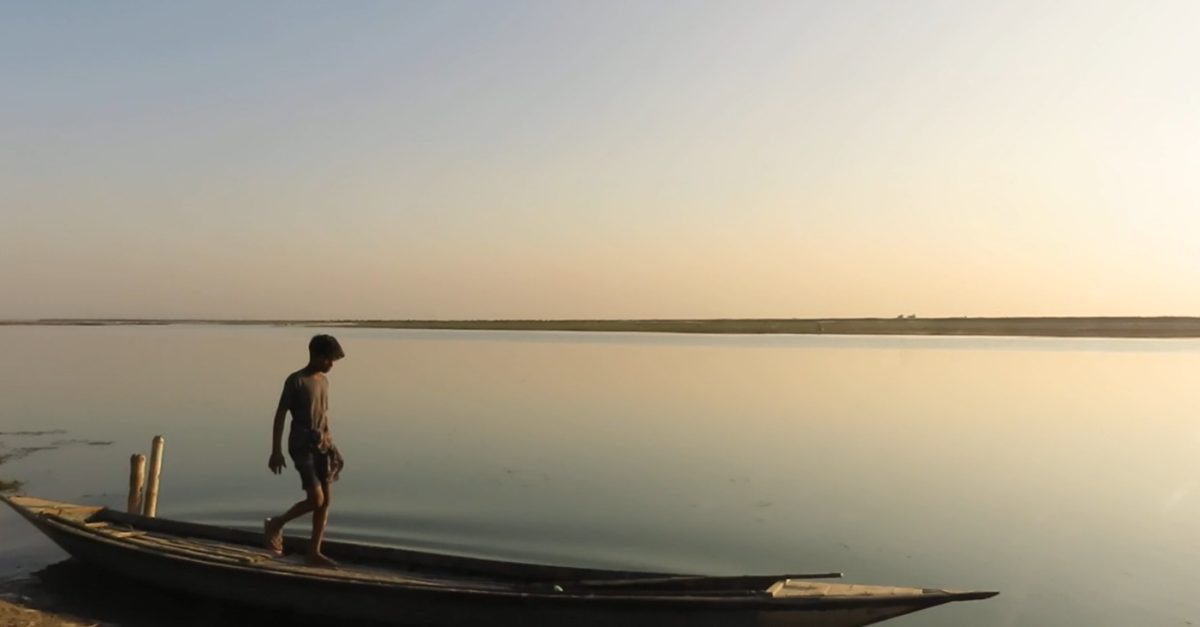
Mirza Lutfar Rahman is a poet and filmmaker who hails from Assam’s Sontoli. He belongs to the region’s marginalised Miya community that often finds itself at the end of state persecution. Rahman’s poems and visual work have introduced many people to the hardships and beauty of living in the north-eastern state’s Char-Chapori areas. Char usually refers to isolated islands that emerge within the Brahmaputra River, while Chapori refers to inhabited areas located on relatively elevated riverbanks.
Rahman, a part of Assam’s Miya literary movement, brings “Nidaner Hookah”, completed in 2022, an experimental short documentary that explores an identity in flux, wherein people combat environmental erosion and struggle for their own emancipation. In a brief conversation, Rahman discusses the struggles of Assam’s marginalised regions, media depiction of minority communities, and what inspires him as an artist. Hope you enjoy it.
Monish: “Nidaner Hookah” provides a rare glimpse into the life of Assam’s Bengali-origin Muslim population, an identity which continues to be politically sensitive and marginalised. Can you tell the audience as to why that has been the case?
Mirza Lutfar Rahman: During the colonial administration, people from then undivided India’s East Bengal were moved to the region for farming and other agricultural purposes. Originally Bengali speakers, the language gradually evolved with the people. As people adopted local customs and traditions, so did the language, as it embraced words from the local Assamese language. The final result is a language that is now associated with my community, the Miya community. While community members still continue to associate Assamese as their mother tongue in official documents, what we speak at home and in personal spaces is a completely different dialect. This also somewhat, at least according to me, indicates an identity in confusion, which is not helped by the fact that we are often looked at as foreigners.
Monish: “Nidaner Hookah” weaves a beautiful portrait with your poetry reflecting on politics, struggle, and selfhood. Can you tell us what inspired the form of this documentary?
Mirza Lutfar Rahman: I had actually been selected for a filmmaking program wherein I was supposed to make a visual piece. I believe a major inspiration for my documentary has also been the strong literary movement that has been taking place amid Assam’s Miya community. The poetry featured in the documentary was actually written during this time period. I had posted the poem on a social media website, and I was utterly surprised by the positive reaction I received.
As I slowly learnt about the art of filmmaking, I rented a room at a Char and decided to shoot non-stop for a month without any breaks. My goal was to capture the daily happenings, all its problems, all the community networks and interactions that take place within my community, from dawn to night itself.
Monish: Your documentary consists of many powerful sequences, many of which depict the cultural and religious beliefs of the showcased community. Can you tell us more about their social practices and how they finally made it to your documentary?
Mirza Lutfar Rahman: Our community is seen through the lens of Islam and often persecuted because of it. However, what I have tried to show is that Islam is not monolithic but consists of shades within itself. In the Miya community, members often choose an elder who is known as “Dewani”. Luckily enough, this annual ritual, which is also showcased in my documentary, was taking place at the Dewans’ house while I was shooting. Honestly, I consider myself lucky to be able to document this cultural celebration. The rituals involving candles and folk songs, as shown on camera, can be said to be more closely linked with Sufism as people remember and pay respects to their revered saints or ‘peers’.
Monish: Your documentary plays on the perfect blend of riveting poetry and everyday musings of a community. Every word of the voice-over tells a tale of both hope and sorrow. Your visual project is also aptly named “Nidaner-Hookah.” Can you tell us the meaning and essence behind the documentary’s name?
Mirza Lutfar Rahman: As I mentioned, Dewans play a major role in the community’s functioning. People flock to these leaders, be it to solve quarrels, legal problems, or even to extend support to community members in need. For the purposes of the documentary, Nidaner Hookah translates to Nidan’s hookah or claypipe. With this metaphor, I wanted to convey how our community has become confined to the world of Dewans, who are primarily the authority in such communities. Our struggle, our aspirations, and our identity have become confined just like the water in a clay pipe. I wanted to communicate how people and politicians alike, for their political gain, burn, smoke, and discard us just like a clay pipe.
Monish: Do you feel the Indian documentary market is at the stage where niche work such as yours can also be introduced to the masses?
Mirza Lutfar Rahman: I agree that such visual work should reach as many people as possible. I have always felt that documentary practice is one of the most impactful arts out there. How would it be possible for someone like me, who lives in a “Chapori” in Assam, to reach out to you? Documentary is a strong medium for any citizen to stand up for their rights and raise their voice.
Unfortunately, at the same time, I do feel that works such as mine hardly reach people. I mean, some may reach out inquiring about the documentary or request viewings, but the number is still small. I really do not know how the documentary industry can be changed or improved, but I do know it is the urgent need of the moment.
Monish: In your documentary, the audience also gets an insight into how climate change is impacting the lives of people living in Chars and how precarious livelihoods can be. Was it a conscious decision to reflect this reality in your visual work?
Mirza Lutfar Rahman: Yes, the issue of environment and related erosion is just as burning in the Miya community as the issue of say citizenship. Our community recognises that things cannot go on as they have till now, and that is what I also tried to capture with my camera. The audience will find moments of humanity and the strong bond that is shared between our community members in many scenes, especially in the ending. As I mentioned, I made sure to shoot all day long and be truthful to the subject matter. What naturally came on the camera was the fact that such difficulties have indeed led members of the community to have a stronger bond, where everybody pitches in whenever required.
Monish: Media depictions, especially in present times, have overwhelmingly portrayed the Muslim population of Assam in a negative light. Do you feel that works such as yours break such stereotypes?
Mirza Lutfar Rahman: Definitely, see one thing people need to understand is that this process of marginalisation and violence has not been a phenomenon of the last decade, but stretches far longer. Even in 1997, we were listed as ‘Doubtful’ voters, which opened the gates for further persecution. Even ‘Miya’, the name by which our community is now known, is actually a slur towards the religion we practise.
Just like how the Miya literature movement reclaimed this slur as a powerful tool of self-expression, my intentions with the documentary were pretty similar. I wanted to show people that these island residents are just like them…people trying to survive amid tough conditions. Thus, I relied heavily on documenting what constitutes life there. In a way, I wanted to be the boatman bringing people into our world.
Monish: How do you view the emergence of social media and other digital platforms for community filmmakers such as you?
Mirza Lutfar Rahman: I think digital platforms and social media are the reason we are even talking. The days of us being an isolated community are slowly getting over. We, in our isolated geographical locations, can now look towards the outside world. Residents of “Char-Chaporis” are now getting educated, and let me tell you, we expect a lot of literary figures and filmmakers from our community in the near future.