We all have a driving force inside of us – a bundle of kindling, kinetic energy that churns and spins, hurtling us toward success. It demands more than we have: a place amongst the stars, the top of the podium, the tallest seat at the table. It shapes our dreams with flickers of an unformed future. It is simply part of our human experience to want more. But what happens when we burn too brightly? Like the duelling maestros of “Amadeus,” what happens when we let candlelight become an inferno?
Miloš Forman’s 1984 rhapsody ensnared viewers with its depiction of the human experience. It was a concerto of emotion, ranging from the flurries of excitement to the slyness of envy, to the dramatic beats of power. However, it was the battle between Amadeus and Salieri that drew the critics into a standing ovation. It was a battle worthy of myth and legend, where the voracity of youth toppled towering figures. Salieri engendered the narrative with vitriol from the start, believing them to be enemies by fate. But, the two composers were bound by a force stronger than hate: they were bound – and destroyed – by their twin flames of obsession.
Adapted from Peter Shaffer’s 1979 stage play, “Amadeus” whips an ordinary reality into a dramatic fantasy. Opening in 1823, Antonio Salieri (played by F Murray Abraham) recounts his life’s story to a priest (Herman Meckler), after claiming he killed Mozart. He remembers his time as the Emperor of Vienna’s (Jeffery Jones) court composer, where he first met Mozart. After intriguing the court with his eccentric nature, Mozart was commissioned to write his first opera for Vienna. It becomes apparent that Mozart’s gifts fall ahead of his time, failing to truly impress the emperor, but Salieri believes him to be divinely inspired. Rejecting God for making Mozart his ‘instrument,’ Salieri vows to destroy Mozart and his career.
Salieri’s obsessive nature begins and ends with Mozart, but is defined by his relationship with God. It becomes apparent that Salieri viewed God as a kind of confidant, one who would steer his ship towards success. As a child, Salieri is willing to offer his agency just to become God’s vessel. Giving up ‘the proudest prayer a boy could think of,’ he provides his ‘chastity, my industry… every hour of my life’ in service of his Creator. From a young age, he diminishes his entire life to one, obsessive cause – to make symphonies that would please the Lord’s ear.
The moment Salieri surrenders himself entirely to religion – the moment where every failure, every green blot of jealousy is down to God’s hand – is where he becomes a bitter beggar, scheming for divine revenge. Much like a son is betrayed by his father, Salieri cannot understand why God refuses to talk to him, to favour him.
Also Read: Amadeus [1984] Movie Review – For the Artist in You
After witnessing Mozart’s music, Salieri begins to believe that God has chosen him as his ‘instrument.’ Believing that he hasn’t an ounce of control, Salieri turns from pandering and praising God to questioning and accusing Him. He blames God for implanting the desire to make music in his body, comparing it to ‘a lust.’ Salieri feels that he cannot be free of God’s cruelty. Even at the end of his life, he is forced into confession with a God he has condemned. His story is spearheaded by divine angst, as he lives a life driven by Machiavellian discontent. Music lives, like an infestation, in his body and is God’s curse.
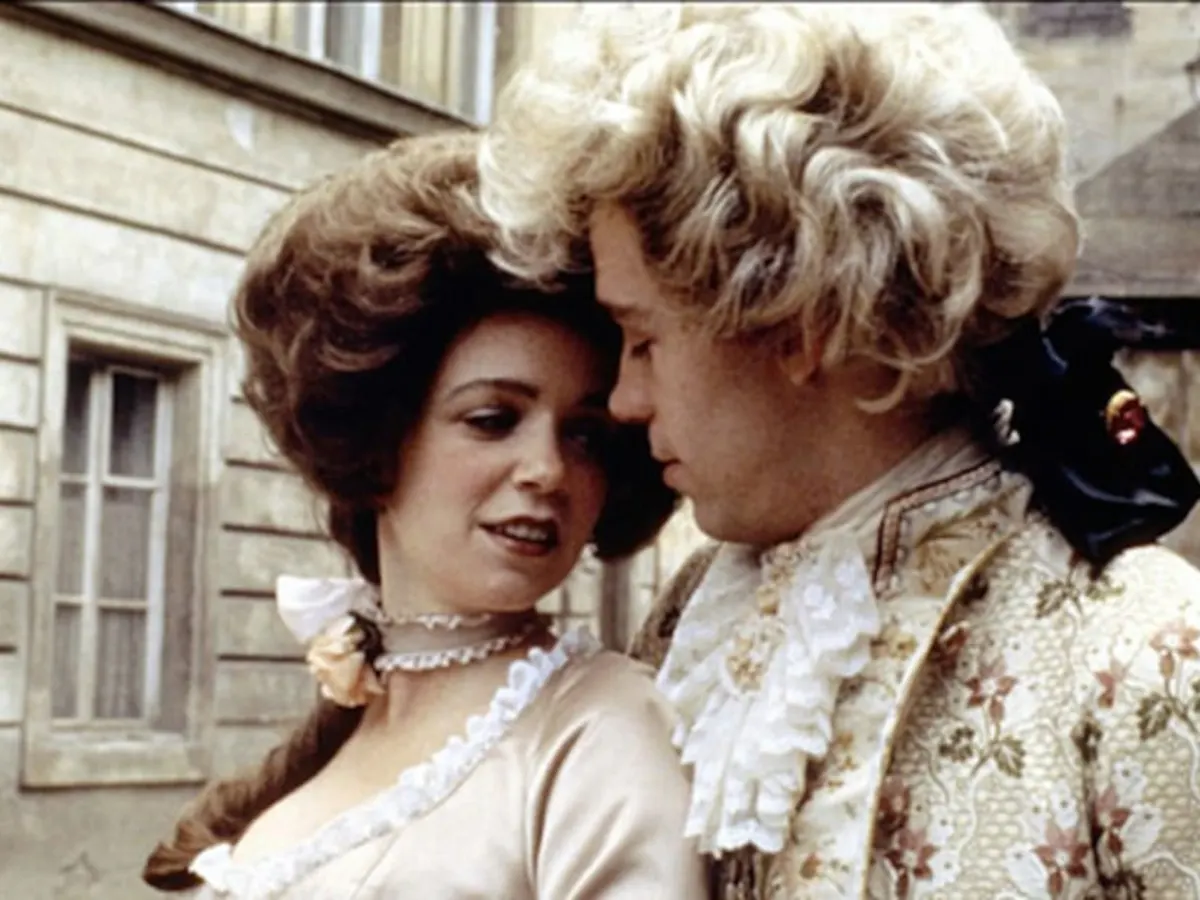
Whilst Salieri lives a narrow, restrained life, Mozart’s lifestyle bursts with joviality. He explodes onto our screens with childish abandon, chasing his fiancée Constanze (Elizabeth Berridge) around, before a royal performance. Rolling around the floor of a room filled with desserts, Mozart is the picture of hedonistic luxury. In contrast to the muted, dusty tones of Salieri’s clothes, Mozart can be found in fanciful lilacs and periwinkles. His wigs are feathered, sometimes a shade of pink – an 80s infusion to suggest his vibrant modernity. His outward appearance reflects the gleeful joy that emanates from within him.
Throughout the film, Mozart splatters his canvas with the luxuries of wine, parties, and sex. Salieri begins to take this as a personal attack, affronted by Mozart’s lack of restraint. Mozart, unbound by vow or promise, can afford to chase inner luxuries that Salieri cannot. His search for frivolous fun sees him bed an opera singer, Salieri lusted after, as well as marry without the consent of his Father. However, his inner conflict battles over the concept of work versus play. Mozart’s lodgings later became a battleground, where wine glasses and sheet music lie like fallen brothers in arms. His quest for the frothy divinity in life overtakes him.
Whilst Salieri is locked in the confessional with God, it is Mozart whom he seemingly kneels before. Salieri is born onto our screens screaming Mozart’s name – and he leaves us burdened by it; to Salieri, before there was God, there was Mozart. His obsession encompasses various powerful emotions – hate, envy, malice. Salieri uses hyperbolic intensity to describe their encounters, remarking that ‘I liked myself… until he came’ and ‘I can’t think of a time when I didn’t know his name.’ He begins to liken Mozart to God’s own tool, placed on Earth as ‘an obscene child,’ formed to torture him.
And yet, within his hatred kindles unbridled devotion and worship – and he begins to conflate the rival with the Lord. He starts to break away from his own religious confidant, to fall at the feet of Mozart’s musical prowess. Salieri begins to use holy language as his obsession deepens, citing his music as “miraculous.”
As Salieri retells his story, both young and old iterations are bound in rapture by Mozart’s music. It has both haunted and entranced him throughout his whole life. He attends each of Mozart’s performances – be it vaudeville or royal performance – to stand on high, looking down and worshiping ‘a sound I alone could seem to hear.’ Whilst Salieri aims for superiority, Mozart’s music gets him closer to God – and when he cannot seem to please the Lord, Mozart is the one to help hear Him, see Him, feel Him.
Also Check: 10 Essential Movies About Theater and Theater Artists
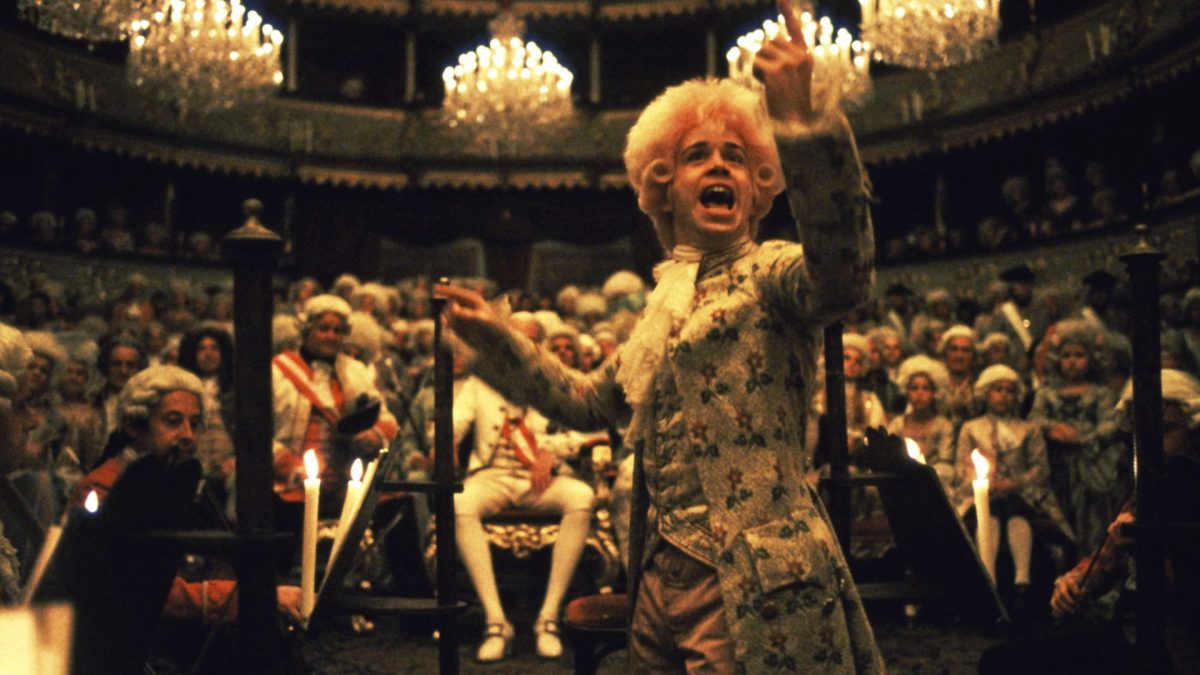
As the film progresses, Mozart’s desire to create music rages against his hedonistic lifestyle. He presents a consistent desire to prove himself, to carve out the space for new music, amongst stale sonatas. Unafraid to speak the truth, Mozart’s obsession with his own brand of music makes him rash. He remarks to the Emperor’s court that Italian operas about love are ‘rubbish,’ that the court is full of ‘musical idiots’ who are unfit to judge his music. His obsession with how music should sound drives him to pompous ambition. It’s as if his very DNA is line after line of sheet music.
Mozart’s devotion to expelling his every symphony takes over his life – hijacking his ego along with it. ‘Fed to the teeth with… old dead legends,’ he refuses to compromise, driven by his vision – and his vision alone. Choosing to be subversive, he trusts his music, his mind, which opt for banned stories and taboo subjects. He begins to keep his music to himself, sitting up through the night to work on new scores. Haunted by a never-ending string of music, he is driven from the bottle to the conducting circle, in an echoing loop.
In the final act of “Amadeus,” both Salieri and Mozart reside in a pit of burnt-out exhaustion. After arduous weeks, Mozart’s internal war has collapsed in on itself. The loss of his father sickens him, which he combats with ‘medicine’ and parties. The struggle of work versus play is epitomized by his attempts to write two new scores – one a funeral march, the other a Vaudeville opera. Lying in bed, he is bruised, pallid, and beaten – with Salieri, now given full access to his rival’s mind.
More animated than ever, Salieri leers over Mozart, puppeteering Mozart’s weary fingers, as he conducts his final score. Hoping to stave off his insatiable devotion, Salieri merely cements a lifelong chokehold into a deathly grasp. His obsession with his rival and with getting closer to God now turns from an endless cycle into hollow static. Wracked with grief, he spindles into old age, breathing only to curse God – and living only to wax devotedly about Mozart. Being so close to his own ideas of musical perfection has merely made him more obsessive.
“Amadeus” is a tale of nuclear proportions, where symphonies and operas are hurled like grenades. Notes spin out of control, interweaving and disconnecting, suggesting and hiding. And, in and amongst the inky blackness of their scrawled music notes, are two bright stars. They shine out, desperate to be heard and to be seen, but it is not long before one engulfs the other. Mozart and Salieri are legendary reminders of what happens when we let our instincts go, to chase one unbending path. Whilst the constant climb to status and satisfaction may be sweet, we risk losing our sense and sound along the way.