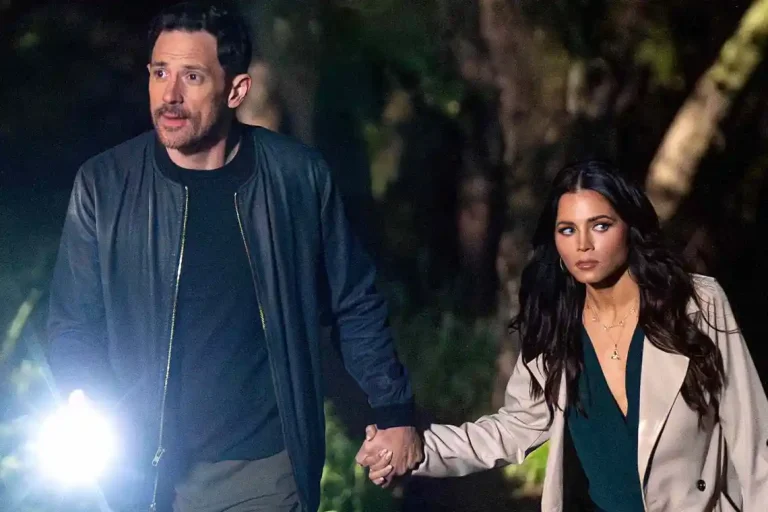
When the end credits for “Anniversary” started scrolling down my TV screen, I sat up, brought my knees up to my chin, and wrapped my arms around my shaky calves. I felt sick to my stomach. Regardless, I would recommend “Anniversary” in a heartbeat. Jan Kamosa’s English-language debut, “Anniversary,” is likely this year’s most controversial film that you haven’t even heard of. Despite having a star-studded cast featuring Oscar-nominated actress Diane Lane, Kyle Chandler, Phoebe Dynevor, Zoey Deutch, Dylan O’Brien, Madeline Brewer, and McKenna Grace, “Anniversary” has been near-disowned by its distributor, Lionsgate.
Released in US cinemas at the end of October to only 800 cinemas, the film was ignored and left unreviewed by major publications like The New York Times and Washington Post, and The Wrap’s Sharon Waxman released a story with the contribution of the film’s producer’s, Nick Wechsler, accusing Lionsgate of deliberately burying the film due to their lack of marketing support. Waxman even granted readers the knowledge that $3 million had been budgeted at one stage to market the film. For anyone following the film’s insignificant presence in the press or upcoming award predictions, it’s very clear that not even half of this budget was spent.
The film isn’t atrocious, if you’re trying to figure out why something like this would happen. According to Wechsler, no one knows how to market a political film anymore without scaring off their audience or causing backlash. The film was allegedly held back a year from release after Donald Trump’s win in the 2024 US elections. With the likely worry of provoking Trump supporters and inciting further fear in the average American viewer, the film is one that’s still too spikey for some to swallow a year into Trump 2.0.
Filmed in the summer of 2023, the film was meant to depict a dystopian reality likely inspired by historical fascist regimes such as Hitler’s Nazi Germany, the Fifth Brazilian Republic, or modern-day North Korea. Instead of mirroring the Christian nationalist state depicted in “The Handmaid’s Tale,” “Anniversary” focuses on freedom of speech, censorship, and enforcing a unified political belief rather than a religious one. But in the aftermath of the assassination of far-right podcaster Charlie Kirk, causing a censorship crisis in the US, it’s a miracle the film was released at all.
Paul (an excellent Kyle Chandler) and Ellen (a stellar Diane Lane) are a middle-class couple and parents to four children, about to celebrate their 25th anniversary. At their anniversary celebration, Ellen, a professor at Georgetown University, is shocked when she is introduced to her son’s (Dylan O’Brien) new girlfriend, Liz (Phoebe Dynevour), an ex-student of Ellen’s who left Georgetown after Ellen mocked her radical thesis in front of the entire class.
Her thesis, “The Change,” opts for a one-party state meant to create national unity. Liz’s ideology, as Ellen describes it, “is supportive of acts to subordinate to the point of denigrating the constitution”. The words ‘anti-democratic’, “dangerous’ and ‘inflammatory’ are tossed around to capture Ellen’s disdain and horror towards Liz’s beliefs. When Liz’s thesis is published, Ellen laughs it off. However, as most fascist regimes unfold, slow change begins to rattle the tight-knit family as we become witnesses to significant snippets of the family’s encounters over the next five years.
Unlike other releases this year, namely Zack Cregger’s box office trooper, “Weapons,” which was critiqued by renowned film critic Mark Kermode, for not leaving any of its mysteries unanswered or ambiguous, we never get a full rundown of what “The Change” belief systems entail and why exactly it draws such popularity. Whilst supporters of “The Change” system appear to dress more conservatively, there is no clear trademarking of specific progressive or conservative beliefs. Its ambiguity is its secret weapon. What is more frightening than ambiguity?

Although a pro-choice storyline is brought up, it’s ultimately one of the things that don’t completely land in the film. There’s no conversation about reproductive rights being taken away, and it’s confirmed by the third time jump that abortion is still accessible and legal. However, many depictions of civil rights being taken away, such as criticising the government publicly, employment termination for destroying the Change-related materials, and the diminishing right to protest, are incidents that all hit a bit too close to home.
The film explores different psychological outcomes of individuals living under authoritarianism, ranging from a character who becomes consumed by depression, a young person trying to save their future, and the lengths a parent will go to save their child in an impossible situation, even if it means betraying their own morals. Many of these arcs are executed beautifully and, as scary as it is to admit, authentically.
The film has many highlights. The performing ensemble excels together, with a standout performance notably from Diane Lane, who delivers a devastating, heartwrenching, award-worthy performance. McKenna Grace, although only being the youngest player at 17, manages to steal the show and delivers a mature, magnificent performance.
Komasa is confident and bold in his American debut. The film stays loyal to Komasa’s European Arthouse roots and often relies, successfully, on his actors to nourish the silent ambience of each scene. His decision to focus on a middle-class family may make people flinch at first, but it’s a great perspective to look at. We know poorer people will suffer the most under a fascist regime. By focusing on a middle-class, maybe even upper-middle-class family, Komosa makes it clear that absolutely nobody will be safe.
Whilst the film begins slow and steady on its feet, it loses its balance at times as The Taylors’ world begins to decay with each time jump. There is some sense to this, as instability and a fractured family unit are fraying at the seams. How can we demand stability when what we’ve seen is shocking enough for anyone to completely crumble? With weak spots here and there, the film may appear too concise for viewers craving answers.
However, it ultimately thrives on its neorealism and commitment to reminding us, as human beings, of our history and the daunting psychology behind some of our past and present political systems. More specifically, it asks how ideology can fracture a society, then follows the question to its more intimate destination, how the same force can split a family, slipping quietly from public rupture to the kind that tears apart a home.
Some viewers may come away frustrated that the film doesn’t mirror the America of 2025 with sharper precision. Context can’t be treated as common knowledge, even for devoted audiences. “Anniversary” was filmed long enough ago that the idea of Trump returning to office felt like the kind of dark joke exchanged on set, an improbable political riff rather than a prediction anyone expected to outlive shooting.
Because the film opens without situating itself in time, today’s viewer ends up bridging the gap between hindsight and authorial imagination alone. A brief note at the beginning could have eased that burden, allowing the film’s intentions to be met without requiring external excavation. Seen today, the film becomes a bittersweet tonic, tasteful in its melancholy, unsettling in its prescience. It almost tricks the viewer into imagining it was conceived as a deliberate alarm for Americans who might someday recognize a dystopia gathering at home, even though its origins lie in looking backward, shaping fiction from the residue of history rather than forecasting what was to come.
At the end of the second time jump, after Ellen has suffered a blow, she is cuddling with Paul. Paul endearingly says to her, “Everything is going to be okay.” This one simple line, I guarantee you, is the most horrifying line in the entire film.



![Sing Street [2016]: Finding the voice!](https://79468c92.delivery.rocketcdn.me/wp-content/uploads/2016/07/SING-STREET-768x419.jpg)