Martin Koolhoven’s “Brimstone” blurs the line between horror and voyeurism. It grips you while forcing you to avert your eyes, turning cruelty into spectacle yet stopping just short of pure indecency. As those tensions suggest, the film never fully commits to becoming something as provocatively radical as Lars von Trier’s “Nymphomaniac,” but it certainly doesn’t play it safe either.
Told in an anachronic structure, its power lies in its Old Testament fury — a biblical morality tale filtered through the sadomasochistic cruelty of a Western, sometimes tipping dangerously toward reverence for its own brutality. Guy Pearce, as an incestuous figure of dread, is chilling precisely because he rarely erupts. His quiet menace and controlled gestures suggest that “Brimstone” isn’t merely about suffering — it’s about the terrifying shape piety takes when it’s twisted beyond humanity.
Brimstone (2016) Plot Summary & Movie Synopsis:
Revelation
Broken into 4 parts, Revelation, Exodus, Genesis, and Retribution, the film begins in a quaint town of the Old West. Elizabeth “Liz” Grundy (Dakota Fanning) lives with her husband Eli (William Houston) and two children, Matthew, from the husband’s previous marriage, who doesn’t acknowledge Liz to be his real mother, and Sam, her daughter.
Liz is a midwife and mute, while Sam helps with the translation. All’s well till a mysterious preacher who’s simply known as The Reverend (Guy Pierce) comes into town. During the sermon, Liz freezes once she catches the familiar face. But as duty calls, she is expected to deliver a baby at the church itself.
When faced with the decision to save the mother or the baby, she chooses to save the mother, only informing her later. Nathan, the expectant father, blames Liz and later that night shows up at Liz’s residence, guns blazing. The Reverend shows up and sends Nathan home. He then proceeds to have a secret conversation with Liz, where he motions that she needs to be punished because she chose to kill the baby.
The next morning, Eli finds all his sheep dead and proceeds to talk to Nathan, who has since left town. That night, Liz tries to kill the Reverend but finds Sam’s doll on his bed. Upon returning, she finds Eli disemboweled in the barn. He asks her to take the kids and go to his father’s. Before leaving, Eli asks Matthew to mercy kill him, and he obliges, and then they leave.
Exodus
Joanna (Emilia Jones), a young girl rescued by a Chinese family, is brought to the town of Bismuth and eventually sold to Frank, who runs a brothel. She is initially cared for by Sally, a fellow sex worker who becomes her fragile source of tenderness, until Sally is executed after killing a client who tried to rape Joanna.
As Joanna grows older, she falls under the wary protection of Elizabeth (Carla Juri), another worker who helps her survive the brutal routine of the trade. But the illusion of safety shatters when Elizabeth bites off a customer’s tongue in self-defense — and the punishment she receives mirrors the violence she resisted.
Joanna teaches Elizabeth sign language from a book. Elizabeth decides to flee and arranges a marriage with Eli through marriage brokers, who don’t have any problem with a woman without a tongue. But as the day approaches, the Reverend comes to the brothel. Upon recognizing Joanna, he starts thrashing her with a whip. At that moment, Elizabeth tries to save Joanna but is killed by The Reverend. Joanna seizes the opportunity and slashes The Reverend’s throat and makes her escape to the doctor. She cuts her tongue off and takes Elizabeth’s place with Eli.
Genesis
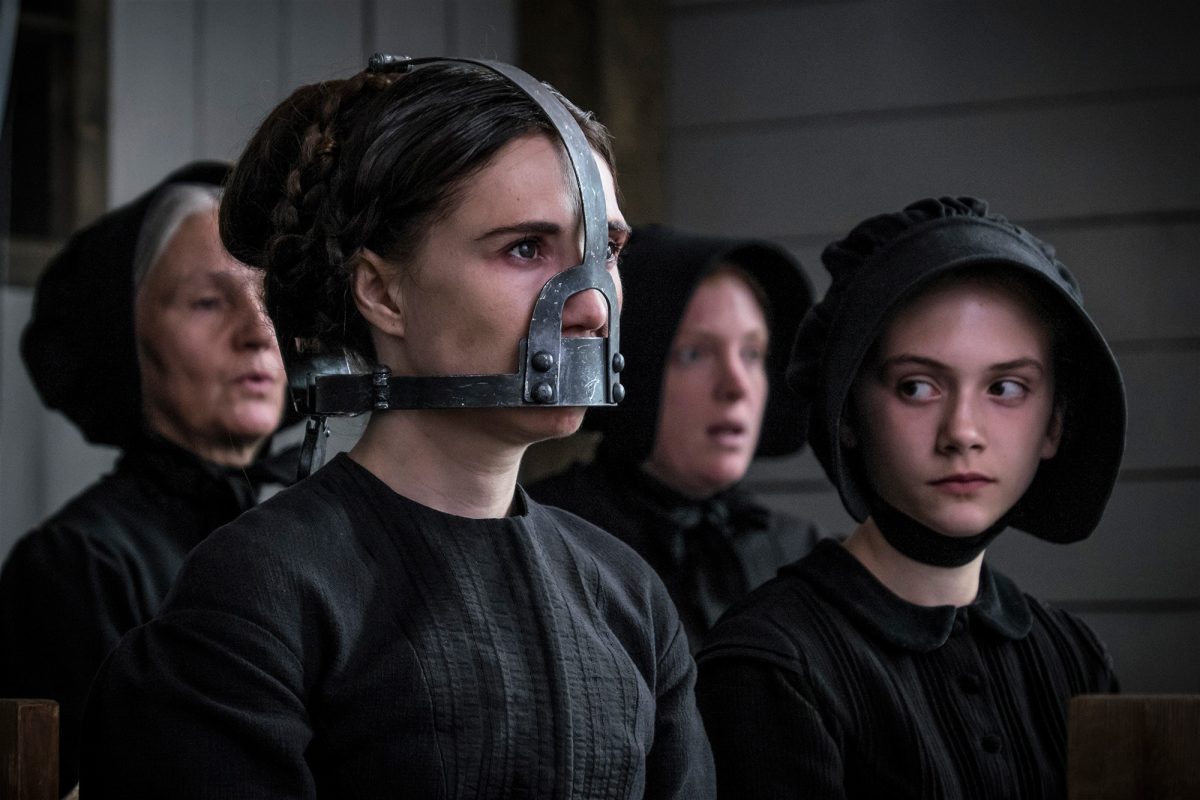
Joanna is revealed to be the daughter of the Reverend and Anna (Carice van Houten). When Joanna reaches puberty and is discovered by her mother and the Reverend himself, she is asked to behave like a woman. Meanwhile, two wounded cowboys, Samuel (Kit Harrington) and Wolf (Jack Roth), make their way somehow to their barn, where Joanna cares for them. Anna’s reluctance to sleep with The Reverend pushes him to lust after Joanna. When Anna confronts him, he beats her with his whip and places a scold’s girdle around her face.
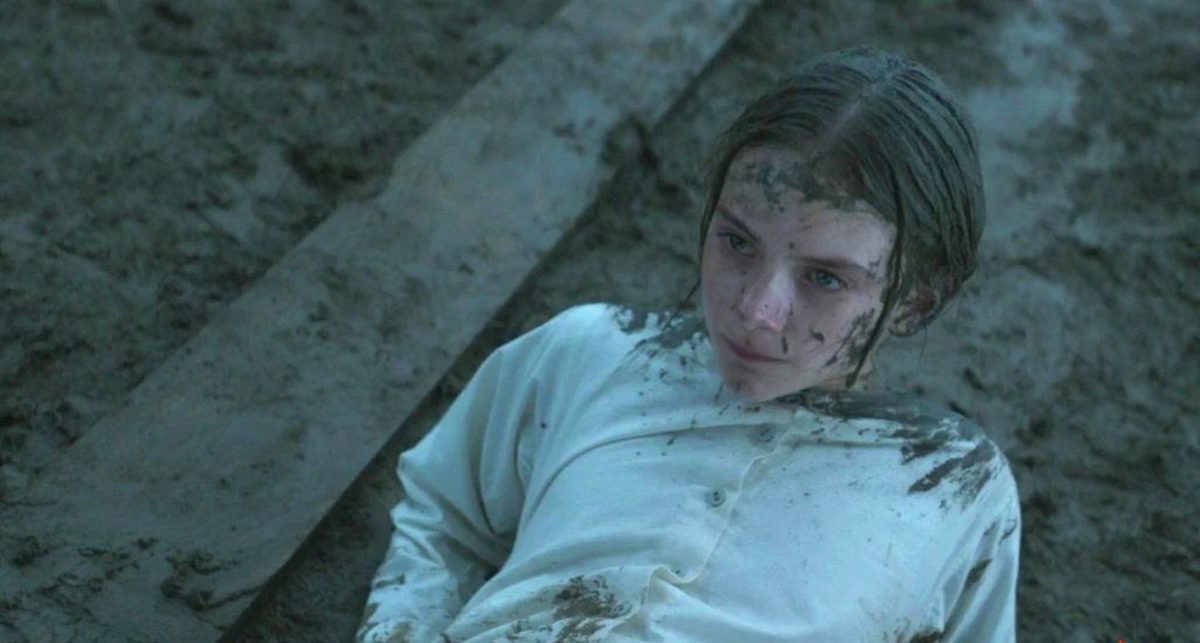
Unable to face the humiliation, Anna hangs herself mid-sermon. The Reverend starts to prepare Joanna for marriage and to take Anna’s place. He drags her to the church, and as Joanna struggles, Samuel comes to save her. She pledges her love for him, but the Reverend kills him swiftly. The following night, he whips and then rapes her. The next morning, Joanna runs away while the Reverend is asleep.
Retribution
Liz and her children make their way to the snowy cabin of Eli’s father, but tragedy befalls them as The Reverend shoots and kills Matthew. Somehow, the mother and daughter reach Eli’s father’s cabin. Liz prepares to kill him, only to find that the Reverend somehow entered the cabin and brutally murdered the ageing father. He ties Joanna up and declares that she’s no longer of any use to him — but her daughter, Sam, is.
With chilling cruelty, he tells Joanna she will watch everything he intends to do to the girl. He lashes Sam, and in the chaos of his sadistic frenzy, Joanna somehow manages to break free. She grabs a gun, shoots the Reverend, and sets him ablaze, ending his reign of terror in fire and rage. Later, we find Joanna far from that nightmare, having transformed the once-desolate cabin into a working sawmill, carving out a future from the ashes of her past.
One fine day, Joanna is greeted by Nathan. He was sent to Bismuth by The Reverend to get a fresh start, and as the new Sheriff, he had come across the old wanted poster of a mute sex worker by the name of Elizabeth Brundy for the murder of Frank, whom Elizabeth had killed before she went to save Liz/Joanna. As Nathan arrests her and takes her into custody, Liz jumps from the boat and kills herself. The film ends as Sam, now a grown woman, also having a daughter of her own, remembers her mother fondly.
Why the anachronic narrative format?
Touted as a Western, the film follows the format of the greats. If the story were portrayed in a linear format, it would have veered from its actual objective. The oppression is somewhat glorified, but in the crucial frames, the director doesn’t cut away. He crystallizes the story through generations of women and generational abuse that never stops. As Liz tries to live a life of some semblance, she is rocked by the appearance of a boogeyman from the past. Her oppressor, who was supposed to be dead, is back in flesh in front of her.
Also Check: 4 Important Guy Pearce Movies You Simply Can’t Miss
This structure also helps to uncover the depths of abuse that Joanna/Liz had to go through before finding that normalcy through Eli. Without visualizing what Eli offered as a husband or what Liz’s life was as a midwife, the stark, cold binary between Joanna and Liz’s lives risks turning gratuitous violence into the dominant register of the narrative. The non-linear structure mirrors Joanna’s fractured trauma and Liz’s buried repression. It may feel like a convenient storytelling device, but it rings emotionally true.
The film successfully plays with linearity, as it showcases Joanna’s abuse. By organizing Joanna’s story around key temporal thresholds, the structure delineates abuse as a repeated pattern rather than a singular event, charting how it is sustained and reconfigured from adolescence into adulthood.
This keeps the scars on her body fresh in the minds of the audience, lest they get engrossed in the film. It’s also to give the audience space to interact with the character and perhaps themselves. The most obvious element in this form of storytelling, keeping in mind the story, is the biblical canon and the religious overture, which should not be forgotten.
The Relation Between Abuse, Patriarchy, Religion, and Genre
The film subverts the genre of the Western. Westerns are usually understood where there is a clear distinction of morality. This story is about depravity. It’s the exploration of the depravity of man, justified by the moral banalities of god. The never-ending loop of religion upholds the superstructure of patriarchy, thereby moralizing the abuse and oppression of women.
The framing of abuse is particularly bordering on the cynical and glorification. Koolhoven does well to rein it back, but it’s hardly a fairy tale. When the Reverend whips the women, the camera doesn’t pan away. The camera stays still on the abuse and the woman. Anna’s expression is one of subdued familiarity. The oppression is so repetitive that it doesn’t bother her, but when it comes to her daughter, there is fear.
Her fear is that of the same pattern being repeated, and it does in front of her eyes. She cannot avert her eyes, and the camera doesn’t either. Violence begets violence. Especially the kind of incestuous violence that The Reverend unleashes, all ratified by the scriptures. This visual congregation of images does not come through as holding a mirror to society. Rather, it becomes an image of violence in itself, often encouraging rather than the opposite.
The Reverend’s blood-curdling Amish appearance and being the stoic man of god often takes away from the filthiness of who he is. His justification to Anna as to why he should be able to bed his own daughter is chilling and borders on glorification rather than a warning. He subjects Joanna to the same horrors he once inflicted on Anna, but this time he doesn’t even bother hiding behind righteousness.
His cruelty sheds its disguise, stretching beyond any pretense of divine order, especially when he targets Joanna’s daughter Sam, who hasn’t even reached puberty. The fact that he still tries to justify his violence exposes the rot beneath his piety. When men of God are given unquestioned authority to bend scripture to their desires, it becomes nothing more than fuel thrown onto the already raging fire of patriarchy.
Even though you would want to forget The Reverend, the entire film is filled with men who are each a carbon copy of the other, barring Eli and his father, and to an extent, Samuel. Frank is not a man of god but he is a man of business, and anyone who upsets his business needs to be killed. Even in this chapter, the fates of Elizabeth and Sally are all examples of how oppression and abuse move through society with an air of quiet nonchalance.
Brimstone (2016) Movie Ending Explained:
Why did Joanna Kill Herself?
For Joanna, the only part of her that she could save was her daughter. Her entire life has been that of erasure. When she takes on the identity of her late friend Elizabeth, she also sheds the abuse that Joanna had suffered at the hands of The Reverend. But when he comes back from the dead, she is again reminded of where she actually stands in the hierarchy. Her desire for a perfect, happy life is a myth.
So when confronted with Elizabeth’s truth, she doesn’t flinch away from it. She accepts her fate and her punishment with a smile on her face, knowing that she is able to break the pattern with her daughter. Her mother couldn’t do it and killed herself, but here she was, already securing a future for her daughter. She did not have any second thoughts while drowning herself, knowing fully well that her daughter would be free from this cycle.
The most interesting aspect of the death is when Joanna/Liz doesn’t even try to explain. The scold’s girdle, muteness, and tongue mutilation are all grotesque visual metaphors of the hierarchy of women in the lawless, frontier societies. But where the film lacks is that, instead of bordering on catharsis, it borders on spectatorship. These images curate mere intrigue and don’t offer resolution. Her drowning is also another image of erasure. Even though from a narrative resolution, Koolhoven does end it, but it ends up erasing Joanna’s abuse.
The lasting image of violence should also be counteracted by images of freedom. In this case, the film offers one and skimps on the other. This creates an image of an imbalance of power. Hence, the ending is convoluted in its own way. There is no redemptive arc of the protagonist, and all that remains is the lasting impression of survival rather than living.