“I don’t know what I want. How could I know what I want if I say yes to everything?”
Review by Pallavi Tripathi
White man’s America is easily a well-explored theme in cinema. Be it in the superhero universe (Captain America), TV space (Madmen and Masters of sex), or even Todd Haynes’ earlier work (Far from heaven, it did have a glimpse of black man’s world as well). And why shouldn’t it be? It was the period of immense changes that eventually set out to define generations to come. One such change was women getting into office jobs- they were becoming economically independent, eager to explore the world through their own eyes & living and experiencing and expressing what they love. Hayne’s latest ‘masterpiece’, Carol, is themed around this change.
Essentially, Carol is a love story, but what makes it great is the people involved in it and the time period. While same-sex love remains a taboo in larger parts of the world, this story takes us to the 50s America and the blossoming love between an upper-class woman (Carol Aird) whose marriage has run its course and a woman (Therese Belivet) working on a retail store who eventually becomes a photographer.
Todd Haynes has talked about Douglas Sirk’s influence on his career, and it is evident in his films. The characters in his films, both male and female, are in confined spaces, both emotionally and physically. Haynes has used his lenses cleverly to portray that. We see the characters through half-opened doors, through closed windows, closing elevators, and under-bridge meaning the framing of scenes is such that it makes their confinement very clear.

Todd added a Hitchcock-esque twist by incorporating close-ups of hands, faces, and objects to heighten the mystery, as the movie is based on Patricia Highsmith’s novel. Highsmith’s earlier books, Strangers on a Train and the Ripley series, have been adapted on screen by great directors, and here Phyllis Nagy has wonderfully adapted them. The visuals of this movie will be remembered for a long time because of its beauty and ability to transform the tale onto screen profoundly, and Edward Lachman must be thanked and praised for that.
Finally, the performance of the lead actresses, Cate as Carol and Rooney as Therese, is moving! Their costumes are stunning. While Carol starts as the object of desire and spectacle, it’s Rooney who silently and strikingly steals the show. She is naive and undecided, even about things as vague as what to order for lunch, and later takes the biggest leap of faith for the thing she actually loves and wants. Their chemistry has been praised and all for the right reasons. It’s fireworks packed to entertain and shouldn’t be missed.
Review by Nafees Ahmed
In one of the most beguiling and captivating scenes, we see an affluent & stylish middle-aged lady from New Jersey, wearing a fur coat, with succulent red lips holding a cigarette, elegantly walks into the Toy section of Manahattan Store for the last-minute shopping. She takes a watchful look at calm and shy clerk Therese Belivet (Rooney Mara) while she slaps a pair of gloves, and patiently inches towards transfixed Therese.
They strike an unimportant conversation about toys and dolls, as if they are giving time to peep into the souls of each other. Carol Aird (Cate Blanchett) unexpectedly smiles slyly on her way out and, pointing to the Santa cap Therese wears, she says in her husky voice, “I like the hat.” It is intense and electrifying to say the least. The scene feels like Therese realizing that someone, for the first time, has acknowledged her inner self without the exchange of any thoughts. Amidst all these, you can sense the hollowness and solidarity of perfume-loving Carol (Damn!, How does Cate make you aware of olfactory sense) even when you are not aware of her life.
Adapted from “The Price of Salt” written by Patricia Highsmith in 1952, the films open in a restaurant from the third-person view, which introduces us to the principal characters talking to each other. Though Therese & Carol talk trivial things at that moment, it is their eyes at that moment that hints for something intense is happening. The gravity of that scene we do not realize until we see what brought them together in the first place. It is an aching & beautiful moment at the same time.
Carol is a story about a lesbian love affair in an era when such things were beyond taboo and scandalous. Todd Haynes paints the longing of two solitary souls with silence, while he allows shimmering sets, exchange of thoughtful looks, subconscious cigarette smoking, and a moment of togetherness with such careful seduction that you can’t withstand falling in love with such despair and emotionally wretched characters.
Theresa is a quiet observer, aspiring photographer, and a thoughtful young woman, who (unintentionally) looked Audrey Hepburn, is waiting for something to happen in life. She says yes to everything, she is open to everything, and then, poised, Carol happens.
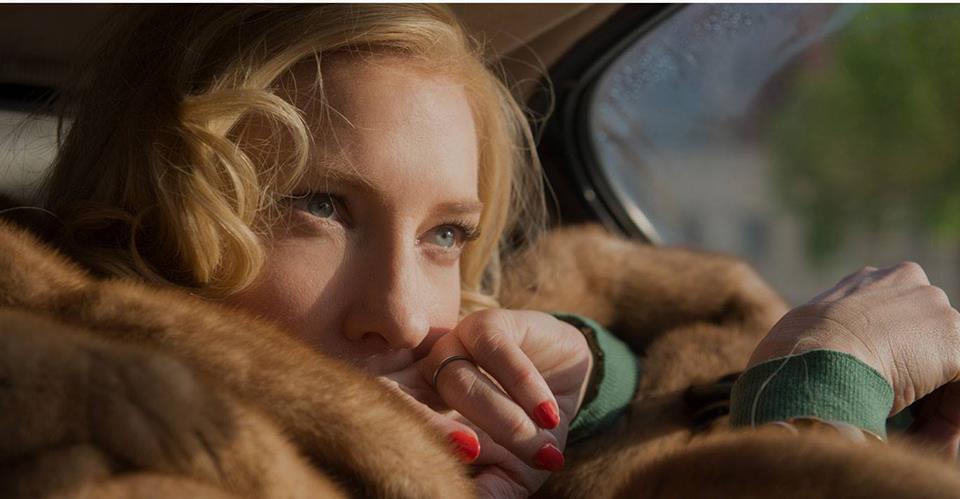
They meet at lunch, then at Carol’s home for Christmas Eve celebration, and then Therese agrees to a road trip. They both have different reasons to take the road trip, while Therese is unclear about her own life, running towards finding the meaning of life, and she also finds comforting solace in the company of Carol; Carol is running away from life, from her own existence, looking for a moment of solace for her restless heart. Carol’s emotionally wretched life is due to a battle with her soon to be ex- husband, Harge (perfectly played by Kyle Chandler).
Along the journey, they gradually fall in love: Therese instantly realizes it, but Carol takes her sweet time deliberately, but eventually she surrenders herself to the fate, and passionately reciprocates to Therese. Her reluctance comes from the fact that she has traveled the same lane with her now morphed best friend, Abby, and Harge, who knows about Abby, might use “closeness” with Therese as an unprincipled behavior for winning the custody of their only child.
Romance between these two women is guided by a perturbing attraction, as well as the social conscience about the ramifications of a serious relationship, which will be unnerving. They have a mature relationship of ‘no questions asked’ values. As much as this film explores the love between its two female characters, you see two contrasting characters trying to come on terms with their lives.
The film is beautiful if you survive the heart break emotional drainage by the end. Todd Haynes has masterfully crafted this drama with a deft direction. He uses close-ups skillfully to transcend physicality to emotional culmination. Hayness leaves no stone unturned to get the 1950s feel right, and he syncs the technical team like a magician. Like cinematographer Edward Lachman using Super 16 film to shoot that renders authenticity to the film, Carter Burwell’s delicate score leaves a lasting impact.
Lastly, Carol would have been a different film without Cate and Mara; there is no second thought to it. Cate Blanchett deserves an Oscar for her performance; she is that good. The critical choice was to cast an actress to play Therese who could match Cate’s splendid performance, and Rooney Mara does it. Mara keeps you guessing about her character’s next move until midway. Her alienation is very much noticeable. Mara never gives any opportunity to Cate to overshadow her performance and character; she maintains the delicate balance that complements Cate. Carol is not only one of the best films of this year, but this decade too.





![Cairo Station [1958] – The Struggles against Sexual Repression and Social Oppression](https://www.highonfilms.com/wp-content/uploads/2017/06/cover-768x584.jpg)