Claude Schmitz’s “Conrad & Crab – Idiotic Gems” revolves around two police officers trying to solve a case in a quaint French town, but they don’t exactly look the part. They are nowhere close to the likes of Rust Kohle and Martin Hart, let alone the bad boys that Will Smith and Martin Lawrence brought to the big screen.
In short, they aren’t hard-boiled detectives who put their heart or soul into their work, nor are they larger-than-life figures to command the screen with their charm or bravado. Instead, they are middle-aged men with potbellies who feel more like government employees tired of their years of bureaucratic drivel, rather than athletic or curious investigators.
Their weariness may remind you of Bob Odenkirk’s Hutch Mansell, whose age affected his professional obligations the second time we met him. It reduced his aptitude and appetite for his risky work, owing to his depleting athleticism. Conrad and Crab’s fatigue stems from similar reasons, albeit it doesn’t seem nearly as tragic as it does in that blood-soaked actioner.
Instead, we get a far more laid-back version of this particular kind of weariness, which makes the film feel almost like a police procedural directed by Jim Jarmusch. Schmitz’s film is similarly breezy and charming, as it focuses on the mundane details of the detectives’ lives instead of building suspense through the usual procedural beats.
The two protagonists, Alain Crab (Rodolphe Burger) and Conrad (Francis Soetens), enter the town, mildly reluctant to resume their duties. Conrad seems a little more disinterested than Crab in their line of work. His unenthused demeanor makes him gullible to any opportunity to settle down, away from the professional drudgery. Crab, although not excited about his work either, approaches it all differently than his partner. He only wants to wrap up the case as soon as possible so he can get out of that town and its peculiar irritants.
The townspeople seem like a motley of characters cherrypicked to annoy him and Conrad. They include a young woman who files a case for her missing jewel, a teenager who refuses to give a straight answer, and a business owner who takes every query from Crab as an affront, considering it a violent attack on his existence.
Their interactions rarely remain focused on the robbery case, as almost every local seems habitually drawn to digression. Someone would start talking about their little dog, while someone else would talk about their romantic desires. Someone would invite them for a stroll down a lane or a tour through a local point of attraction.
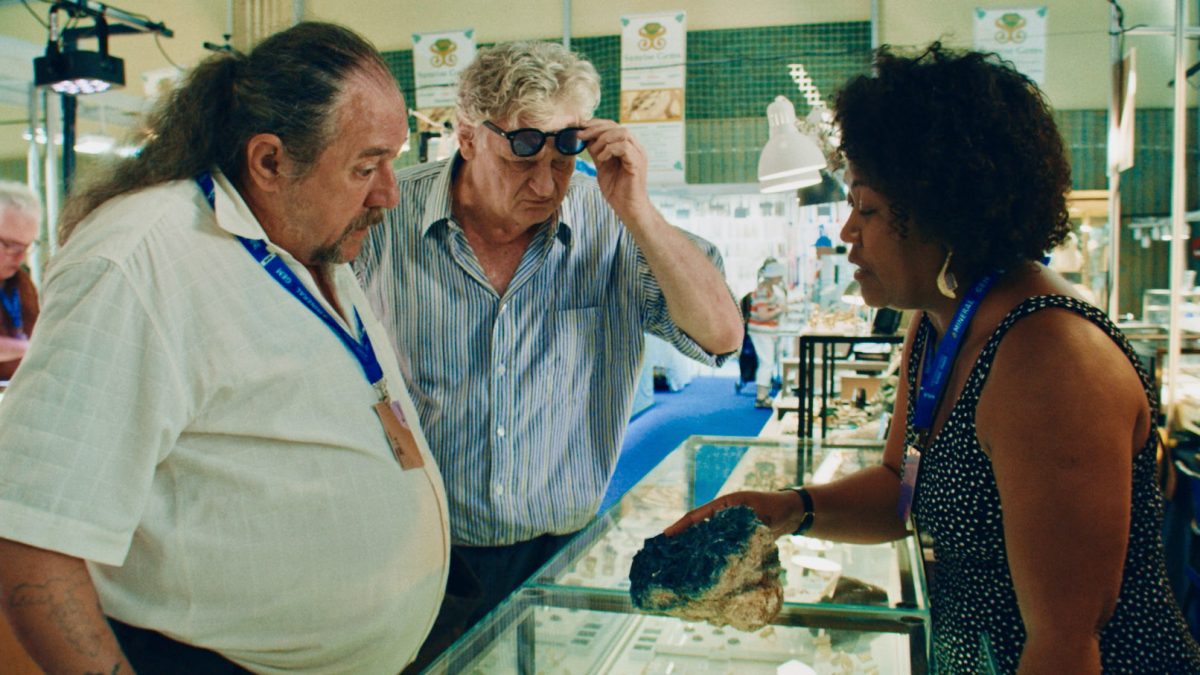
The detectives aren’t immune to digression either. They seem more concerned with anything that isn’t related to the case. Their general lack of attention or concern leads the film to a delightful string of comedy of errors, where people either misjudge each other’s intentions or their own. That wouldn’t have been possible without a fine blend of writing, performances, and direction, which can reveal their idiosyncrasies.
Schmitz, who wrote and directed the film, manages that with such ease that the whole experience feels like a cosy siesta where you’re invited to be with these oddball characters. Although not as violent or brutal as “Fargo,” it manages the level of specificity that the Coen brothers‘ classic does in exploring its small-town characters.
Burger, who often sees Crab’s world through a pair of dark-tinted glasses, portrays him as a dedicated, duty-bound employee with almost a co-dependent relationship with Conrad. Soetens joins him as Conrad, not only a colleague but a close friend and a patient listener, whose passivity gels perfectly with Crab’s timid, almost forced, interest in logistical details of their case. Schmitz explores their internal conflict in choosing between love and friendship, revealing their awkwardness as humorously as their age-bound physical and emotional limits.
Overall, the film draws humor organically through the social manners of its characters based on their age, gender, or class. Neither an indictment nor a celebration of any specific socio-cultural position, it becomes a light-hearted trip through this small town, where the clash of personalities leads to some low-stakes, relaxing drama.
Although there’s not much to appreciate in terms of your usual whodunit thriller or a socio-political interrogation, there’s still enough to enjoy, thanks to its simple observations about how people deflect, get flustered, or recoil, owing to the remnants of their past or the possibilities of their future. Florian Berutti helps it further by gorgeously capturing their bright, colorful landscapes, balancing the intimate with the expansive.
Together, the execution and the ensemble ensure there’s no dull, humorless moment, even if the people we meet lead lives far duller than conventional standards.