“Daughters of the Forest” (2026, “Hijas del bosque”), a new documentary that premiered at CPH: DOX, offers a closer look at the flora and fauna in the Mexican wilderness through the eyes of two indigenous mycologists, as they gain ancestral wisdom about the species that have long been a part of their familial lives.
Although a wondrous experience in its own, the film also highlights the urgent concerns of eco-conservation plaguing the entire world. The issue has been present for several decades, stemming from unsustainable modes of growth and development. We have witnessed it through years of industrialization, which has prioritized monetary yields over collective gain.
Look at how authorities help build structures like dams without considering the neighboring communities that may not survive flooding. They encourage businesses to create more jobs, but they are reckless with Earth’s resources, which they ultimately deplete. The most recent example might be the rise of data centres that risk depleting the water resources in nearby towns and villages, leaving locals with existential crises.
Something similar has been affecting the communities where Lis and Juli/Julieta (the two mycologists at the heart of Otilia Portillo Padua’s documentary) grew up. They have faced the brunt of deforestation for a long time. It’s mainly because of loggers who cut down trees in the wild, affecting the ecosystem that has shaped their indigenous way of life.
For centuries, the native population has maintained a delicate balance with the surrounding ecological diversity through respectful interdependence. They learnt about the fungi, among other species, and passed on their knowledge to the next generation. That’s how they learnt the value of mushrooms, understood their medicinal and spiritual qualities, and cared dearly for those insights.
The director explores these observations, including analyses of the mode of communication among the vegetation in that habitat, which makes every species’ survival crucial to the ecosystem’s survival. However, it is damaged by outsiders, who use local resources without facing any repercussions. The communities have been fighting deforestation, but their voices remain unheard.
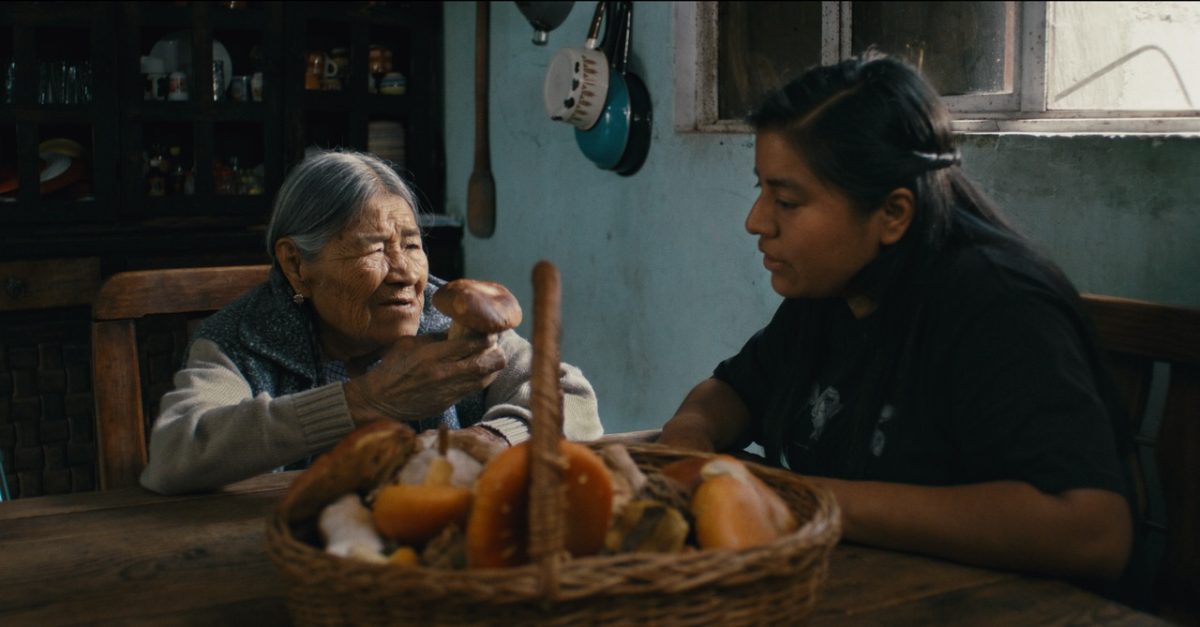
Padua’s film offers a damning portrait of this urgent crisis, leaving us with a pang and prompting us to think about their future. It also introduces a critical thread of discussion about the lack of reciprocation toward the indigenous population. The outsider voices seek their insights for individual gain, but do not help them exchange. In one scene, Juli’s mentor, Dr. Olivia, notes the human aspect of these interactions and that the voices in these communities are not treated with the required empathy.
It may bring to mind the story at the centre of “IT: Welcome to Derry,” which also shows the settler forces extracting information from the native population, but doing so to harm them rather than to stay in harmony with them. They gather knowledge but do not help the very communities from which it came and sustained it for generations. This vein of exploitation and alienation affected Lis and Juli’s ancestors and continues to affect them.
It shows up in Juli’s academic ambitions, partially limited by the expectation to communicate in English rather than Spanish, as the native languages have been slowly dying. It inadvertently becomes a mirror to similar situations across the globe where native languages, cultures, and resources are under threat from self-serving populist forces.
While addressing these relevant aspects of eco-conservation, Padua offers an immersive experience through a mix of interviews with her subjects, snippets from their daily lives, and evocative visuals of native trees and mushrooms. The closest comparison to her hypnotic cinematic style might be Terrence Malick’s approach to crafting similar montages in “The Tree of Life,” intersecting aspects of human life with nature.
It lends the film a similarly elusive layer of abstraction, leaving us to ponder the connection between what we see and hear. Martín Boege’s cinematography and Lorenzo Mora’s editing remain at the core of piecing together the stimulating discourse and making it a part of a cohesive whole.
Beyond details of indigenous identity, Padua also highlights the women-centered aspects of survival in a rapidly changing world through the eyes of her female subjects. It offers a peek into this dimension of their struggle. As the world leans into apocalyptic levels of pessimism, these women reveal a side of resilience that doesn’t receive the attention it needs in male-centered scientific reflection. Padua’s direction sustains an intricate balance between insight and emotion, making us feel what they feel as mothers, daughters, or female academics, while letting them guide us through a fascinating marriage between their ancestral wisdom and modern science.
The film could certainly have offered a detailed understanding of the root causes of deforestation through an investigative lens, by analyzing the motivations behind those exploitative practices and exploring how and why loggers continue to thrive in that space despite a clear threat to their survival on a grander scale.
It seems like a missed opportunity for a film that addresses the interconnectedness of it all. Despite concerns about its narrative scope, it offers illuminating documentation of the lives of these women, who compel us to consider the connections among our past, precarious present, and future.





![Hyenas [1992] Review – A Vibrant Allegory on Neocolonialism and Materialism](https://www.highonfilms.com/wp-content/uploads/2021/07/Hyenas-1992-768x432.jpg)