
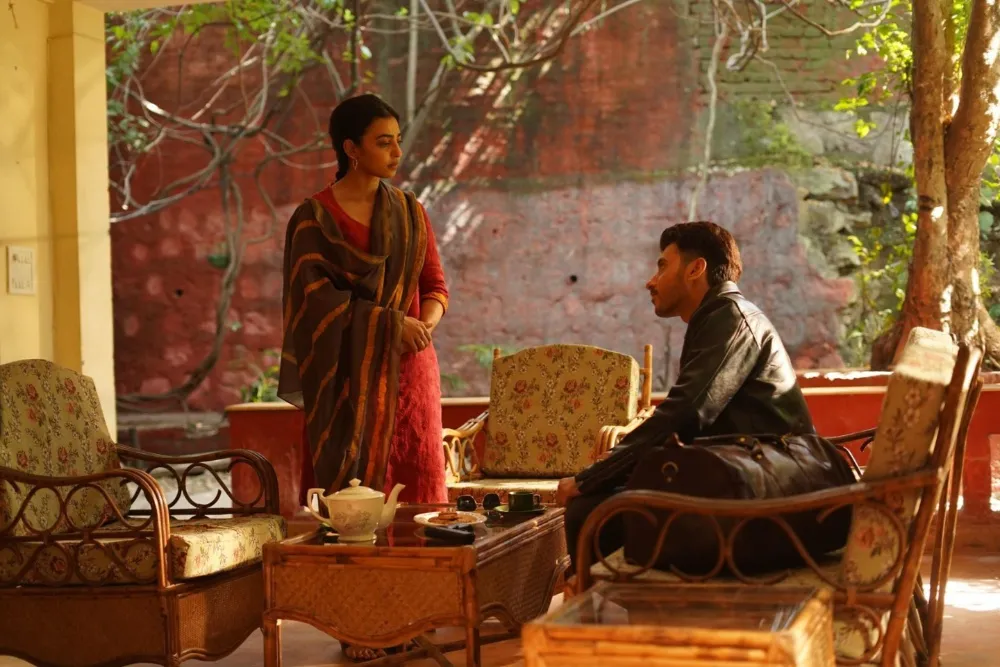
Tisca Chopra’s debut feature film “Saali Mohabbat” was dropped on Zee5 on 12th December. It’s an intelligent whodunnit structured in a framed narrative. The film opens in a posh upper-class household but slowly dives into the quiet town named “Fursatganj” where a double murder takes place, and Smita, the character-in-focus, goes through a blackmail-like trial, but as the film goes on, the audience witnesses Smita taking up the responsibility of writing her own destiny.
The film features a wide range of actors, such as Radhika Apte, Anshuman Pushkar, Divyenndu Sharma, Sauraseni Maitra, Anurag Kashyap, and others. Last week, I had the pleasure of interviewing Divyenndu Sharma. Through our deep conversation, I tried to find out how he approached the character of a typical desi policeman in the film, which has the potential to take the audience’s breath away. And also, apart from this, I found out that Divyenndu is an absolute connoisseur of Cinema and Art that cinephiles would love to know about. I hope you enjoy our conversation.
Soumalya: Hi Divyenndu.
Divyenndu: Hello Soumalya.
Soumalya: “Saali Mohabbat” is Tisca Chopra’s debut feature film. How did you find her as a filmmaker? Could you share your experience of working with her?
Divyenndu: I found her a very passionate filmmaker … very, very passionate indeed. I think … she not only directed this film, you know, she also wrote it along with her husband. So, the script was growing with her for quite a long time. So, yeah, she was in it, man, for more than 100%. And there was a fun part in working with a first-time director … you can feel their nerves, which is very nice to feel. But yeah, as a filmmaker, she is very collaborative and receptive to suggestions, I would say. I had a great time working with her.
Soumalya: Alright! Let’s move on to our next question. I find the character you played in the film very layered. The character is greedy. He craves luxury. At first glance, he appears to be a Desi policeman with average intelligence, but there are moments when he breaks free from this mould and almost single-handedly solves the mystery. How did you approach the character? How did you prepare for it?
Divyenndu: You rightly said it, Soumalya. The character is someone who comes from a small town but wants to break free … yeah, he wants luxury in life and feels trapped somewhere. He thinks he can achieve much more in life, but he is stuck in such a milieu that works like an obstruction for him. I tried to make him as human as possible and, as you correctly said, as layered as possible … to make him look flawed and to make him a character that people can relate to because we all have those emotions in ourselves … love, greed, or whatever you call it.
Even though he is a grey character, I tried to carve out some kind of … humane aspect out of him, so when people watch him, they don’t say he is an out-and-out bad guy … maybe he’s an opportunist. He’s got an opportunity, and he’s dealing with such people who are not that fair in life … so if he really takes a piece from the pie, it won’t disturb the entire ecosystem. At the same time, there’s a duality, you know … he’s got a certain duty upon his shoulders to prove himself someone worthy …
Soumalya: And someone capable …
Divyenndu: Exactly! Someone capable. He also thinks he is smart enough to manoeuvre things, but often finds himself on the receiving end. So, my whole struggle with the character was not to make him a cliché or a caricature of his prototype because he is your guy when he’s investigating, and you want him to succeed, and at times, you also want him to slip.
Soumalya: And I think you pulled it well!
Divyenndu: Ha Ha Ha … Thank you … That’s so sweet of you!
Watch The Trailer:
Soumalya: Divyenndu, you gained immense popularity after the first season of “Mirzapur.” Your fame continued to grow as the show expanded, and people still talk about your performance. So, after Mirzapur, did you fear being typecast?
Divyenndu: No man! But on the contrary, “Mirzapur” opened multiple doors for me. Before “Mirzapur,” people used to think that I could do only comedy roles, but you know, “Mirzapur” gave that bang to the door and said, ‘Hello! I can do other stuff as well.’ After “Mirzapur,” I have been getting all these different characters to play in different films such as “Madgaon Express”, “The Railway Man”, “Agni”, “Life Hill Gayi”… It’s been so diverse after Mirzapur…
Soumalya: So true…
Divyenndu: Also, you know it’s not easy to write a character like “Munna”. I, of course, take credit for playing it, but I always say let’s not forget the genius of Puneet Krishna, who wrote it… and it was such a beautifully written role that I feel blessed to have that opportunity to play Munna.
Soumalya: Somewhere, I heard that you were first offered the character of Babloo?
Divyenndu: Yes, that’s correct.
Soumalya: So, Divyenndu, who were the actors that influenced you and helped shape your craft?
Divyenndu: There are many characters, man! Going back to… I’m a bit old school, you know… so yeah, Motilal, Dilip Kumar, Balraj Sahani, Farooq Shaikh, Amrish Puri, Naseeruddin Shah, Om Puri, Jack Nicholson, Al Pacino, Robert De Niro… I mean, there are so many greats, you know… There’s Mohanlal… What a fine actor he is! So yeah, man… There are so many actors that I got inspired by. And yeah, Amitabh Bachchan also… he was so convincing in the commercial discourse… It’s not easy… he was such a convincing actor in those larger-than-life films… full of high drama…
Soumalya: He was untouchable in the 70s…
Divyenndu: Oh Dude! Absolutely!
Soumalya: What it seems from the names you mentioned is that you basically admire the actors who belong to the classics or arthouse cinema?
Divyenndu: Yes, yes… You know, Soumalya, after completing the course in FTII, I never thought I would come into commercial cinema. I thought I would engage with arthouse cinema primarily… but I don’t know how… after FTII “Pyaar Ka Punchnama” happened, and after that David Dhawan’s “Chashme Baddoor” and all those films came my way, and my career took a turn towards commercial cinema. But from the core of my heart, I still want to be that arthouse cinema actor. Sadly, I don’t get those kinds of roles frequently, but I’d really want to be part of such arthouse films.
Soumalya: When you were undergoing this process, didn’t you find it difficult to cope with the commercial discourse?
Divyenndu: Oh yes, man! It was difficult… difficult indeed! It wasn’t easy… because, see, when I started acting, I was in school. I started doing one-act plays, two-act plays when I was six years old. Then in my college, I did theatre for three years, and then FTII happened. So, for someone like me to come and be a part of commercial cinema wasn’t a very easy task.
Yeah, there were adjustments… but I… I still want to say thanks to the stars because there were so many other actors waiting for opportunities, and I got the opportunity, so I must make full use of it and enjoy the journey. And with the emergence of OTTs, the horizon of Indian cinema has been widened… new kinds of filmmakers came, new stories came, new actors came… so that, I think, was a very interesting turn in our film industry.
Soumalya: That’s very true… and I also think that there’s theatre… it has always been there, but today one can’t deny the importance of OTTs.
Divyenndu: Yeah, man! Absolutely!
Soumalya: Alright! So, let’s move on to our last question. Before we end this, we always ask our guests about their five favorite films, but since we’re called “High on Films,” could you share some movies that you believe represent the cinematic high moments, where you feel cinema truly reached its peak? What films made you feel that way?
Divyenndu: Oh God! Where shall I begin? Alright… “The Godfather…”
Soumalya: The entire trilogy?
Divyenndu: First and second part, honestly… the third is fine also (chuckles)… and then I would say Hrishikesh Mukherjee’s filmography. Please count it as one. Then I would mention “Big Fish”…
Soumalya: Oh! I haven’t seen “Big Fish” …
Divyenndu: Dude, whenever you feel like something wrong is going on in your life, to which you feel it is difficult to sync with, just watch “Big Fish”…
Soumalya: Sure, man!
Divyenndu: Then I would name Kieslowski’s “Three Colours: Blue”… and… yeah, “Amores Perros” and… oh, there are so many films, man… okay, I’d recommend “One Flew Over the Cuckoo’s Nest.”
Soumalya: Alright, Divyenndu. It was lovely talking to you. I wish you all the very best for “Saali Mohabbat.”
Divyenndu: Thank you, Soumalya!





![On Body And Soul [2017]: ‘Mumbai Film Festival’ Review](https://www.highonfilms.com/wp-content/uploads/2017/11/on-body-and-soul-a-testrol-es-lelekrol.20170817122456-768x325.jpg)

