I had a year full of commitments to write and, at times, deliver talks on Ritwik Ghatak in 2025 as the year marked his centenary. Hence, the last calendar year didn’t give me a moment’s rest to engage critically with contemporary cinema. Missing all that great stuff that was screened in multiple film festivals, I was immersed in Ghatak’s works and had to grapple with political ideologies, which led to a loosening of my ties with contemporary cinema.
I walked into the theatre to watch my first film of 2026 with a heavy heart, as the news of Bela Tarr’s passing away popped up on my mobile just a few minutes before the show, and of course, with a thrill running in my veins—as always is the case with watching a Sriram Raghavan film.
I would have found myself in a stalemate situation if the film were not “Ikkis.” To be honest, I wasn’t expecting such a smooth transition for me. As I said, I had devoted the previous year to an auteur, and my mind was still brimming with monochromatic images that were shaped by a certain political ideology and humanism. The last article I wrote in 2025 was on Ghatak’s “Subarnarekha” (1965), and a scene from the film that still haunts me is of an abandoned and desolate airstrip where two kids play gleefully.
Later on, Ghatak notes and carves out the dystopian philosophy from the scene by writing, “The two innocent creatures would not know that it is several such ruins of aerodromes that lie behind the disaster that looms over them.
Still, they play in the midst of destruction and ruins. How frightening their innocence is!” Raghavan’s “Ikkis” hits exactly on this note, though in a much lighter way, when in the penultimate moment a shepherd passes “Madan Lal” (Dharmendra’s swansong, which couldn’t have been better) and “Nisar” (brilliantly essayed by Jaideep Ahlawat) with his herd of goats through a meadow, unaware of the fact that the very land he is passing now had once witnessed the bloody destructions begotten by a war.
It is not the film that you would expect from Sriram Raghavan. He has been a champion filmmaker in the crime-thriller discourse with an enviable strike rate of coming up with flawless thrillers, often taking place in an urban setting. The transition from urban cityscapes to an arid landscape of war has evidently been a difficult one for the maker, for “Ikkis” couldn’t be placed beside his best creations by any means, but what allows us to embrace it is the political timeframe of its emergence.
“Ikkis,” as a war film, emerges in such a time, with an anti-war counter-narrative to the recent cheap propaganda, when the entire Bollywood has been fixated on redefining the war-film genre with typical chauvinistic chest-thumping and a jingoistic blood thirst.
Also Check: The 20 Best Indian Movies of 2025
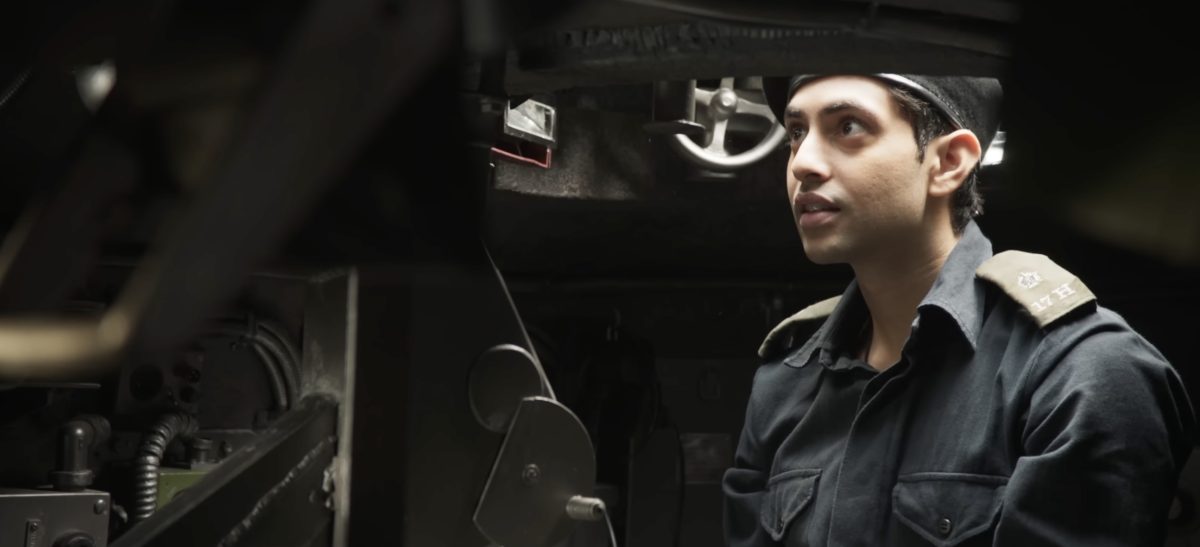
The film unfolds the saga of India’s youngest Param Vir Chakra recipient, Second Lieutenant Arun Khetarpal (played by Agastya Nanda), whose ‘Jazba’ (ardour), according to his father, has now turned into a ‘kissa’ (legend). Arun’s face is all smeared with cake; his twenty-first birthday is not over yet, and he is summoned to the arena of war.
The yet-to-become braveheart has a dream of playing golf in Lahore once they win the war; thus, he takes his golf kit with him before reporting to the field. Arun is brimming with the patriotic zeal, but he is too real, unlike “Ajay Sanyal” from “Dhurandhar” or “Vihan Singh Shergill” from “Uri: The Surgical Strike”, to thump his chest and shout “How’s the Josh?”
Even in his dream of playing golf in Lahore, there’s a tenderness that you often find and would expect from army personnel, and a decency which should be the crux of a morally educated human being’s patriotic ideals. Here, Raghavan and his co-writers (Pooja Ladha Surti and Ajit Biswas) demarcate “Ikkis” from the handful of war films that, instead of shaping the film genre, have, to date, been the reason for major mishaps in the country.
Here a soldier struggles to locate any environmental contrast in the Pakistani lands, the army feels no grudge against the commoners who belong to the rival nation, the lieutenant is not enthusiastic about the war, a Pakistani veteran soldier finds it difficult to address a martyred Indian soldier as ‘Dushman’ (enemy), and Lahore still remembers the revolutionary Bhagat Singh on his ‘Shahadaat’ (martyrdom day).
The narrative of “Ikkis” is unleashed in a nonlinear manner. Madan Lal, who is an ex-brigadier of the Indian army, travels to Pakistan to attend a school reunion and visit his ancestral home in Sargodha in 2001, when the scars and wounds of Kargil have not faded from the hearts and minds of both nations. There, in Pakistan, he is received amiably by Nisar, who too has been a veteran soldier but is too gentle to confess something, in front of Madan Lal, that he has been carrying like a burden for thirty years. Post-Kargil, Pakistan is very suspicious of Indians. Nisar has not at all been encouraged by his own people, even his family, to receive an Indian as a guest in his house.
ISI agents were recruited to keep an eye on his moves. Against this backdrop, Nisar and Madan converse occasionally about the past and rekindle their memory of the war fought in 1971. It is through their nostalgic dialogues that the narrative jumps back to 1971, and Arun relives his days and nights of Love and War.
The juxtaposition of these two narrative planes forms the film’s structure and forges a counter-narrative that embodies the fact (which might not please the chauvinists) that two servants of two different states are rivals only by their respective notions of patriotism, and time fades even the deepest of scars that once could have raised a barbed wire between them.
“Ikkis” is divided into two halves, as is usually the case with Indian films that join the commercial line-up. While the latter half takes us to the battleground—fraught with tanks, landmines, and airstrikes that create a realistic ambience of war (all thanks to Anil Mehta, the cinematographer, and the team that worked behind the visual effects and sound)—the first half focuses on Arun’s becoming a disciplined soldier in the Poona Horse regiment, who falls in love with “Kiran” (Simar Bhatia) but sacrifices his amour to refrain from compromising the values and principles of an army.
This stretch of the film is largely contemplative, lingering on small, intimate details of Arun and his comrades. These moments carve out their humanity, presenting them as soldiers willing to give up their lives yet unwilling to romanticize war, fully aware of the damage and suffering it inflicts on the wider population.
Must Read: The 40 Best Movies of 2025
Little discrepancies that affect the film are to be found in the first half. While the chapter of romance between Arun and Kiran doesn’t seem to derail from the primary narrative at large, it incorporates itself into the narrative with the risk of engendering a few clichés that you often don’t expect from Sriram Raghavan. The early teenage love kindles a fire inside Arun to take the challenge of securing the first place in an inter-regiment sports competition, and the depiction of the competition solidifies the camaraderie within the Poona Horse regiment that later, in the film, would evoke an emotion in the audience.
However, the romance itself lacks substance. Apart from Kiran’s giving Ernest Hemingway’s “For Whom the Bell Tolls” as a present to Arun, the love affair is full of dialogues and songs (promotional stuff that one cannot bypass while working in the commercial discourse) that you would have found in an average film made by some average maker.
The beauty of “Ikkis” lies in its contemplative, slow-mannered treatment of a narrative that is politically conscious of its surroundings. It does not emerge like a comet to work as an effective rebuttal to its counter-narrative (films). It has a historical base that recounts the shared past we once had in pre-partitioned India.
The film evokes nostalgia by placing a character in his ancestral home, almost submerged in a sanctuary of the past, and is received well by those who now possess the residence, thus pushing the concept of the Radcliffe Line (a trickery by our colonial masters to divide two prominent communities) to the margins of history.
“Ikkis” is a triumph of united humanity over a moribund terrain of divided communities. The film, as I said earlier, is not the perfect war film you might be looking for, but its promise to recreate a historical event in the language of sight and sound makes it a site of historical reconstruction amid a time when corrupted versions of past events are used to pump up a layman for mere electoral gains. If you have seen too many propaganda films lately, then purge yourself by watching “Ikkis”!



![Phantom Thread [2017]: A Perverse Fever Dream of Love](https://www.highonfilms.com/wp-content/uploads/2018/02/Phantom-Thread-768x462.jpg)