Although brief, an intense exchange of words & ideas with Radhika Apte felt extremely special. The opportunity to interview one of my favorite actresses of all time arose with the release of Tisca Chopra’s debut feature, “Saali Mohabbat,” which premiered on Zee5 on December 12th. “Saali Mohabbat” is a smart whodunnit that explores a double murder in the desolate small town of “Fursatgunj.”
The film features such a coterie of talented actors that one would have to watch the movie critically at the risk of slipping into the enchanting slope of performances by actors such as Anshuman Pushkar, Divyenndu Sharma, Anurag Kashyap, Sauraseni Maitra, Sharat Saxena, and, of course, the one and only Radhika Apte.
She carries an unparalleled aura with her that emanates a sharp intellect and never fails to mesmerize us. A few days ago, I interviewed Radhika. Our conversation went beyond a particular film and brought forth a handful of things that would not only help the reader understand what Radhika thinks about her character in “Saali Mohabbat” but also take them to a much deeper level to understand Radhika’s thoughts behind the characters she has played to date. I hope the conversation below will be a treat for the reader.
Soumalya: Hi Radhika!
Radhika Apte: Hey!
Soumalya: Your performance in “Saali Mohabbat” was really good, as always. How did you enjoy working with Tisca Chopra for the first time?
Radhika Apte: It was interesting, actually … and it was for the first time I worked with a director who is also an actor, you know, and there are great advantages to that. Tisca was familiar with the challenges an actor faces on the set while performing, like how to portray the character, how to deal with co-actors, or other general things we ask on the set.
So, it made our tasks quite easy. But, also, there’s another thing … if you’re an actor, you have a clear idea of how you want your characters to be portrayed because you also conceive yourself doing that, but Tisca looked beyond that, and she gave the actors total freedom to perform, which is very commendable … here she really nailed it!
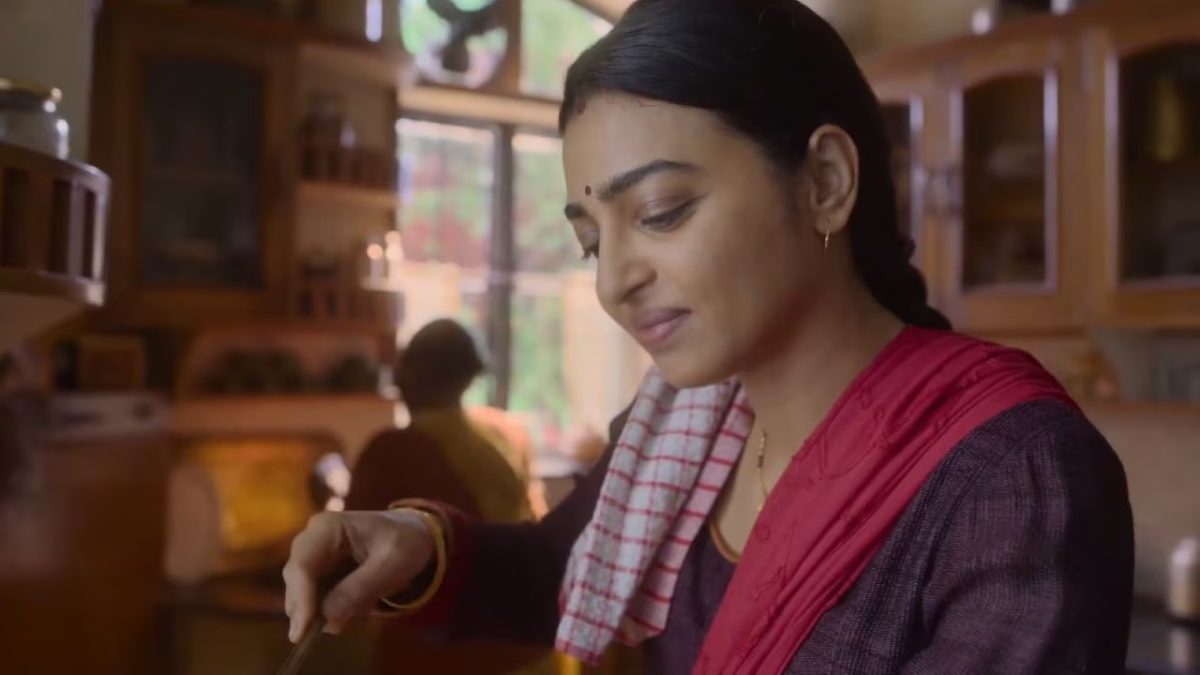
Soumalya: I see… You played the character of Smita in the film. On the surface level, she is a simple housewife, but deep down, she has a dark side, which perhaps she too was unaware of in the beginning. How did you prepare for the character?
Radhika Apte: See, everybody has a dark side. Nobody is born with a dark side … it is the circumstances that make you who you are. How you react to the circumstances has to do with your life so far … your upbringing matters … and so many other things. So, the reaction of people varies from person to person when they are put in certain circumstances … and that’s the beauty behind embodying such complex characters.
Lots of people saw “Saali Mohabbat” recently at various screenings … there were a few journalists and critics also … and, you know, I loved their reactions … and also, I noticed that a lot of people related to “Smita” very deeply, and as we know there are quite a few generations of women who have gone through and are going through the deprivations that Smita goes through in the film, so they really rooted for her …. and that’s quite interesting … because … umm … it’s quite difficult for me to tell you what I feel about her because I don’t want to reveal what happens to her in the film, but I, of course, root for her.
The character, to answer your question, is actually more complex than dark, and that’s where the film’s beauty lies too … it doesn’t take any side, it just tells you the story and creates a dilemma inside the audience, who would keep thinking, after watching the film, whether they liked the characters or not.
Soumalya: True … Now I’ve got an interesting question for you, but this may sound a bit repetitive since you’ve already answered a part of this question. See, I’m not generalizing, but when I look at your oeuvre to date, it seems to me that you love embodying characters who are psychologically dark and complex. It can be “Uma” from “Sister Midnight”, “Mehak” from “Phobia”, or “Smita” from “Saali Mohabbat.” Do you have a personal philosophy behind choosing such characters? It would be great if you could share the rationale behind working in such films.
Radhika Apte: Umm… No… It’s not like that. I don’t have a gravitational thing towards playing dark characters… I just find it… the thing is, characters who’ve had a very simple life, where nothing really happens, do not convey the stories that we generally find interesting. Isn’t it? I mean, what makes you interested in the story of a woman who had a lovely childhood, a lovely upbringing, then went to college, met a lovely man, married him, and had a lovely life? It’s not the kind of story that keeps you interested after a point.
Again… I’m coming to the dark side… I know a lot of people who have done something or the other which is dark… we don’t know how people act and react in their intimate spaces, even if they are our friends. I don’t want to call it dark. I hate calling it dark. It is the complexity of our characters that makes me gravitate towards them, because that makes a character real… of course, “Uma” from “Sister Midnight” is not real (chuckles)…
Soumalya: Of course … (chuckles)
Radhika Apte: But it’s a very deep film, you know… and I really like the film. But yeah, I love to delve deep into a character, explore that character, investigate it, find the complexities, and portray it… I find it more interesting.
Soumalya: You know, this evening I was watching “Badlapur”—actually re-watching it. What a beautiful performance you delivered there.
Radhika Apte: Aww … Thank you!
Soumalya: So, Radhika… I was wondering who the actresses/actors were who have influenced you the most?
Radhika Apte: I… I don’t know… I mean, there are certain performances, but if you’re asking for names, then it’s really difficult for me to mention… because there are so many performances, and even today there’s so much to consume… so many great performances. Of course, there are certain performances that influenced me and made me want to better my craft and keep going… and I’ve been really, really lucky to have worked with some great co-actors… such as Divyenndu in “Saali Mohabbat.”
He was so good in the film… he was super funny, and his performance was so great in the film that he puts you in the oscillation between whether you like him or not… sometimes you like him, and sometimes you don’t necessarily like his choices, but you feel bad for him. He played it so well, and it was indeed a treat working alongside him, and he made the work easy for me, you know, because in most of the scenes he was talking, and I was listening to him only… and that’s all I did. I listened to him, and I was very lucky to have worked with Divyenndu… and also, “Raat Akeli Hai: The Bansal Murders.” Working with Nawazuddin Siddiqui is always fun because he is so good.
Soumalya: Before we end this, we always ask our guests about their five favorite films, but since we’re called “High on Films,” could you share some movies that you believe represent the cinematic high moments, where you feel cinema truly reached its peak? What films made you feel that way?
Radhika Apte: Oh my God! I don’t know… trust me… There are too many films… I honestly find it very hard to rank and rate, and…
Soumalya: I’m not asking you to rank or rate. I’m just asking, what are the five films that you watch again and again?
Radhika Apte: One film I’ve seen more than any other film in my life is “As Good As It Gets” (1997). It’s my all-time favourite. I can watch it over and over again and never get bored. And… Umm… God, my brain is not working! I can’t tell you any more… well, I like “Andaz Apna Apna” (1994). And recently we were talking about thrillers since “Saali Mohabbat” is a thriller, and I was telling them about three thrillers where the twist occurs when you find out whodunit, and it makes you genuinely shocked! These films are the three Hindi films that really shocked me… One is “Gupt” (1997)… It’s really shocking. Then I’d say “Jewel Thief” (1967)… the older one.
Soumalya: I haven’t seen “Jewel Thief…”
Radhika Apte: Oh, you haven’t seen that? It’s really good… and the third is “Khamosh” (1986) by Vidhu Vinod Chopra. I remember when I found out whodunit, I was really shocked, and the way you find it out is very cool… sorry, I’m not answering your questions directly, but…
Soumalya: No problem …
Radhika Apte: That’s the problem with recommending films, you know, you try to remember names, but then suddenly you come up with entirely different ones… but the one film that I keep watching again and again is “As Good As It Gets.”
Soumalya: I’ll watch it soon.
Radhika Apte: Yes, please.
Soumalya: Alright. So, Radhika, it was really nice talking to you. I wish you all the very best for “Saali Mohabbat.”
Radhika Apte: Thank you so much!