Beth de Araújo’s sophomore feature, “Josephine,” explores the aftermath of a horrible incident through the eyes of an 8-year-old child. The script trades into a complicated lane, dealing with some excruciating conversations that we would usually not want to have with someone so young. It takes us through some bleak moments in a child’s life with an approach that feels audacious and confrontational. It’s not the first time Araújo has tackled themes in ways that would make us confront our reality. Even a brief look at her past projects reveals how she has often taken similar creative risks with her subject matter.
Her debut feature, “Soft & Quiet,” is also a taut and relentlessly dreary affair that explores the dark underbelly of white nationalism. It’s a horror film that rarely offers us a moment to catch our breath through what appears to be a continuous 90-something-minute take. Yet, the technique is only a part of why it affects the degree it does.
Ryan Coogler’s “Sinners” is a horror film, not simply because of vampires but because of the vices of subtle or evident racism that pervade the reality of Black people to date. Similarly, “Soft and Quiet” isn’t a psychological horror simply because of the visceral experience built through its stylistic choices, but because white supremacy remains a consistent peril.
“Josephine” is a crime drama that feels like a brutal horror tale for similar reasons. It pushes us further and further into the child’s interiority, revealing investigative details through her eyes, thus adding another dimension to its investigation of society’s moral fabric. The film establishes its inciting incident within a matter of a few minutes — a horrid rupture that leaves us in what feels like an endless nightmare.
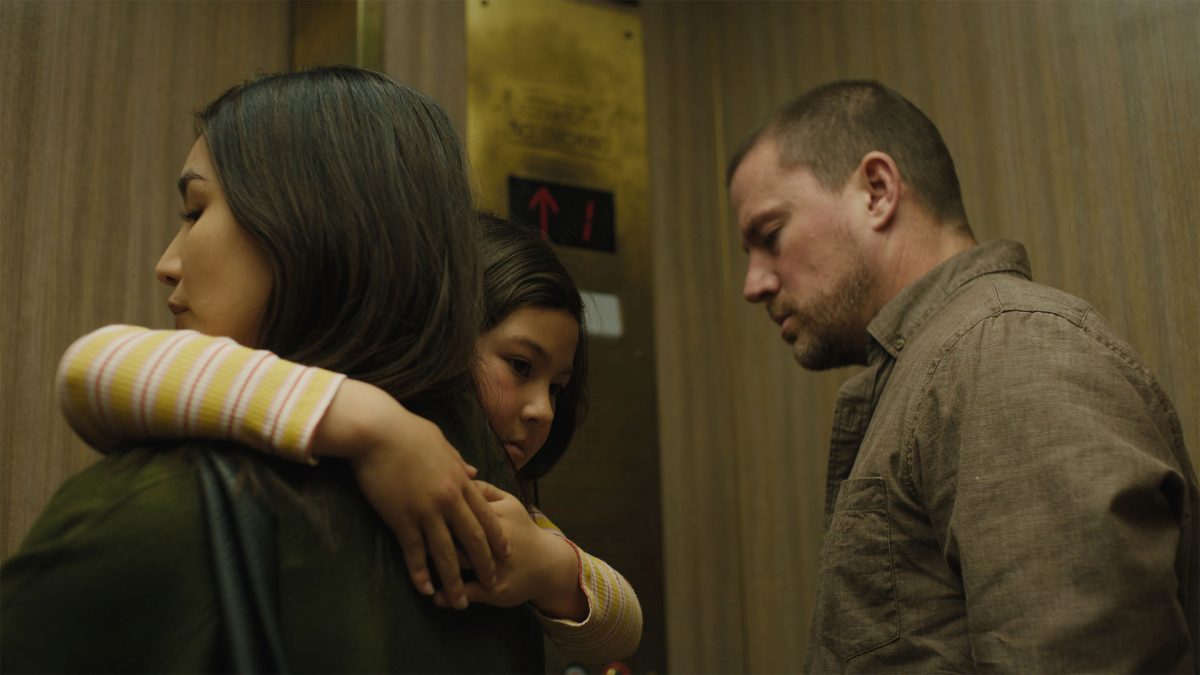
It introduces the young protagonist, Josephine (Mason Reeves), on an early morning, going for a jog with her father, Damien (Channing Tatum), in the nearby woods. It seems like a frequent ritual in their life, exercising at the crack of dawn. It informs us of their warm, jovial relationship and of her cheery innocence.
During the morning run, when he accidentally ends up being away from her for a few moments, she notices a man storming into a washroom after a woman enters. In the next few beats, Josephine tragically witnesses a heinous rape incident from a distance, alone. Soon, Damien arrives at the crime scene and starts chasing the rapist while Josephine is left with an indelible imprint of this horrendous trauma. As the investigation begins, we witness the complications in the legal battle to bring justice. Yet, with Josephine being the sole witness to the crime, her testimony becomes instrumental in the proceedings.
It brings to mind all the inhumane ways in which survivors are silenced and expected to acquiesce due to loopholes in the judicial system in place. It also prompts us to reflect on how it would affect the impressionable mind of a young girl, which also invites reflection about the parents’ role in helping her process her trauma, which she can’t articulate as an adult can.
People talk about grief being a difficult topic to broach with a child. What about what she witnessed? What about the line between love and desire? How can a child realize intricacies in adult relationships, and how are parents supposed to act in such a delicate situation? It compels us to introspect, not merely within the context of its characters, but also in our lives.
Also Read: 10 Powerful Films That Tackle Depression, Trauma, and Therapy
Araújo’s script is so cleverly written that you can notice every gradual shift in Josephine’s psyche with utmost clarity. It places different perspectives within its scenes, even in the absence of evident dialectic. There’s a scene where we see one person carefully listening to Josephine to understand what she needs, while the other simply assumes what a girl her age would be gravitated to. It could have been just another blink-and-you-miss-it moment, but Araújo subtly makes its presence felt, as her camera remains sustained on Josephine’s face, capturing even the slightest change in her emotional canvas.
Araújo utilizes some filmmaking methods that lead to an emotional effect similar to what Sean Baker did with “The Florida Project” to emphasize a subjective experience. It never feels heavy-handed because there’s always a richer subtext or purpose beneath to mull over. Even the absence of insight into the culprit’s life feels purposeful, as he remains present mainly as a lurking, haunting presence in all the lives he harmed, whether with or without remorse.
Projects dealing with themes of sexual assault and rape can sometimes run at risk of reaching a judgment on how people deal with the aftermath, but the film’s deftly compassionate approach doesn’t let that happen, even with characters like Josephine’s mother, Claire (Gemma Chan), who appears underwritten, especially as compared to Tatum’s character, whose interiority is explored at least in brief moments.
Yet, that serves a purpose, as it informs their family dynamic, where one’s hesitation or silence isn’t out of apathy, instead a calculated understanding, indicative of upbringing and a gender-specific position within any given dynamic. That’s why the decision of not exploring their histories doesn’t hinder, nor does it affect the psychological or socio-political complexities from the script.
“Mason Reeves, making her acting debut, is remarkable as a child caught in the throes of a moral dilemma, forced to confront an adult world of desire and violence without the language or emotional maturity to process it. The resulting loss of innocence feels scathingly tragic, and Reeves remains impressive even when the film briefly loses narrative momentum.
Channing Tatum, who’s usually associated with his showier roles, finds a remarkable amount of nuance in his carefully restrained performance, which was also evident in his wonderful act in last year’s “Roofman.” Eleanore Pienta and Dana Millican, who also starred in Araújo’s debut, are also impressive in their supporting roles, and so is Syra McCarthy. Considering everyone’s assured and neatly measured creative input, it doesn’t come as a surprise that the film has won the jury’s vote at the festival.